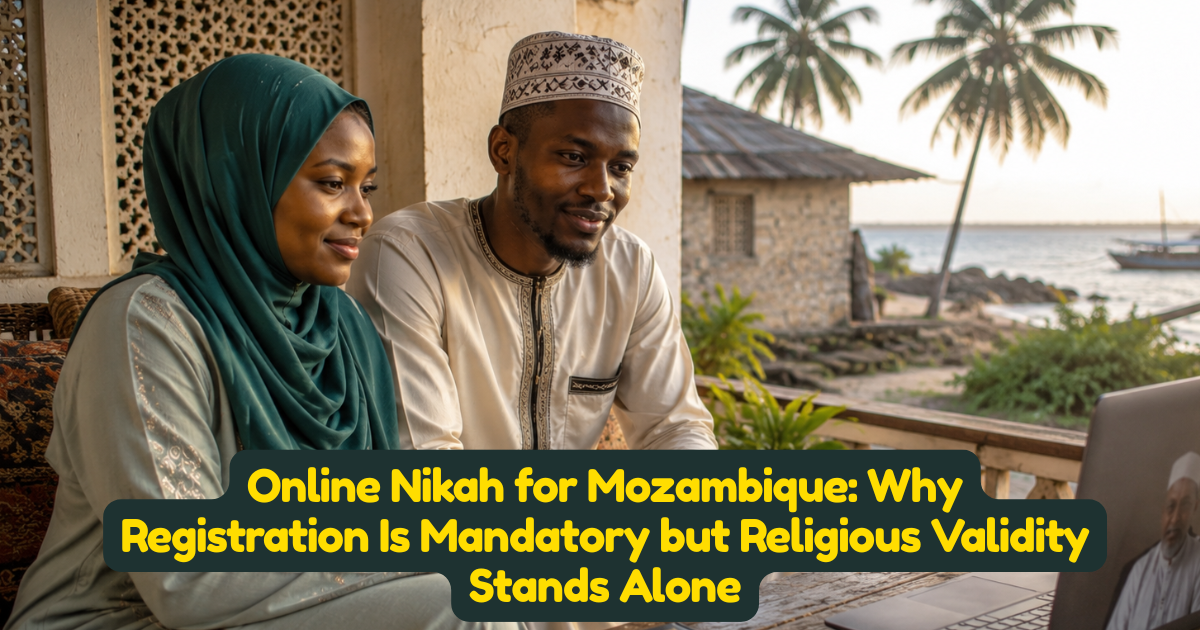
Online Nikah for Mozambique: Why Registration Is Mandatory but Religious Validity Stands Alone
Mozambique's marriage framework holds two genuinely important, real principles together at once: civil registration of marriage is explicitly mandatory under national law, while a religious marriage's validity within its own faith tradition, including Islam, is separately confirmed as not depending on state recognition at all. Understanding how these two principles actually fit together matters for anyone with a Mozambican connection planning a Nikah.
The Governing Law: A Genuinely Recent Family Code
Mozambique's current marriage framework is comparatively recent legislation. Official reference confirms the country's Family Code was passed by the Assembly of the Republic in 2019 and published in the Boletim da República on 11 December 2019, replacing the country's earlier 2004 family law framework.
The Real, Explicit Registration Requirement
This is a direct, unambiguous legal fact worth quoting precisely. The official text of Mozambique's Family Law, published in the country's official government gazette, states plainly: "A celebração do casamento está sujeita a registo obrigatório" — the celebration of marriage is subject to mandatory registration. This is a direct, codified statement leaving no ambiguity about whether registration is optional in Mozambique.
A Genuinely Important, Honest Distinction on Religious Validity
This is worth understanding clearly, since it explains how the mandatory registration principle actually coexists with religious marriage practice. Detailed guidance on Mozambican marriage procedures directly addresses this exact question, confirming that a religious marriage — whether Catholic, or from other religions including Islam — is a celebration establishing the marital bond according to the rules of that specific religion, and it submits solely to that religion's own rules, not depending on recognition by the State or civil law to be valid within the religion in question. This is a genuinely clear, honest statement of exactly the distinction this series has documented consistently: religious validity and civil recognition are separate questions, and Mozambique's own guidance states this explicitly rather than leaving it implicit.
Why the Registration Requirement Still Matters Enormously
Given this real distinction, it's important to be direct about what it does and doesn't mean practically: a Nikah conducted in Mozambique remains genuinely valid as a religious marriage under Islamic principles regardless of civil registration status — but the Family Law's mandatory registration requirement is what determines whether that marriage carries civil legal weight for property rights, inheritance, spousal benefits, or any interaction with Mozambican state institutions. This mirrors precisely the pattern this series has documented across dozens of other countries: religious validity stands on its own, while civil protections depend specifically on completing the separate registration step.
The Real, Official Civil Registration System
Mozambique operates a genuinely established, official civil registration and vital statistics system worth knowing about directly. The country's official CRVS (Civil Registration and Vital Statistics) portal, operated by Mozambique's government, provides the formal registration infrastructure through which marriages, alongside births and deaths, are officially recorded — the specific mechanism through which the Family Law's mandatory registration requirement is actually fulfilled.
Property Regime Planning: A Real, Available Legal Tool
Mozambique's Family Law provides couples with a genuinely useful, real planning mechanism worth understanding. Detailed legal analysis confirms that under Law No. 22/2019, future spouses have the ability to organise the patrimonial aspects of their marriage in advance through a formal legal instrument called a convenção antenupcial (prenuptial agreement), allowing the couple to define the property regime that will govern their marriage, adapted to their specific economic and family circumstances. This gives Mozambican couples a real, legally recognised tool for structuring financial arrangements before the marriage, worth considering alongside the mahr discussion that's already a standard part of Nikah planning.
What This Means for Structuring an Online Nikah With a Mozambican Connection
Given Mozambique's clear dual structure, couples completing an online Nikah with a Mozambican connection should treat civil registration through the country's official CRVS system as a mandatory, non-optional step following the religious ceremony — not because the religious ceremony's validity depends on it, but because Mozambican law is explicit that civil legal protection specifically does.
Frequently Asked Questions
Is marriage registration mandatory in Mozambique? Yes — the Family Law states directly and without qualification that marriage celebration is subject to mandatory registration.
Does a Nikah's religious validity in Mozambique depend on state recognition? No — Mozambican guidance explicitly confirms a religious marriage is valid within its own faith tradition based solely on that religion's own rules, independent of state or civil recognition.
Can Mozambican couples arrange their marital property regime in advance? Yes — the 2019 Family Law specifically provides for a convenção antenupcial (prenuptial agreement), allowing couples to define their property regime before marriage.
Suggested Internal Links
Zainab Butt
Author