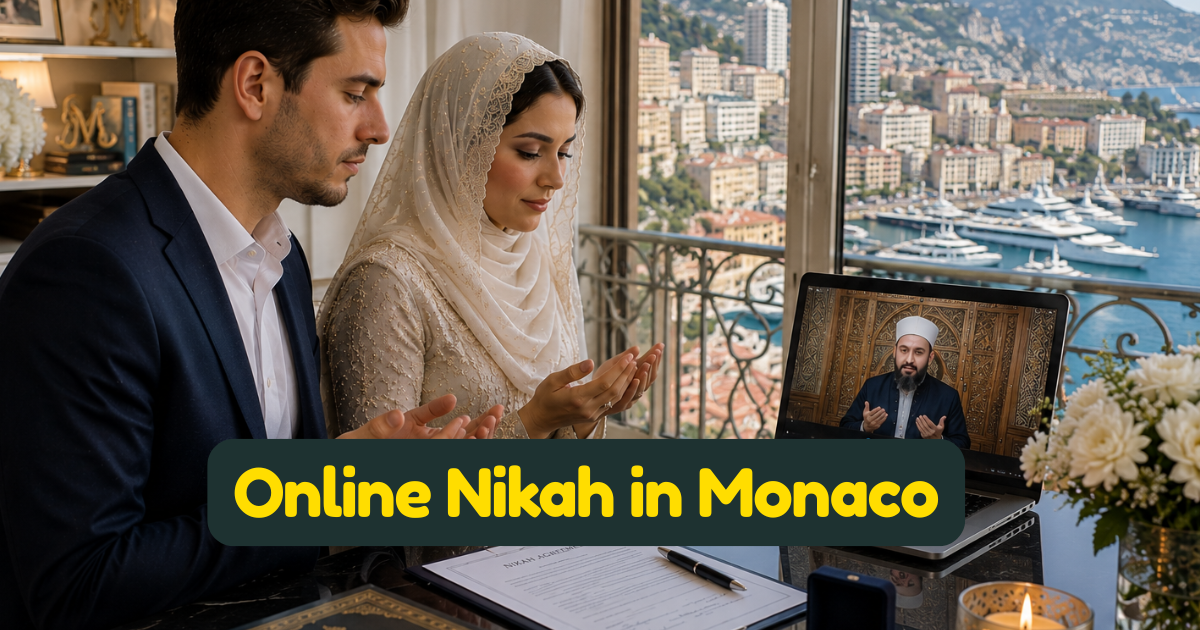
Online Nikah in Monaco: Two Hundred Muslim Residents, No Mosque, a Border You Cross on Foot for Friday Prayers, and a 30-Day Residency Rule That Stops Wealthy Visitors From Marrying
Monaco is 2.02 square kilometres — the second smallest country in the world by area, smaller than many city parks, pressed between the French Riviera hills and the Mediterranean. In those 2.02 square kilometres live approximately 37,000 people, of whom roughly 7,200 are Monegasque citizens. The remaining 28,000 or so are non-citizen residents — French, Italian, British, Russian, American, and yes, Arab and Iranian — drawn by Monaco's well-known tax advantages and Mediterranean lifestyle. Among those 28,000 non-citizen residents, according to the U.S. Department of State's 2022 International Religious Freedom Report on Monaco, there are approximately 200 Muslims, most of them North Africans working in the principality's service economy. Add to this a small number of wealthy Arab and Iranian non-citizen residents, and a vast transient population of Gulf royals, Saudi and Emirati billionaires, and Muslim visitors who arrive for the Formula 1 Grand Prix, the Monaco Yacht Show, and the casino — and you have one of the most economically disproportionate Muslim presences anywhere in the world: tiny in residents, enormous in passing wealth.
There is no mosque in Monaco. There has never been one. The Muslim community — including both the North African workers and the wealthy Arab residents — worships at a mosque in Beausoleil, the French commune immediately across Monaco's northern border, reachable on foot in minutes. As the U.S. State Department's 2019 Religious Freedom Report confirmed, the Monaco Muslim community deliberately chose not to seek official religious recognition — not because of government hostility, but because the community was described as mostly non-religious and believed official recognition would require building a mosque, which Monaco's extreme real estate prices make practically impossible. The community's informal status and cross-border worship arrangement reflects the pragmatic reality of Islamic life in a 2-square-kilometre principality where construction permits are among the most expensive in the world.
Monaco's Civil Marriage Framework: The Mairie and the 30-Day Rule
Monaco's civil marriage is conducted exclusively at the Monaco Town Hall (Mairie de Monaco), located at Place de la Mairie 98000 Monaco, as confirmed by the official Monaco Government public services portal. Only civil marriages are legally recognised under Monegasque law; a religious ceremony may take place after the civil procedure but has no independent legal standing.
For foreigners — including the many non-citizen residents of Monaco — the civil marriage process includes one requirement that has direct and significant consequences for Muslim couples: as confirmed by Angloinfo's Monaco marriage guidance and Monaco event specialists Monaco Events, at least one of the partners must have lived in Monaco for a minimum of 30 continuous days before the wedding. This residency requirement is enforced by the Mairie de Monaco.
Additional requirements for the Monaco civil marriage include:
- All documents submitted at least two months before the ceremony — a significantly longer preparation window than most other European countries in this series.
- Valid identification (passport or national identity card), original birth certificates, a certificate of celibacy and a certificate of matrimonial capacity.
- All documents translated into French by a sworn translator and apostilled in the country of issue. Monaco joined the Hague Apostille Convention, meaning apostilled documents from Morocco, Algeria, Turkey, Egypt, and most Muslim-majority countries are accepted.
- Publication of banns whose duration varies by nationality — for example, Italian residents must publish for a minimum of two months prior to the marriage.
- Proof of dissolution of any previous marriages — divorce decree or death certificate.
The minimum age for marriage in Monaco is 18 (with parental consent possible from 16 for boys and the unusual historical minimum of 15 for girls, though these exceptions are rarely invoked in practice).
What the 30-Day Rule Means for Muslim Visitors to Monaco
The 30-day continuous residency requirement creates a practical and structural barrier that is particularly relevant to Monaco's Muslim visitor economy. The Gulf royals and Saudi billionaires who visit Monaco for the Grand Prix or the yacht shows are typically in the principality for days or weeks — not months. A Saudi prince who wishes to contract a civil marriage in Monaco cannot do so during a Formula 1 weekend visit. His residency in Monaco would need to be established over 30 continuous days before the ceremony — a commitment that, while not impossible for those with Monaco residences, is not compatible with a short visit.
This structural fact explains why Monaco's enormous concentration of visiting Muslim wealth has not generated any demand for mosque construction or Islamic marriage services within the principality: the wealthy Muslim presence is transient, not residential. The people who might fund a mosque are not staying long enough to need one for legal marriage purposes.
How an Online Nikah Works for Monaco's Muslim Community
For Monaco's permanent Muslim community of 200 North African workers and small number of Arab residents, the Islamic side of marriage must be arranged entirely independently of the Mairie. The nikah — requiring a wali, two Muslim witnesses, agreed mahr, and free consent — cannot be conducted at the Mairie and is not provided by any institution within Monaco's 2 square kilometres. The mosque in Beausoleil across the French border can conduct a nikah, but for couples where the wali is in Morocco, Tunisia, or Algeria, and where both witnesses need to hear the offer and acceptance, an online ceremony conducted through InstantNikah.com provides the Islamic contract wherever the parties are located.
A qualified qazi officiates remotely. The wali joins from wherever he is. Two witnesses confirm the contract on the call. The mahr is agreed and documented. A nikah certificate is issued. For the scholarly basis of remote ceremonies, our guide on the video-call nikah ruling covers each major madhab. Where the wali appoints a proxy, our guide on appointing a wakeel in nikah explains the process. For the civil registration guide, our resource on registering a nikah civilly after the Islamic ceremony covers the Monaco-France cross-border marriage sequence.
The Cross-Border Marriage Dimension
For Muslim couples who prefer to register their civil marriage in France rather than Monaco — given that many Muslim workers in Monaco live in the adjacent French communes of Beausoleil, Cap-d'Ail, or Roquebrune — the French civil marriage process at the local mairie applies, with a 10-day banns publication period. A French marriage certificate is internationally recognised and accepted by home countries for family law purposes. Our article on online nikah in France covers the French civil process in detail.
Quick Answers for Muslims in Monaco
Is there a mosque in Monaco? No. Muslims in Monaco worship at a mosque in Beausoleil, France, immediately across the northern border, accessible on foot within minutes.
Can wealthy Muslim visitors marry in Monaco during a short stay? No. Monaco's civil marriage requires at least one party to have lived continuously in Monaco for 30 days before the ceremony. Short-stay visitors cannot fulfil this requirement.
Is an online nikah Islamically valid from Monaco? Yes — when the wali participates, two witnesses genuinely hear the contract, mahr is agreed, and consent is free. Monaco's civil requirements do not affect Islamic validity.
Why does Monaco's Muslim community have no official recognition? The community deliberately chose not to seek official recognition, partly because formal recognition would require institutional infrastructure — including potentially a mosque — which Monaco's extreme real estate prices make prohibitively expensive.
Two Hundred Residents, Billions in Visiting Wealth — and a Nikah That Fits in No Registry
Monaco's Muslim paradox is unlike any other in this series: a principality with one of the world's highest concentrations of Muslim wealth among its visitors, yet a resident Muslim community of 200 people who cross a national border on foot for Friday prayers. The Mairie de Monaco handles civil marriages with characteristic Riviera efficiency — but only for those who have lived in Monaco for 30 consecutive days. And neither the Mairie nor the Beausoleil mosque provides the Islamic contract that makes a Muslim marriage complete. InstantNikah.com does — for Monaco's North African workers, for its Arab and Iranian non-citizen residents, and for any Muslim visiting the most glamorous address in the Mediterranean who wants their nikah contracted properly regardless of where they are. When you are ready, book your online nikah and speak with our team.
Admin User
Author