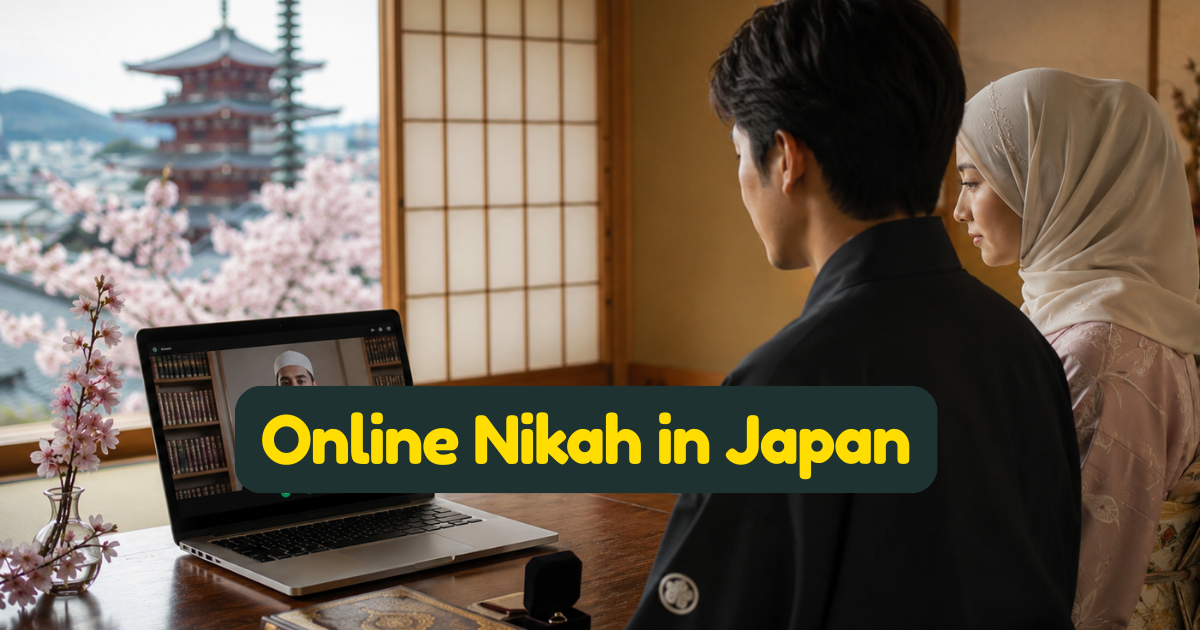
Online Nikah in Japan: A Complete Shariah-Compliant Guide for Muslims Marrying in a Civil-Only Country
A young engineer from Indonesia, two years into a contract in Nagoya, calls his fiancée's family in Surabaya and realises something uncomfortable: there is no mosque-led marriage in Japan that the government will ever stamp, and no wali within a thousand kilometres. This is the quiet dilemma facing a fast-growing community. Japan now counts somewhere between 230,000 and 350,000 Muslims, most of them foreign-born residents, with mosques multiplying from a handful in the 1980s to roughly 150 today, according to reporting compiled by Nippon.com and demographic research summarised by Waseda University. Yet the legal architecture of marriage in Japan was never built with a nikah in mind.
If you are Muslim and living, studying, or working in Japan, this guide walks through exactly how a religiously valid marriage can be arranged, where the Japanese civil system fits in, and how InstantNikah.com conducts a Shariah-compliant online nikah for couples who cannot reach a qualified imam or qazi in person.
Why Japan Is an Unusual Place to Marry as a Muslim
Most Muslim-majority countries treat the religious contract and the legal record as one event. Japan does the opposite. Here, marriage is purely an administrative act: you become married the moment a completed Kon-in Todoke (marriage notification) is accepted at a city or ward office. Temple, shrine, church, or mosque ceremonies carry no legal weight whatsoever. As the U.S. Embassy in Japan states plainly, the only proof of marriage you will ever hold is the certificate the municipal office issues after accepting your registration.
This creates a gap. The Japanese state will record your union but offers nothing Islamic. Meanwhile, a nikah performed informally between two people — without a guardian, proper witnesses, or any qualified officiant — risks falling short of what scholars require. Bridging that gap correctly is the whole point of a structured online ceremony.
What Actually Makes a Nikah Valid
Before discussing logistics, it helps to be honest about the conditions Islam attaches to marriage, because these are the parts the Japanese ward office cannot supply.
A guardian (wali) for the bride
The majority of scholars hold that a bride marries through her wali. The Prophet (peace be upon him) said, "There is no marriage without a guardian," a narration recorded by Abu Dawud, al-Tirmidhi and Ibn Majah and graded authentic. Where a woman has no Muslim guardian — common for a convert whose family is non-Muslim — recognised fatwa bodies allow an imam or the director of an Islamic centre to act as her wali. The Assembly of Muslim Jurists of America addresses precisely this scenario, which matters in Japan where extended Muslim family is rarely nearby.
Two upright witnesses who genuinely hear the contract
A nikah conducted in secret, without witnesses, is treated as invalid. Egypt's Dar al-Ifta is unambiguous: a marriage agreed privately and kept hidden, with no witnesses or announcement, is null. For an online ceremony this is not a technicality to wave away — the witnesses must clearly hear the offer (ijab) and acceptance (qabul). A reputable provider ensures the audio is clear and the witnesses confirm what they heard, rather than treating their presence as a formality.
Mahr and free consent
The bride's mahr is her right, agreed and ideally written into the contract, and both parties must consent without coercion. None of these elements depend on physical geography, which is exactly why a properly run remote nikah can satisfy them while two people sit in Osaka and Tokyo — or in Tokyo and Karachi.
How an Online Nikah Works for Couples in Japan
A Shariah-compliant online nikah is not a shortcut or a loophole. It is a real marriage contract conducted over a secure live video connection, with each required role filled by a real person. In practice, InstantNikah.com arranges a qualified officiant, confirms the bride's wali (or appoints a suitable wali where she has none), seats two valid witnesses on the call, recites and records the offer and acceptance, fixes the mahr, and issues documentation afterward.
The flexibility is what makes it suited to Japan specifically. A nurse on shift work in Fukuoka and a fiancé still completing paperwork abroad can marry without either flying anywhere. A convert in Sapporo whose family does not share her faith can have a wali provided rather than feeling stranded. The contract itself is identical in substance to one performed in a mosque; only the medium is remote. For couples weighing whether a video ceremony counts, our explainer on video-call nikah rulings covers the scholarly reasoning in detail.
The Civil Side: Registering Your Marriage in Japan
A nikah secures the Islamic side. To be married in the eyes of the Japanese state — and for spouse-visa and inheritance purposes — you must also complete the civil registration. The two are separate steps, and most couples do both.
You register by submitting a Kon-in Todoke to any municipal or ward office. The form requires the signatures of two witnesses aged eighteen or over, of any nationality, and foreign nationals must supply a passport, residence card, and a translated affidavit. The Consulate-General of Japan in Los Angeles provides a useful breakdown of the marriage registration form and witness requirements for those navigating it from abroad.
The document that catches people out is the Certificate of No Impediment, sometimes called a certificate of legal capacity to marry or an affidavit of competency. Japan requires foreign nationals to prove they are legally free to marry. British nationals, for example, obtain this through the process explained on GOV.UK, typically via their local register office before travelling. Citizens of other countries obtain an equivalent affidavit from their embassy in Japan. Religious affiliation does not appear anywhere on the Japanese paperwork, which is one more reason the nikah has to be handled separately.
If you want a deeper walkthrough of doing the religious ceremony first and the registration second, see our country-by-country guide on registering a nikah civilly after the Islamic ceremony.
Situations Where an Online Nikah Solves a Real Problem
- International students. Japan hosts large student populations from Indonesia, Bangladesh, Pakistan, and Malaysia. A student on a tight visa timeline often cannot fly a wali in or travel home to marry. A remote ceremony keeps the marriage valid and dignified.
- Converts with non-Muslim families. A Japanese revert, or a foreign resident who has recently taken shahada, may have no Muslim wali at all. Appointing a qualified wali is a standard, well-documented practice.
- Long-distance couples. One partner in Japan and the other awaiting immigration clearance elsewhere can complete the nikah now and align the civil paperwork when circumstances allow.
- Professionals seeking privacy. Discreet, properly witnessed ceremonies are entirely possible without sacrificing validity — the requirement is genuine witnesses, not a public hall.
For expatriate readers in particular, our companion piece on online nikah for expat Muslims addresses the recurring concerns of life far from one's home community.
Honest Cautions Before You Begin
An online nikah makes you married in Islam; it does not, by itself, make you married under Japanese law. Treat the civil registration as a non-negotiable second step if you intend to live in Japan as spouses, apply for a dependent visa, or protect inheritance rights. Japan's broader Muslim infrastructure is still maturing — institutions such as Tokyo Camii, the country's largest mosque, anchor community life, and Japan's long Muslim history is well chronicled by outlets like Al Jazeera. But because religion is absent from the national census and from civil records, as the Statistics Bureau of Japan reflects, the responsibility for the Islamic side rests entirely with the couple and a trustworthy officiant.
Quick Answers Couples in Japan Ask Most
Is an online nikah valid if I am in Japan? Yes, provided the contract meets the Islamic conditions — a wali, two witnesses who clearly hear the offer and acceptance, agreed mahr, and free consent. The location is irrelevant to validity.
Does Japan recognise the nikah as a legal marriage? No. Only a Kon-in Todoke accepted by a municipal office creates a legally recognised marriage in Japan. The nikah and the registration are separate.
Can a convert with no Muslim family still marry? Yes. A qualified imam or Islamic centre can serve as her wali, a practice supported by mainstream fatwa councils.
What if my partner is in another country during the ceremony? That is one of the most common cases an online nikah is designed for, and it does not affect the contract's validity.
Marrying Correctly, From Wherever You Are in Japan
Living in Japan should not force you to choose between your faith and the law. With a properly conducted nikah for the religious side and the ward-office registration for the civil side, you can satisfy both fully. InstantNikah.com exists to handle the religious half with care — qualified officiants, valid witnesses, a guardian where needed, and clear documentation — so that couples from Hokkaido to Okinawa can begin married life on a sound footing. When you are ready, you can book your online nikah and speak with our team about your specific circumstances.
Admin User
Author