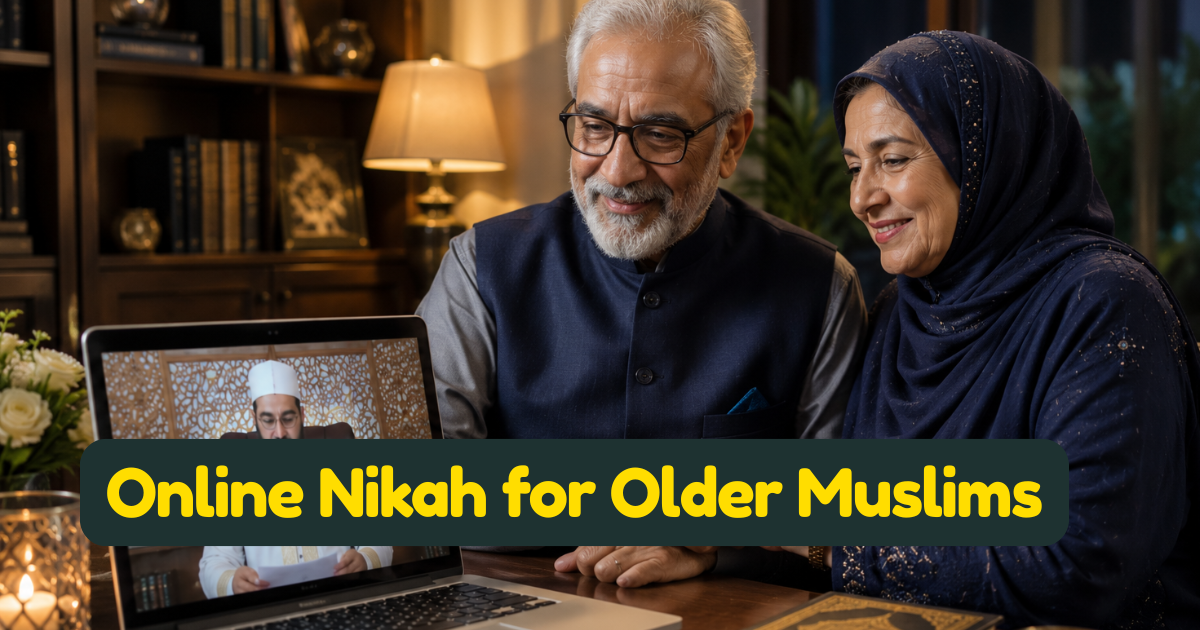
Online Nikah for Older Muslims: Is Age a Barrier and What Does Islam Say?
Somewhere along the way, a quiet but deeply damaging idea embedded itself into Muslim culture: that marriage, after a certain age, becomes inappropriate. That a woman past sixty who wishes to marry is somehow undignified. That a man in his seventies seeking companionship should be quietly discouraged. That older Muslims who want to remarry — whether after widowhood, divorce, or simply a long period of being unmarried — should accept solitude as the natural conclusion of their story.
Islam has never said any of this. Not once. Not in the Quran. Not in authenticated hadith. Not in the recorded positions of any major school of Islamic jurisprudence.
What Islam has said — consistently, across fourteen centuries of scholarship — is that marriage is a mercy, a source of tranquillity, and a right that belongs to every Muslim who is able and willing. The Quran uses the word rahmah — mercy — to describe what Allah places between spouses. Mercy does not expire at sixty. Tranquillity is not reserved for the young.
This guide is written for older Muslims who are considering marriage — perhaps for the first time after years of being single, perhaps after losing a spouse, perhaps after a divorce that left them rebuilding their lives well into the years when their community assumed the chapter was closed. It is also written for their children and families, who may be the source of the resistance they are encountering.
The questions this guide answers are the real ones: Is there an Islamic age limit on nikah? What happens to 'iddah after menopause? Who serves as wali for an older woman whose father and brothers may have passed away? What does the nikah process look like for someone with health limitations or mobility challenges? And why are so many older Muslims specifically choosing online nikah as their preferred path forward?
---Does Islam Set an Upper Age Limit on Nikah?
The answer is straightforward and unanimous across every school of Islamic thought: no. There is no upper age limit on marriage in Islamic law. There is no point at which a Muslim — male or female — becomes Islamically ineligible to marry due to age alone.
The conditions for a valid nikah relate to mental capacity, the absence of existing marriage, the absence of prohibited degrees of relation, and the completion of any applicable 'iddah period. Age is not among them.
This is not a loophole or a modern reinterpretation. It is the original, classical position. The earliest Muslims — the Companions and those who followed them — did not treat marriage in later life as unusual or improper. They treated it as a normal expression of a human need that does not disappear simply because a person's hair has turned grey.
The Seerah and the Companions: Marriage in Later Life Was Normal
The Prophet ﷺ was twenty-five when he married Khadijah رضي الله عنها, who was forty. She was not young by the standards of that time or any other. She was a woman of established life experience, prior marriages, children, and business leadership. The Prophet ﷺ described her as among the greatest women Allah ever created. Their marriage — one of the most celebrated in Islamic history — is a standing refutation of the idea that a woman's marriageability diminishes with age.
Umar ibn al-Khattab رضي الله عنه married Ali's daughter Umm Kulthum when he was already an elderly man, well into his caliphate. This was not considered remarkable by the Companions around him. It was a normal human act conducted by a man who wanted companionship and family connection in the later years of a demanding life.
Abu Bakr al-Siddiq رضي الله عنه, Uthman ibn Affan رضي الله عنه, and other major Companions married and were married in their later years without any recorded scholarly objection or social censure. The early Muslim community simply did not carry the cultural baggage that many contemporary Muslim societies have imported — largely from pre-Islamic cultural traditions — around age and marriage eligibility.
---Where Does the Cultural Pressure Actually Come From?
If Islam has no objection, the resistance that older Muslims often face must come from somewhere else. Understanding its origin helps to identify it clearly for what it is — culture, not deen.
In many South Asian, Arab, and African Muslim cultural contexts, marriage has been constructed primarily as a social and familial arrangement rather than an individual religious right. Within that framework, older Muslims — particularly older women — who wish to marry are sometimes perceived as disrupting established social structures: inheritance expectations, family hierarchies, caregiving assumptions, and the social status of children and grandchildren.
A widow in her sixties who remarries may complicate her children's inheritance expectations. A divorced man in his seventies who brings a new wife into the picture may disrupt the informal arrangements his adult children have made regarding his care and his estate. These are real pressures, but they are financial and social pressures — not Islamic ones.
The Prophet ﷺ warned explicitly against using cultural or familial authority to prevent a woman from marrying when she has the right to do so. The concept of the adhal — the unjust obstruction of a woman's marriage by her wali — is treated seriously in Islamic jurisprudence precisely because the temptation to subordinate a woman's marital rights to family interests has always existed.
Naming this clearly is important: when an adult Muslim woman in her fifties or sixties is told by her children that she should not remarry, or when an older man is discouraged by his family from pursuing a new nikah, and when neither position has any Islamic basis, what is happening is a cultural imposition being presented as religious guidance. The two are not the same.
---'Iddah After Menopause: What the Scholars Say
For older women specifically, the question of 'iddah — the waiting period that must be observed before a new nikah — takes on a particular dimension that most available content handles poorly or not at all.
The standard 'iddah for a divorced woman involves waiting for three menstrual cycles. This serves two primary purposes: confirming that the woman is not pregnant, and providing a period of transition and potential reconciliation. For a widow, the 'iddah is four months and ten days, as established by Surah Al-Baqarah.
But what happens when a woman has reached menopause and no longer menstruates? This is precisely where older Muslim women most often encounter confusion — and where the Quran provides a specific and overlooked answer.
The Quranic Ruling on 'Iddah for Post-Menopausal Women
Surah At-Talaq (65:4) addresses this directly: "And those who no longer expect menstruation among your women — if you doubt, then their period is three months, and [also for] those who have not yet menstruated."
This verse establishes a clear and specific ruling. A divorced woman who has reached menopause and no longer menstruates observes an 'iddah of three calendar months. This is the position agreed upon across all four major madhabs without meaningful scholarly disagreement.
The three-month 'iddah for post-menopausal divorced women is slightly shorter in duration than the menstruation-based 'iddah would be if menstruation were still occurring, and it is calculated by the passage of calendar time rather than by biological cycle. This is a clear Quranic concession that acknowledges the biological reality of older women while maintaining the protective purpose of the waiting period.
For widows who have reached menopause, the 'iddah remains four months and ten days — the same as for any widow — since the widow's 'iddah is not cycle-based but time-based. The Quranic verse in Al-Baqarah that establishes this ruling does not differentiate by age or menopausal status, and scholars across all schools apply it uniformly.
The Question of Irregular or Transitional Menstruation
Women in perimenopause — the transitional period leading to complete cessation of menstruation — often experience irregular cycles that make 'iddah calculation genuinely complex. A woman who is unsure whether her menstruation has permanently ceased or is merely irregular should consult a qualified Islamic scholar to determine which 'iddah ruling applies to her specific situation.
The scholars' general guidance is that a woman who has not menstruated for a sustained period — with variations in the scholarly definition of "sustained," ranging from several months to a full year depending on the madhab — may be treated as post-menopausal for the purposes of 'iddah calculation. This is not a question to leave ambiguous before proceeding with a new nikah, and the team at InstantNikah.com can help connect women with qualified scholars who can provide the appropriate guidance for their specific circumstances.
---The Wali Question for Older Women
For older Muslim women specifically, the wali requirement presents a practical challenge that younger women rarely face: the genuine absence of any living male Muslim relative to serve in the role.
A woman in her seventies may have outlived her father, her brothers, and in some cases even her sons. She may have no paternal uncle, no male cousin within the appropriate degree of relationship, and no adult Muslim male relative of any kind available or willing to serve as her wali. This is not an edge case — it is the lived reality of a significant number of older Muslim women, particularly those in diaspora communities where extended family networks have dispersed across multiple countries.
What Happens When No Natural Wali Exists
The position across the major madhabs is consistent on this point: when no natural wali is available, the function of wali passes to a qualified Islamic judge or scholar — a qazi. This is not a compromise or a lesser alternative. It is the established Islamic provision for exactly this situation, documented in classical fiqh literature and applied by Islamic courts and scholars for centuries.
The Hanafi position, which is followed by large numbers of South Asian and Turkish Muslims, is particularly accommodating in this area — recognizing that a mature woman of sound mind who has no natural wali has broader latitude in how the wali function is fulfilled. The Maliki school similarly gives significant weight to the welfare and agency of the woman herself in cases where the wali chain is broken.
For older women pursuing an online nikah through InstantNikah.com, the wali question is among the first things assessed in the initial consultation. Where no natural wali is available, the scholars associated with the service are qualified to fulfil this role — ensuring that the nikah is Islamically complete without requiring the woman to indefinitely postpone her marriage because of a structural absence she did not choose.
When a Son Serves as Wali
An adult Muslim son may serve as his mother's wali for her new nikah in certain madhab positions, as discussed in the guide on online nikah for widows. For older women whose fathers and brothers have passed away but who have adult sons, this is often the most natural arrangement.
The emotional dimension of this arrangement — a son formally authorising his mother's remarriage — requires honest family communication before the ceremony. In the best cases, it becomes an act of honour: a son standing for his mother, fulfilling an Islamic role that affirms her dignity rather than diminishing it.
---Companionship, Loneliness, and the Islamic Acknowledgement of Human Need
There is a dimension of this conversation that Islamic scholarship has always understood and that secular discussions of elder marriage tend to reduce to medical terminology: the human need for companionship is not a luxury. It is not a desire that older people should be expected to transcend. It is a genuine and serious aspect of what Allah created us to need from one another.
Allah says in Surah Ar-Rum (30:21): "And of His signs is that He created for you from yourselves mates that you may find tranquillity in them, and He placed between you affection and mercy." The verse does not specify an age bracket. The signs of Allah — ayat — referenced here include the tranquillity of a companionate marriage at every stage of life.
The research literature on loneliness in older adults is extensive and sobering. Social isolation in later life is associated with significantly elevated risks of cognitive decline, cardiovascular disease, depression, and mortality. These are not abstract statistics for older Muslims who have lost a spouse and find themselves navigating daily life without a partner — they are the lived texture of a difficult reality.
Islam's provision for marriage in later life is not merely a legal permission. It is a mercy. The Prophet ﷺ described marriage as completing half of one's deen — a statement that carries the same weight at sixty-five as it does at twenty-five.
When an older Muslim is told by their children or community to simply "accept their situation," they are being asked to accept something Islam never required of them. Naming this clearly — as a religious matter, not merely a personal preference — can be important for older Muslims who have internalised the cultural message without recognising it as cultural rather than Islamic.
---Practical Considerations Unique to Older Muslim Couples
Beyond the religious and cultural dimensions, older Muslims considering nikah face a set of practical considerations that younger couples rarely encounter. Addressing these openly before the nikah — rather than discovering them as post-marriage complications — is both practically wise and Islamically consistent with the spirit of honest pre-marriage communication.
Health and Capacity
A valid nikah requires that both parties have the mental capacity to understand and consent to the contract. This is a standard that applies regardless of age — it is as relevant for a thirty-year-old with a cognitive condition as it is for an eighty-year-old without one. Age itself does not affect capacity.
However, in situations where one party has a health condition that affects cognition — dementia, severe cognitive decline, or incapacitating illness — the question of valid consent becomes genuinely complex and requires careful scholarly assessment before proceeding. A nikah contracted without genuine informed consent from both parties is not valid regardless of the circumstances, and this protective principle applies equally to older Muslims.
For couples where one partner has significant health challenges but retains full mental capacity, the Islamic position is clear: physical health is not a condition of nikah eligibility. A Muslim who is seriously ill, physically limited, or facing terminal diagnosis retains the full right to marry. The desire for companionship and the comfort of a halal relationship does not require a clean bill of health.
Financial Transparency and Mahr
Older couples typically bring more complex financial lives to a new marriage than younger ones. Existing assets, pension arrangements, maintenance payments from previous marriages, property ownership, and — critically — the inheritance expectations of adult children from previous marriages all require honest pre-nikah discussion.
The mahr for an older woman's nikah is her full and unconditional right, exactly as it is for any bride. There is no Islamic basis for the cultural practice of offering reduced mahr to older women on the grounds of age, previous marriage, or the presence of children. The mahr belongs entirely to the bride and should reflect genuine agreed value.
For a thorough understanding of what mahr can consist of and how it functions within the nikah contract, the guide on what is mahr in nikah provides complete detail.
Inheritance Planning After Remarriage
When an older Muslim remarries, the Islamic inheritance formulas — the rules of mirath — apply to the new marriage from the moment the nikah is complete. A new spouse acquires Islamic inheritance rights in the other's estate. Simultaneously, children from previous marriages retain their own inheritance rights from their biological parent.
In practical terms, this means that an older Muslim who remarries and then dies without a clearly documented Islamic estate plan may leave a complicated situation for their heirs. The intersection of Islamic inheritance law and the civil probate systems of Western countries is an area where professional guidance — both from an Islamic scholar with inheritance expertise and from a solicitor or attorney familiar with local estate law — is strongly advisable before or shortly after the nikah.
This is also one of the sources of resistance that adult children sometimes express when a parent remarries: genuine anxiety about their inheritance position. Addressing this concern honestly — acknowledging it as a legitimate practical worry while being clear that it does not constitute Islamic grounds for preventing the nikah — is part of the frank family communication that remarriage in later life requires.
Living Arrangements
For older couples, the question of where to live after the nikah can be more complex than it is for younger ones. Both partners may have established homes, adult children who live with them or nearby, care arrangements for elderly relatives, or health-related housing requirements. These are legitimate practical matters to resolve before the nikah, not after.
Islam requires a husband to provide a wife with appropriate housing — a private, dignified living space that meets her needs. What constitutes appropriate housing is assessed relative to the couple's circumstances, and scholars have always applied this standard with flexibility rather than rigid prescription. An older couple who choose to maintain separate residences while being in a committed nikah relationship is a scenario that contemporary scholars have addressed, with nuanced positions varying by madhab and individual circumstance.
---Why Online Nikah Is Particularly Suited to Older Muslims
Older Muslims who are considering nikah face a set of logistical and social realities that make the traditional in-person ceremony format genuinely difficult in ways that have nothing to do with unwillingness or lack of sincerity.
Mobility and Health Limitations
An older Muslim with joint pain, limited mobility, recovery from illness, or any number of age-related physical conditions may find that travelling to a mosque or ceremony venue is genuinely difficult or impossible. An online nikah removes this barrier entirely. The ceremony takes place wherever the individual is most comfortable — at home, without travel, without physical exertion.
This is not a concession to laziness. It is an accessibility provision that reflects the Islamic principle of facilitating worship and religious practice rather than placing unnecessary hardship in its way. The Prophet ﷺ consistently chose the easier of two permitted options when both were available.
Geographic Separation
Older Muslims often meet potential spouses through extended family networks, mosque communities, or online Islamic marriage platforms — and those connections frequently cross international borders. A man in Bradford and a woman in Karachi who have agreed to marry do not need to wait until one of them can travel, or until an in-person ceremony can be coordinated, to establish a valid nikah. For couples in this situation, the guidance in the online nikah for couples in different countries article is directly applicable.
Privacy from Community Scrutiny
Older Muslims who remarry often do so under a degree of community commentary that younger couples rarely experience. A private online nikah allows the couple to establish their marriage quietly, with the proper Islamic structure intact, without making the ceremony a public event that invites unsolicited opinions. The religious validity is identical. The social performance is optional.
Simplicity When Simplicity Is Appropriate
Many older Muslims who have been through larger ceremonies in earlier life simply do not want the complexity of a large event. They want something focused, dignified, and real. An online nikah ceremony through InstantNikah.com typically takes between fifteen and thirty minutes. It involves the qazi, the couple, the wali, and two witnesses. Nothing more is required. For a couple in their sixties or seventies who have lived enough life to know what actually matters, there is something clarifying about that simplicity.
Same-Day Arrangements When Circumstances Are Urgent
For older Muslims where health circumstances create genuine urgency — a partner who is seriously ill and wants to establish the nikah before their health deteriorates further, or a couple managing a rapidly changing situation — the same-day online nikah service represents a provision that traditional ceremony formats simply cannot match.
---Managing Family Opposition to an Older Muslim's Remarriage
The most common obstacle older Muslims report when considering nikah is not logistical. It is familial. Adult children who object. Siblings who disapprove. Community members who express concern. And sometimes — particularly for older women — a wali who refuses to cooperate without valid Islamic reason.
Each of these situations has a specific Islamic framework that governs it.
Adult Children Who Object
Children — including adult children — have no Islamic authority to prevent a parent's marriage. Their feelings deserve to be heard and their concerns deserve honest engagement, particularly where those concerns relate to inheritance, care arrangements, or the welfare of younger grandchildren. But their disagreement, however strongly felt, does not constitute an Islamic veto over a parent's lawful right to marry.
The guidance in the online nikah for parents with children from a previous marriage covers the full landscape of managing this dynamic — including the emotional framework for helping adult children understand a parent's remarriage without requiring their permission for it.
The Wali Who Refuses Without Valid Reason
If an older woman's natural wali — a son, a brother, another male relative — refuses to fulfil his wali role without a valid Islamic reason, this constitutes the adhal that Islamic jurisprudence addresses directly. A wali who withholds his role in order to protect his own financial interests, to prevent inheritance complications, or simply because he disapproves of his mother's or sister's choice, is acting outside his Islamic authority.
In such cases, the wali function may be assumed by a qazi. This is not a workaround or a loophole — it is the classical Islamic provision for exactly this situation. For older women navigating a wali who is obstructing their nikah for non-Islamic reasons, the detailed guidance in the online nikah without a wali article is directly relevant.
Protecting Yourself From Exploitation
While this guide is primarily written for older Muslims pursuing genuine, sincere nikah, it would be incomplete without acknowledging that older individuals — particularly those who are recently widowed, lonely, or financially comfortable — can be targets of predatory marriage proposals. Islam's emphasis on the wali role and on witnesses serves partly as a protective mechanism against exactly this kind of exploitation.
An online nikah through a reputable, structured service like InstantNikah.com includes a consultation process that is designed to ensure both parties are entering the contract with clear understanding and genuine intent. This is a protective layer that benefits older Muslims in particular — providing a structured, professionally guided process rather than a rushed arrangement with minimal oversight.
---Frequently Asked Questions From Older Muslims Considering Nikah
Is there a maximum age at which a Muslim can marry?
No. Islamic law establishes no upper age limit on marriage. The conditions for a valid nikah — mental capacity, absence of existing marriage, absence of prohibited relation, completion of 'iddah — apply at every age. Age alone has never been and remains not a condition of marriageability in any school of Islamic jurisprudence.
What is the 'iddah for a post-menopausal woman who has been divorced?
A divorced woman who has reached menopause and no longer menstruates observes an 'iddah of three calendar months, as established by Surah At-Talaq (65:4). For a post-menopausal widow, the 'iddah remains four months and ten days, as established by Surah Al-Baqarah (2:234). Women in perimenopause with irregular cycles should consult a qualified scholar to determine which ruling applies to their specific situation.
My children say I am too old to remarry. Do they have any Islamic say in this?
No. Adult children have no Islamic authority to prevent a parent's remarriage. An adult son may serve as his mother's wali — which gives him a formal role in the nikah process — but the wali role is one of facilitation and protection, not veto. A wali who refuses to facilitate a valid nikah without Islamic justification is engaged in adhal, which classical Islamic jurisprudence treats as a serious overreach. If a natural wali refuses to cooperate, a qazi may assume the role.
Can I do an online nikah if I have mobility or health challenges?
Yes. An online nikah via video call requires no travel, no physical exertion, and no attendance at an external venue. It can be conducted from your home, at a time suited to your health needs. Physical health is not a condition of nikah eligibility — mental capacity is. Provided both parties have full understanding of and genuine consent to the contract, health limitations of any kind do not affect the validity of the nikah.
Does remarrying affect my late husband's pension or my civil benefits?
This is a civil and financial matter that varies entirely by jurisdiction and by the specific terms of any pension arrangement. Many widow's pension schemes in Western countries do include provisions that reduce or terminate payments upon remarriage. This is not an Islamic question — it is a civil one, and it deserves proper investigation before the nikah rather than surprise discovery afterward. Consulting a financial advisor or benefits specialist in your country of residence is strongly advisable.
Is a nikah valid if the husband is significantly older than the wife, or vice versa?
Yes. Islamic law does not impose age-gap restrictions on marriage between consenting adults. Large age differences between spouses were not uncommon among the Companions and are not treated as problematic in classical Islamic scholarship. What matters is genuine mutual consent, fulfilment of the Islamic conditions, and the commitment to fulfil each other's rights within the marriage.
What documentation will I need for an online nikah?
Basic identification for both parties is required, along with documentation of any previous marriage dissolution — either a divorce certificate or, for widows, the husband's death certificate. Specific requirements vary by circumstance, and the team at InstantNikah.com walks through documentation needs during the initial consultation. The online nikah certificate guide provides detail on what documentation is issued after the ceremony.
---A Note on Dignity
This guide has addressed legal rulings, scholarly positions, and practical logistics. But beneath all of it runs a simpler current that deserves to be named directly.
Every older Muslim who wants to marry — who is carrying the weight of loneliness, navigating the quiet difficulty of a life lived without the companionship they once had or always hoped for — deserves to be told clearly that what they want is not embarrassing. It is not excessive. It is not something they should be ashamed of, apologetic about, or required to justify to their children or their community.
It is human. It is honourable. And in Islam, it is a right.
The Prophet ﷺ did not design a faith for the young and leave the old to manage alone. He designed a faith for every stage of a human life — including the stages that come after grief, after loss, after the years that most people assume are behind the important decisions.
If you are an older Muslim who has reached the conclusion that you want to marry — whether for the first time or again — the conversation does not need to begin with justifying that decision to other people. It can begin with a quiet, practical consultation about what the process actually looks like.
You can review the full online nikah process here, read the experiences of others on the reviews page, or contact the team directly with questions specific to your situation. When you are ready to take the next step, booking a consultation is straightforward.
The chapter is not closed. It never was.
Admin User
Author