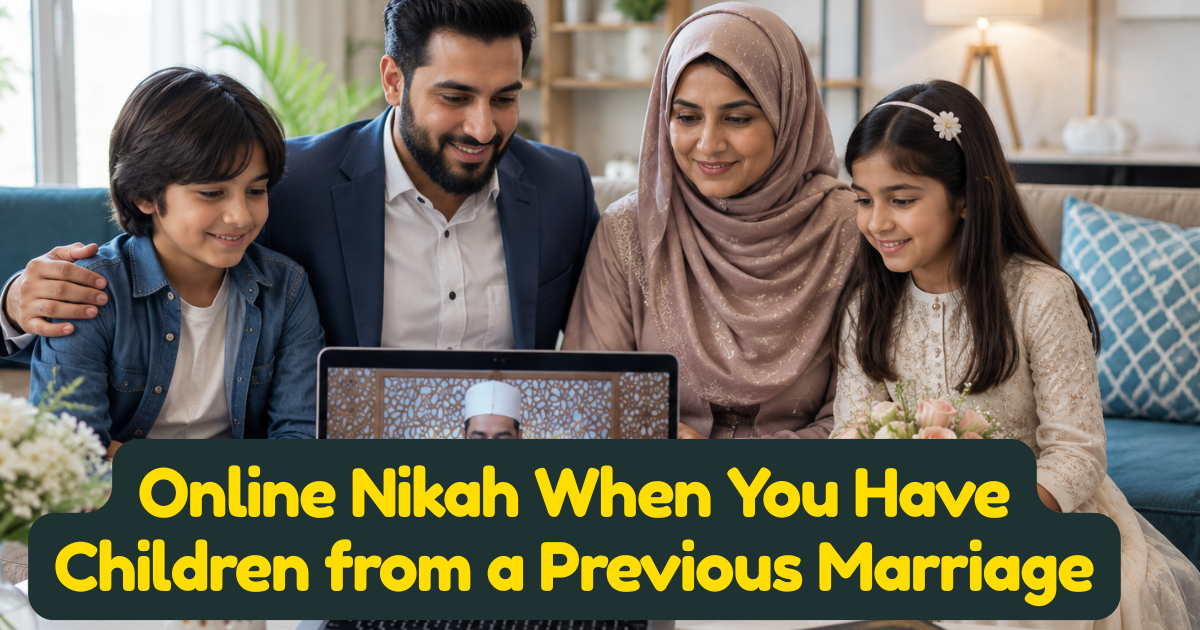
Online Nikah When You Have Children from a Previous Marriage: Guidance for Widows and Divorcees
Remarrying when you are already a parent is one of the most layered decisions a person can make. It is not simply a question of whether two people are compatible or whether the timing feels right. There are small faces to consider — children who did not choose any of this, who are navigating their own grief or confusion, who will wake up one morning in a world that has been rearranged without their consent.
And yet Islam does not ask parents to suspend their own lives indefinitely for the sake of that complexity. It acknowledges it. It gives it structure. It offers guidance that protects children without sacrificing the parent's right — and in many cases need — to build a new and stable life.
This guide is written for the parent who is sitting with both of those realities at once: the genuine readiness to move forward and the genuine weight of what that means for the children already in the home. Whether you are a widow who has completed her 'iddah, a divorcee whose marriage ended months or years ago, or someone whose circumstances fall somewhere between those two categories — the questions this guide addresses are the ones most likely running through your mind right now.
We will cover what Islam actually says, where cultural pressure has distorted that teaching, how a new nikah affects existing custody and guardianship arrangements, what the role of a stepparent is and is not in Islamic law, and why an online nikah often makes particular sense when children are already part of the equation.
---What Islam Says About Remarrying When You Have Children
The Islamic position is not ambiguous: a parent — mother or father — retains the full right to remarry after a previous marriage has ended, whether through death or divorce. Having children from that marriage does not remove this right, reduce it, or condition it on the children's approval.
This needs to be stated plainly because cultural practice in many Muslim communities has effectively inverted this ruling. Mothers, in particular, are frequently told — by in-laws, by community members, sometimes even by their own families — that remarrying would harm the children, that a good mother sacrifices her own companionship needs, that bringing a new man into the home is selfish. None of these positions have Quranic or scholarly grounding. They are cultural constructions, and they have caused measurable harm to millions of Muslim women who spent years of their lives in unnecessary isolation.
The Prophet ﷺ actively encouraged remarriage for widowed and divorced parents. He himself raised children who were not his biological offspring. He married women with children and treated those children with documented care and dignity. The idea that parenthood should preclude remarriage has no foothold in classical Islamic scholarship.
The Hadith on Marrying Someone with Children
Jabir ibn Abdillah رضي الله عنه narrated that when he remarried after his father's death, the Prophet ﷺ asked him about his new wife. Jabir explained he had chosen a previously married woman — a widow with children — rather than a younger, unmarried woman. The Prophet ﷺ did not object. He engaged with Jabir's reasoning thoughtfully, without the slightest suggestion that marrying a woman with children was a lesser or more complicated choice. The exchange is recorded in Sahih al-Bukhari and reflects the normalcy with which early Muslim society approached remarriage in complex family situations.
What Islam requires of a parent who remarries is not the absence of children from the picture — it is that those children are not harmed, not neglected, and not displaced from their rights. That is a standard of conduct, not a prohibition on the nikah itself.
---The Specific Concerns of a Mother Remarrying
While both parents face emotional and logistical complexity when remarrying with children in the home, the Islamic and practical landscape is somewhat different for mothers than for fathers. It is worth addressing each separately before returning to the shared ground.
Hadanah: Who Holds Custody in Islamic Law
Hadanah refers to the right and responsibility of physical custody — who the child lives with and who is responsible for their day-to-day care. In Islamic jurisprudence, the right of hadanah for young children is generally held by the mother, unless she remarries outside of the child's mahram relations.
This is the ruling that causes the most confusion and anxiety for divorced Muslim mothers considering remarriage, and it deserves careful explanation rather than a quick summary.
The majority position across the Hanafi, Shafi'i, and Hanbali schools is that if a divorced mother remarries a man who is not the child's mahram — that is, not a blood relative within the prohibited degrees — her right of physical custody of young children may be forfeited. The guardianship (wilayah) of the child then reverts to the father or his family.
The Maliki school is more nuanced, giving courts and scholars significant discretion to weigh the child's welfare holistically rather than applying an automatic transfer of custody upon the mother's remarriage.
Several important qualifications surround this ruling:
- The child's welfare is the paramount consideration. If it can be demonstrated that transferring custody to the father would harm the child — due to the father's absence, incapacity, or unsuitability — many contemporary scholars and Islamic courts will not enforce an automatic transfer.
- The rule primarily concerns young children. Once children reach a certain age of discernment — generally defined as seven for boys and nine for girls in the Hanafi school, with variation across other madhabs — they may have a voice in where they live.
- Civil law in the country of residence governs what actually happens. Islamic jurisprudence and the civil family courts of the UK, USA, Canada, Australia, and most European countries operate on entirely different frameworks. A civil court will not automatically transfer custody of a child because its mother has remarried. The child's best interests, as assessed by the civil system, will determine custody outcomes regardless of the Islamic ruling.
- Many contemporary scholars and Islamic jurists hold that the ancient rationale behind the custody-transfer ruling — protecting the child from an unrelated male guardian — can be achieved through other means, including robust legal protections for the child and screening of the new spouse. This is an area of active scholarly discussion, not settled historical consensus that cannot be revisited.
For mothers specifically: understanding the difference between the Islamic jurisprudential position and the civil legal reality in your country of residence is essential before making any decisions. Consulting both a qualified Islamic scholar and a family law solicitor or attorney in your jurisdiction is strongly advised if custody arrangements are a concern.
The Father's Ongoing Role After the Mother Remarries
A mother's remarriage does not remove the biological father's rights or responsibilities. He retains wilayah — Islamic legal guardianship — over the children regardless of where they physically reside or who the mother has married. This means decisions about education, religious upbringing, and major life matters remain within his authority, alongside the mother's rights of daily care.
A new stepfather, no matter how involved or how loving, does not acquire wilayah over children from a previous marriage simply by virtue of the nikah. His relationship with those children is one of care and responsibility — morally significant and practically important — but it is not equivalent to the father's Islamic legal guardianship.
---The Specific Concerns of a Father Remarrying
For fathers remarrying after divorce or widowhood, the Islamic and practical landscape looks different. Custody of young children is typically held by the mother following divorce, so a father who is remarrying is generally not in the position of bringing a new spouse into a household where young children are living full-time — though exceptions exist.
The more pressing concerns for remarrying fathers tend to be:
The Rights of Children from the First Marriage
Islamic law is specific about a father's financial obligations to his children from a previous marriage. Nafaqah — financial maintenance — remains his responsibility regardless of his new marriage. A new wife's financial needs do not extinguish the obligation to the children from before. Scholars across all schools are unanimous on this point.
In practice, this means a father who is remarrying needs to be honest with his new wife — and with himself — about the financial commitments that exist and will continue. A nikah built on the concealment of these obligations is likely to generate serious conflict. Transparency before the ceremony is an Islamic duty, not merely a practical suggestion.
The New Wife's Rights Regarding Children Who Visit
A new wife has Islamic rights within her marital home. She cannot be required to assume the role of caretaker for her husband's children from a previous marriage without her explicit agreement. This is a nuanced area where the rights of the new spouse and the welfare of the children require honest pre-nikah negotiation.
The Prophet ﷺ said: "The best of you are those who are best to their families." (Tirmidhi) This applies bidirectionally — the father must honour his children, and the husband must honour his wife. Where these obligations intersect, communication and explicit agreement are the Islamic tools for managing the intersection.
The Children's Relationship with a Stepmother
The cultural archetype of the difficult stepmother is not Islamic in origin — it is a folk narrative that Islam neither endorses nor is obligated to accommodate. A stepmother in an Islamic household is not required to love her husband's children in the same way she loves her own, but she is required to treat them with fairness, dignity, and basic kindness.
Children who visit or live in the household retain full rights to proper treatment. A father who fails to protect those rights — who allows his children to be mistreated or marginalised in favour of a new spouse's preferences — is failing an Islamic obligation, not navigating an unavoidable tension.
---The Stepparent's Role in Islamic Law: What It Is and What It Is Not
This section addresses one of the most commonly misunderstood dimensions of remarriage with children — and one that has significant downstream consequences if it is not clearly understood before the nikah takes place.
Mahram Status Through a Stepparent Relationship
A stepfather becomes the mahram of his wife's daughters — and only his wife's daughters — through the nikah, provided the marriage has been consummated. This mahram relationship is permanent: even if the marriage later ends through divorce or death, the stepfather remains a permanent mahram to those stepdaughters. This has practical implications for travel, for hijab rulings within the household, and for the Islamic permissibility of certain kinds of physical proximity.
The same principle applies to a stepmother: she becomes a permanent mahram to her husband's sons through the consummated marriage.
These mahram relationships do not, however, confer guardianship. A stepparent is a mahram — not a wali. The distinction matters enormously in practice.
Can a Stepfather Serve as Wali for a Stepdaughter's Nikah?
No — not by virtue of being a stepfather alone. The wali hierarchy in Islamic law follows blood and agnatic relationships. A stepfather, regardless of how involved he has been in raising a girl, does not inherit wali authority over her simply through his marriage to her mother.
The wali for a stepdaughter's nikah would be her biological father, or — if he is deceased, absent, or disqualified — the next male Muslim relative in her paternal line. Only in the complete absence of any such relative does the wali function pass to a qazi.
This is a ruling that surprises many blended Muslim families, particularly those where the biological father has been entirely absent and the stepfather has functionally served as the father figure throughout the child's life. The emotional reality and the Islamic legal reality diverge here, and families navigating this situation should seek explicit scholarly guidance rather than assuming the stepfather's role is equivalent to a biological father's.
Adoption in Islamic Law
Islam does not recognise adoption in the Western legal sense — specifically, the practice of a child taking the stepparent's family name and being treated as a biological child in law. The Quran addresses this explicitly in Surah Al-Ahzab (33:5), instructing that adopted children be called by their biological fathers' names.
This does not mean a stepparent cannot love a child as their own, cannot provide financially for them, or cannot be the primary parental figure in their daily life. It means that the Islamic legal framework — around inheritance, mahram status, and wali rights — continues to follow the biological lineage.
Families where children have been raised with a different family name or where civil adoption has occurred should understand that the Islamic legal consequences still follow the biological line, and should plan accordingly — particularly when those children eventually approach their own marriageable age.
---Telling the Children: How and When
Islamic guidance does not prescribe a specific script for this conversation, but it does provide a framework through the broader values of honesty, gentleness, and consideration for the vulnerable. Children in the context of a parent's remarriage are among the most vulnerable people in the situation — they have the least agency and the most to process.
Some principles worth considering:
Timing Matters More Than Most Parents Expect
Children generally do not respond well to being informed of a parent's remarriage immediately before or immediately after the event. Finding out that a parent has already remarried — without any prior conversation — can generate a rupture in trust that takes years to repair.
Where circumstances allow, a gradual approach — introducing the new partner to the children before the nikah, giving space for the children to ask questions and express concerns, and having the nikah conversation well before the ceremony — tends to produce better outcomes for family cohesion.
Age-Appropriate Honesty
Young children do not need the full complexity of the situation. They need clarity, reassurance, and consistency. Older children and teenagers may need more information, more space to express difficult feelings, and more explicit reassurance that their relationship with the remarrying parent is not being replaced or diminished.
Their Feelings Are Not a Veto
Children's feelings about a parent's remarriage deserve to be heard, taken seriously, and compassionately addressed. They are not, however, a veto over the parent's lawful right to remarry. A parent who indefinitely postpones a legitimate and halal nikah because of a child's opposition is not necessarily protecting the child — they may be placing an unfair and invisible weight on that child's shoulders, making the child responsible for the parent's emotional life in a way that is its own form of harm.
Helping children understand — at an age-appropriate level — that the parent's capacity to love and care for them is not reduced by loving another adult is one of the more important conversations in this process. It is also one of the hardest.
---Why Online Nikah Makes Particular Sense When Children Are Involved
A parent who is remarrying with children already in the picture often faces a particular kind of pressure around the ceremony itself. Extended family opinions about the remarriage may be divided. The children may not yet be ready to witness or participate in a celebration. The parent may want to establish the nikah without staging an event that forces the children into a public role they have not consented to.
In these circumstances, an online nikah through a service like InstantNikah.com offers something genuinely valuable: the ability to complete the religious contract — properly, fully, and with complete Shariah compliance — without making the ceremony a production that the entire family system has to navigate simultaneously.
The Nikah First, the Celebration Later
There is nothing in Islamic law that requires the nikah and the walima to happen on the same day, or even in the same season. Many families in complex situations choose to complete the nikah quietly — establishing the religious and legal foundation of the marriage — and then plan a celebration at a later point when family dynamics have settled and children have had more time to adjust.
This sequencing is entirely valid. The nikah is the marriage. The walima is a recommended celebration of that marriage. Separating them by months, if circumstances require it, does not diminish the validity or sincerity of either.
Keeping the Children's Routine Stable
A virtual nikah ceremony can be completed in an afternoon without disrupting school schedules, childcare arrangements, or the routines that children — particularly those who have already experienced family upheaval — depend on for their sense of security. This is not a trivial consideration. For children who have navigated a parent's death or the dissolution of their family through divorce, predictability and routine are among the most stabilising forces in their daily lives.
Managing Extended Family Dynamics
A parent who remarries often faces competing pressures from different sides of a complicated family picture — the remarrying parent's own family, the former spouse's family, and the new partner's family, all potentially with strong opinions about how the marriage should or should not proceed. An online nikah sidesteps the need to manage all of those dynamics simultaneously at a large ceremony, allowing the couple to focus on what actually matters.
Couples who have navigated this can read about their experiences on the InstantNikah.com reviews page. The range of situations represented there reflects how genuinely varied the circumstances of remarrying parents can be.
---The Wali Question When Remarrying as a Divorcee or Widow
The wali requirement for a divorcee or widow entering a new nikah follows the same principles as any nikah — her closest available male Muslim relative serves in this role. What changes in the context of children from a previous marriage is one specific scenario: the adult Muslim son.
If a widow or divorcee has an adult Muslim son from her previous marriage, that son may — depending on the madhab — serve as her wali for her new nikah. This is emotionally complex territory. A son being asked to formally authorise his mother's remarriage is a situation that requires careful, honest family communication before the ceremony — not a surprise delivered in the moment.
For mothers in this situation, the guidance in the online nikah for widows guide covers the wali hierarchy in detail. For situations where no natural wali is available or where the wali is uncooperative without valid Islamic reason, the qualified scholars at InstantNikah.com can assess the situation and, where appropriate, fulfil the wali role in the capacity of qazi.
The broader question of how the wali functions across a range of real-world situations is covered comprehensively in the article on online nikah without a wali.
---Financial Considerations Before the Nikah
Remarrying when children are already in the picture raises financial questions that deserve honest pre-nikah conversation — not because Islam requires a formal financial disclosure process, but because the vast majority of post-remarriage conflicts in blended Muslim families trace back to financial expectations that were never clearly established before the ceremony.
Child Support and Maintenance from a Previous Marriage
Both parties entering a nikah where children exist from previous relationships should be transparent about existing financial obligations. A father who is paying child support to a former wife, or a mother whose maintenance is structured around her not remarrying, needs to understand how the new nikah affects those arrangements — both Islamically and under the civil law of their country of residence.
In some Western jurisdictions, a mother's remarriage terminates or reduces her entitlement to spousal maintenance from a former husband. This is a civil law matter and varies significantly by jurisdiction. It is worth understanding before the nikah is completed rather than discovering afterward.
Mahr in the Context of Remarriage with Children
A divorcee or widow entering a new nikah is entitled to a full mahr — agreed between the parties, belonging entirely to her, separate from any financial arrangements relating to the children or the previous marriage. The presence of children from a previous relationship does not reduce this entitlement.
For a thorough understanding of how mahr works — including what forms it can take and what the bride's rights are if it is not paid — the guide on what is mahr in nikah provides complete detail.
Inheritance Implications for Children
Islamic inheritance law — the rules of mirath — governs how an estate is distributed after death. When a parent remarries, the inheritance rights of children from the first marriage are not extinguished. Children inherit from their biological parents regardless of subsequent marriages.
However, a new spouse's presence does affect the proportional distribution of the estate under Islamic inheritance formulas. Families in complex situations — particularly those with children from multiple marriages — are strongly encouraged to consult an Islamic scholar with expertise in inheritance law, and where appropriate, to make a civil will that reflects their intentions clearly within the bounds of what local law allows.
---Questions Parents Ask Most Often
Do I need my children's permission to remarry?
No. An adult parent's right to remarry does not require the consent of their children, regardless of the children's ages. Their feelings deserve consideration and honest conversation, but their agreement is not a condition of the nikah's validity.
Will my custody arrangement change if I remarry?
Under Islamic jurisprudence, a divorced mother who remarries outside the child's mahram relations may forfeit physical custody of young children to the father. Under civil law in most Western countries, custody is determined by the child's best interests and is not automatically altered by a parent's remarriage. These two frameworks are separate and should be understood separately. Seek legal advice in your jurisdiction if custody is a concern.
Can my new husband adopt my children Islamically?
Islamic law does not recognise adoption in the sense of erasing a child's biological lineage and replacing it with the adoptive parent's. A stepfather can care for, financially support, and build a parental relationship with his wife's children — but they retain their father's name and lineage, and the biological father retains his Islamic rights regarding those children.
What if my former husband opposes my remarriage?
A former husband has no Islamic authority to prevent his ex-wife from remarrying once the divorce is complete and the 'iddah has passed. His rights regarding the children — specifically wilayah and visitation — remain intact, but these are entirely separate from any authority over her marital choices. She does not require his permission or approval.
Should I introduce my new partner to my children before the nikah?
Islam requires that interactions between a woman and a non-mahram man be conducted within appropriate boundaries before the nikah. Introducing a prospective husband to children in a supervised, structured setting — where the relationship being discussed is serious and marriage-directed — is generally considered acceptable within Islamic bounds, particularly given the practical necessity of ensuring compatibility in a situation where children's welfare is at stake. Scholars advise that such meetings remain modest and purposeful.
Can the online nikah be done privately, without the children present?
Yes. An online nikah ceremony through InstantNikah.com involves the couple, the wali, the witnesses, and the qazi. Children are not required to be present. Many remarrying parents specifically choose a private online ceremony precisely because they want to establish the nikah without making the children part of the ceremony before they are emotionally ready for it.
---Moving Forward With Intention
Remarrying when you have children is not a decision that benefits from impulsiveness, but it is also not one that benefits from indefinite delay rooted in guilt, cultural pressure, or other people's expectations. Islam offers a clear framework: fulfil your obligations to the children you already have, be honest with your prospective spouse about those obligations, complete the nikah with proper Islamic structure, and build the new marriage with the same intentionality you would want your children to bring to their own lives one day.
The children are watching. Not just for how this chapter begins, but for what it models about how adults navigate difficulty, honour their faith, and choose hope without abandoning responsibility.
If you are considering an online nikah and want to understand what the process looks like in your specific situation — including wali arrangements, ceremony scheduling, documentation, and the option for a private ceremony — the team at InstantNikah.com is available to walk through it with you.
You can begin by reviewing the full process here, explore relevant guidance for your specific situation across the InstantNikah.com blog, or contact the team directly with questions particular to your circumstances. When you are ready to proceed, booking is available here.
This chapter of your life deserves to begin on solid ground — Islamically sound, emotionally considered, and practically prepared. That is exactly what a well-structured online nikah, approached with the right guidance, can provide.
Admin User
Author