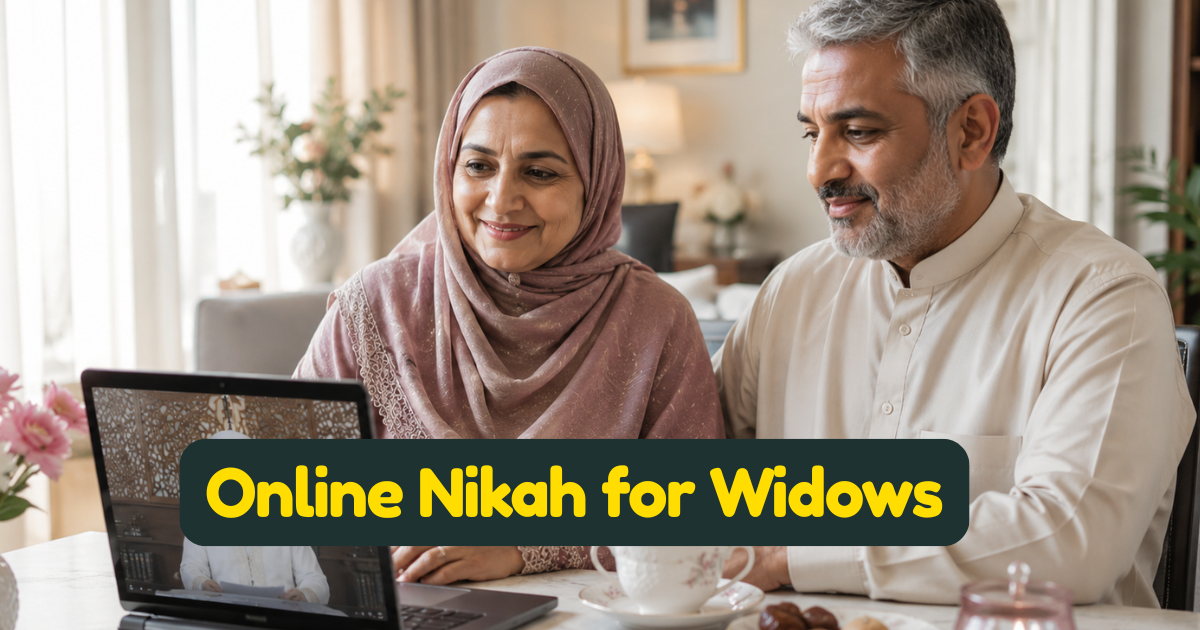
Online Nikah for Widows: Religious Guidance, 'Iddah Requirements, and Starting Again
Loss changes everything. And yet life, with its quiet insistence, continues moving forward. For a Muslim woman who has lost her husband, the thought of marrying again may arrive early or years later — sometimes as a whisper, sometimes as something she cannot quite name. Islam does not ask her to suppress that instinct. It honours it.
Remarriage after widowhood is not a departure from love or loyalty to the one who passed. In the Islamic understanding of life, death is a transition — not a final severance of what mattered. A woman who chooses to remarry is not erasing what came before. She is, as the Quran frames it, choosing life.
This guide is written for women in exactly that position: those who have completed or are approaching the end of their 'iddah, who want to understand the Islamic framework for remarriage clearly and without judgment, and who are considering whether an online nikah might be the right path forward for their particular circumstances.
It is also written for the men who wish to marry a widow, and for the families — walis, sons, brothers — who want to support a woman they love through a transition that deserves care, not complication.
---What Islam Says About a Widow Remarrying
The permissibility of remarriage after widowhood is not ambiguous in Islamic scholarship. It is clearly established and, in many circumstances, actively encouraged.
The Prophet ﷺ himself married widows. Khadijah رضي الله عنها, his first and beloved wife, had been married twice before. Sawdah bint Zam'ah was a widow. Umm Salamah رضي الله عنها — whose own account of her grief and reluctance to remarry is one of the most moving in the seerah — eventually accepted the Prophet's proposal and became one of his most respected wives. These are not peripheral details. They are central to how Islam frames widowhood and the legitimacy of beginning again.
The Quran addresses widows directly in Surah Al-Baqarah, affirming their right to make their own decisions regarding remarriage once the 'iddah period is complete: "There is no blame upon you for what you hint at regarding a marriage proposal to women or what you conceal within yourselves. Allah knows that you will think of them. But do not make a secret contract with them, except for speaking in an acceptable way. And do not resolve upon the knot of marriage until the decreed period reaches its end." (Quran 2:235)
The verse is careful and compassionate in equal measure. It acknowledges the natural human pull toward connection. It gives protective guidance. And it places the widow's dignity and agency at the centre of the entire discussion.
---Understanding 'Iddah After the Death of a Husband
'Iddah is the waiting period a Muslim woman observes following the end of her marriage — whether through divorce or the death of her husband. For widows, the 'iddah has its own specific ruling, distinct from that of a divorced woman, and understanding it precisely is essential before any discussion of remarriage.
The Duration: Four Months and Ten Days
The Quran establishes the widow's 'iddah explicitly: "And those who are taken in death among you and leave wives behind — they, [the wives, shall] wait four months and ten [days]." (Quran 2:234)
This period — four months and ten days from the date of the husband's death — is the 'iddah for a widow who is not pregnant. It is agreed upon across all four major madhabs without significant scholarly disagreement. The calculation begins from the moment of the husband's confirmed death, not from when the news reaches her, according to the majority scholarly position, though some scholars hold that it begins when she receives confirmed news.
The 'Iddah of a Pregnant Widow
If the widow is pregnant at the time of her husband's death, her 'iddah extends until she gives birth — regardless of whether that is shorter or longer than four months and ten days. The Quran states in Surah At-Talaq (65:4): "And for those who are pregnant, their term is until they give birth." This ruling applies to both divorced women and widows, and it takes precedence over the standard duration.
In practice: if a widow gives birth two months after her husband's death, her 'iddah is complete at that point. If the pregnancy continues beyond four months and ten days, the 'iddah extends accordingly.
What the 'Iddah Period Involves
The widow's 'iddah is not simply a waiting period in the administrative sense. It carries specific guidance — known as ihdad — regarding conduct during this time:
- Abstaining from adornment: The widow avoids wearing jewellery, perfume, and decorative clothing during the 'iddah. This is not about punishment; it is about a form of mourning that acknowledges the weight of the loss.
- Remaining in the marital home: According to the majority of scholars, the widow should ideally remain in her marital home during the 'iddah period. There are, however, recognized exceptions — if she has no home, if staying creates hardship or danger, or other compelling circumstances.
- Avoiding formal marriage proposals: She may not enter into a new marriage contract during the 'iddah. However, as the Quranic verse referenced earlier indicates, indirect, respectful signals of interest are not prohibited — the key is that no binding agreement is made.
It is worth noting that contemporary scholars have addressed modern circumstances around 'iddah with nuance. A widow who works, has children to care for, or lives in a Western country where the traditional framework of ihdad does not map neatly onto her daily life, may consult a qualified scholar for guidance relevant to her specific situation. The spirit of 'iddah — a period of grief, reflection, and transition — remains constant even where its practical expression varies.
What the 'Iddah Does Not Require
Common misunderstandings are worth clearing up directly. The widow's 'iddah does not require:
- Complete social isolation
- Permanent withdrawal from employment
- Avoiding all contact with non-mahram men in professional or public settings
- Permission from in-laws to remarry once the period is complete
The last point is particularly important and is a source of significant unnecessary pressure in some cultural contexts. Once the 'iddah is complete, a widow's decision to remarry belongs to her, guided by her wali and her own judgment — not by the opinion of her former husband's family.
---The Wali Question for Widowed Women
Who serves as a widow's wali for her next nikah? This is one of the most frequently misunderstood aspects of remarriage, and cultural confusion around it has caused real harm to women who were prevented from remarrying by in-laws who had no legitimate Islamic authority to do so.
The answer is clear in Islamic jurisprudence: upon the death of her husband, the widow's wali reverts to her original family line. Her father, if living and Muslim, resumes the role of wali. In his absence, the role passes according to the standard order of closeness — paternal grandfather, then son (if she has an adult Muslim son from her previous marriage), then full brother, then paternal half-brother, and so on through the accepted scholarly sequence.
Her former husband's family — his brothers, his parents, his cousins — have no wali authority over her whatsoever. This is not a minority position or a modern interpretation. It is classical fiqh across all major schools.
When There Is No Natural Wali
A widow may find herself in a situation where her natural wali is deceased, non-Muslim, absent, or otherwise unavailable. This is particularly common for:
- Older women whose fathers and brothers have passed away
- Women whose families are non-Muslim (converts, or those from mixed-faith backgrounds)
- Women who have no surviving male Muslim relatives
- Women living in diaspora communities distant from their families of origin
In all such cases, the qualified position across the madhabs is that a qazi or Islamic authority assumes the wali function. This is precisely one of the roles that the qualified scholars at InstantNikah.com are prepared to fulfil — ensuring that a widow can complete her nikah with full Shariah compliance even in the absence of a natural male guardian.
The Adult Son as Wali
A nuance that many women are unaware of: if a widow has an adult Muslim son from her previous marriage, he may serve as her wali for her next nikah — depending on the madhab and the specific scholarly position followed. The Hanafi school, for example, includes the son in the wali hierarchy after the father and paternal grandfather. This is sometimes emotionally complex, but it is an option that exists and has been applied in practice.
---Why Some Widows Choose Online Nikah
The decision to pursue a nikah online rather than through a traditional in-person ceremony is rarely impulsive. For widows specifically, the reasons tend to be layered and deeply personal.
Geography and Family Dispersion
Many widows, particularly those in diaspora communities, find that their families are spread across multiple countries. Coordinating an in-person ceremony is logistically difficult and, in some cases, financially and emotionally prohibitive. A virtual nikah allows all essential parties — the bride, the groom, the wali, the witnesses — to be present from wherever they are in the world.
Emotional Privacy
Remarrying after the loss of a husband carries an emotional complexity that those who have not experienced it often underestimate. A widow may feel the eyes of extended family and community upon her — their judgments, their timelines, their comparisons. A private online nikah offers a quieter beginning. One where the focus stays on what actually matters: the contract, the commitment, and Allah as witness.
Avoiding Community Scrutiny
In some communities, a widow who remarries faces social commentary — about timing, about her choice of partner, about whether she has "moved on too fast" or "waited too long." None of this scrutiny has Islamic grounding, but it is real. An online nikah allows a woman to fulfil her religious right without staging it for an audience that may not be supportive.
Practical Urgency
Some widows have urgent practical reasons for remarrying — visa situations, cohabitation needs, children's welfare considerations, or healthcare-related decisions that require a legally recognized marital relationship. An online nikah can often be arranged far more quickly than a traditional ceremony, without sacrificing any element of religious validity.
Living Abroad with a Partner in Another Country
Many widows meet a new partner while living abroad, sometimes a man who is also overseas. An online nikah for couples in different countries is one of the most common use cases at InstantNikah.com, and the process is well-established for cross-border situations.
---Mahr in a Second Nikah
A widow entering a new nikah is entitled to a full and agreed mahr — just as any bride would be. There is no Islamic ruling that reduces her mahr entitlement because she was previously married, or because her former husband's estate included a prior mahr.
The mahr for her new nikah is a fresh agreement between her and her new husband, negotiated as part of the new contract. It is entirely separate from anything relating to her first marriage.
Culturally, some women feel pressure to accept a lower mahr when remarrying — particularly if they have children from a previous marriage or are considered "older." This pressure has no Islamic basis. The mahr is a right established by Allah for the bride, and it belongs to her alone. It should reflect genuine agreed value, not social calculation.
For a thorough understanding of mahr — what it can consist of, how it is agreed, and what happens if it is not paid — the guide on what is mahr in nikah covers these questions in detail.
---The Emotional Architecture of Beginning Again
No practical or religious guide is complete without acknowledging what actually happens inside a person who has lost a spouse and is considering marriage again. The feelings are not straightforward. They rarely are.
Guilt is common — a sense that moving forward is somehow a betrayal of the one who passed. Islam speaks directly to this. The love shared with a deceased husband is not diminished by the love that may come after. Allah, in His mercy, does not ask us to carry grief as a permanent identity.
Uncertainty is common — about whether she is ready, whether the new relationship is right, whether the timing is appropriate. These doubts are not signs of weakness. They are signs of someone taking seriously what marriage actually means.
Fear of judgment is common — from children who may resist a mother remarrying, from in-laws who feel their connection to a son's widow should supersede her autonomy, from community members who have assigned themselves the role of deciding what is and is not appropriate. This fear is understandable. And it is worth naming clearly: none of these parties has Islamic authority over her decision.
The Prophet ﷺ addressed Umm Salamah's grief directly when he proposed to her. She listed her concerns honestly: she was old, she was jealous by nature, she had children from Abu Salamah who would need consideration. He heard her. He responded to each concern with patience and honesty. That exchange — one of the most human in the entire seerah — is a model for how remarriage conversations should actually unfold. With honesty. With care. Without performance.
---How the Online Nikah Process Works for Widowed Women
The practical process through InstantNikah.com is structured to accommodate the specific circumstances that widowed women often face — including wali arrangements, cross-border coordination, and requests for a more private ceremony.
Initial Consultation
The first step is a consultation — not a booking form, but an actual conversation about the couple's situation. For a widow, this typically involves confirming that the 'iddah period has been completed, clarifying the wali arrangement, and understanding any particular sensitivities around the ceremony. Nothing is assumed. Everything is addressed.
Documentation
Basic documentation is required from both parties — identification, and where relevant, documentation related to the previous marriage (such as the husband's death certificate, which may be needed for civil registration purposes in some countries). This stage ensures that the nikah is properly verifiable and that the certificate issued carries full credibility.
Witness Arrangement
Two Muslim witnesses must be present for the ceremony. These can be people the couple provides — family or trusted friends who join the video call. If the widow has difficulty arranging witnesses independently, the team at InstantNikah.com can assist with this. The process and everything that may be involved in witness arrangements is covered in the guide on online nikah without witnesses.
The Ceremony Itself
The ceremony is conducted by a qualified qazi via video call. It follows the complete Islamic structure — confirmation of the wali's presence, agreement and declaration of the mahr, and the formal ijab and qubool. The tone is quiet and focused. For many widows who have requested this service, that quietness is not a limitation. It is a relief. You can see what the process looks like from start to finish on the InstantNikah.com process page, and read the experiences of others on the reviews page.
Nikah Certificate
Following the ceremony, an officially issued nikah certificate is provided. This serves as the formal Islamic record of the marriage. For questions about using the certificate for civil registration or international recognition, the online nikah certificate guide provides country-specific information.
---Frequently Asked Questions from Widows Considering Online Nikah
Does my son need to give permission for me to remarry?
Permission is not the right word. Your adult Muslim son may serve as your wali — in which case his formal role in the nikah is meaningful. But his role is as guardian in the Islamic sense, not as authority over your decision. He cannot prevent your nikah if you have reached a sound conclusion. If he refuses to act as wali without valid Islamic reason, the wali function can be assumed by a qualified qazi.
My in-laws say I need their blessing to remarry. Is this true?
It is not an Islamic requirement. Your former husband's family has no religious authority over your remarriage. Their blessing may matter to you emotionally, and seeking it may smooth family relationships — but it is not a condition of your nikah's validity. This is a cultural expectation, not a Shariah ruling.
How do I know my 'iddah has ended?
For a non-pregnant widow, the 'iddah ends four months and ten days after the date of the husband's death. Calculate from the confirmed date of death. If there is any doubt about the exact date, or if you were pregnant, consult a scholar to confirm the end date precisely before proceeding.
What if my children oppose the marriage?
This is one of the most emotionally difficult situations a widow faces. Children — particularly older ones — sometimes struggle with a mother's remarriage. Their feelings deserve compassion and honest conversation. However, their opposition does not invalidate the nikah. Your right to remarry is established in the Quran and in the sunnah. Seeking to bring them along emotionally, where possible, is wise and kind — but their agreement is not a condition.
Can I do an online nikah if my new husband is in a different country?
Yes. This is one of the most common scenarios handled through InstantNikah.com. Cross-border nikah ceremonies are structured to accommodate all parties joining from different locations via video call, with the qazi, wali, and witnesses all confirmed and present in their respective locations.
Is it necessary to announce the nikah publicly?
The scholarly position is that a nikah should be known — meaning it should not be treated as a secret arrangement. Having proper witnesses satisfies this condition. A large public announcement or celebration is not required. Many widows prefer a quiet ceremony and a modest approach to informing family, and this is entirely within Islamic bounds.
---When You Are Ready
There is no universally correct timeline for a widow's remarriage. Four months and ten days is the minimum — the religious floor beneath which no nikah may proceed. Beyond that, readiness is personal, and no one outside of you and Allah can truly measure it.
What Islam offers is not a schedule, but a framework: grieve with dignity, observe the 'iddah with sincerity, and then — when your heart and your circumstances align — move forward without guilt and without apology.
If you are considering an online nikah and want to understand the process specific to your situation — including 'iddah confirmation, wali arrangements, cross-border coordination, or simply a private and dignified ceremony — the team at InstantNikah.com is available to speak with you.
You can review the full process here, explore online nikah guidance for second marriages, or reach out directly with your questions. When you are ready to take the next step, booking a consultation is available here.
Beginning again is not a betrayal of what was. It is, in its own way, a form of hope — and Islam has always honoured that.
Admin User
Author