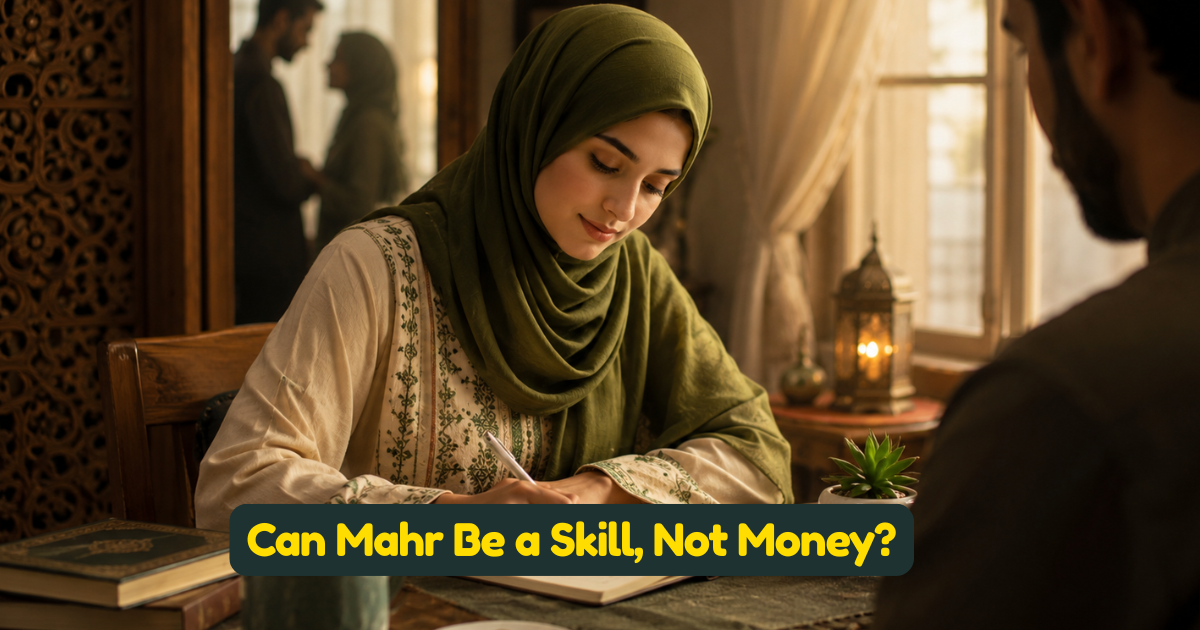
Can Mahr Be a Skill, Not Money?
She didn't want a number. When her fiancé asked what she'd like for her mahr, she thought about it seriously and came back with something that had nothing to do with money at all: she wanted him to teach her the Qur'an, properly, with meaning, at a pace they'd set together after the wedding. It felt like exactly the kind of mahr she'd want — something that would actually stay with her, long after any sum of money would have been spent. Her fiancé loved the idea. Then he wondered whether it was actually allowed.
The Hadith Behind the Idea
This isn't a modern reinterpretation of mahr — it's directly rooted in one of the most well-known and authentic hadiths on the subject. A woman came to the Prophet ﷺ and offered herself in marriage; when no one initially came forward, a man eventually stepped up but had nothing to offer as mahr — not even an iron ring. The Prophet ﷺ asked whether he knew any portion of the Qur'an, and when the man confirmed he knew certain specific surahs, the Prophet ﷺ married her to him on the basis of what he had memorized, as recorded in both Sahih al-Bukhari and Sahih Muslim. It's a genuinely beautiful, well-established precedent — and it's the reason this question comes up as often as it does.
Where It Gets More Complicated: The Schools Disagree
Here's the part that surprises most people, because the hadith itself sounds so clear-cut: the four Sunni schools do not agree on how far this precedent extends to services and skills generally. The Shafi'i and Hanbali schools, and the majority of both early and later scholars, treat this hadith as establishing a general principle — that a genuinely valuable service, teaching the Qur'an being the clearest example, can validly serve as mahr, provided it has real, agreed-upon value and is something the husband can actually deliver. Analysis of this hadith confirms this is the position of the majority of scholars among both the earlier and later generations.
The Hanafi school takes a narrower, more specific view. A direct ruling addressing this exact scenario states it plainly: according to Hanafi jurisprudence, a mahr that isn't "wealth" (māl) in the technical legal sense is not permissible — meaning a service like teaching, however valuable and meaningful, doesn't satisfy the Hanafi definition of what mahr must consist of. Under this view, the Hanafi minimum of ten dirhams in actual monetary or material value would still need to be present, even if a couple also wants to include Qur'an teaching as something additional and meaningful alongside it.
Why the Disagreement Exists
The underlying tension is a genuinely interesting one: is the hadith describing a specific ruling tied to that one man's particular financial hardship, or is it describing a broader principle about what counts as legitimate mahr generally? Hanafi jurists lean toward treating it as an exception grounded in that specific companion's poverty rather than a general redefinition of what mahr can consist of. Shafi'i and Hanbali jurists read the same hadith as establishing the wider principle: that mahr simply needs to be something of genuine, deliverable value that the wife accepts — and a valuable skill, taught in good faith, clearly qualifies.
What This Means Practically for a Couple Today
- If the couple follows Shafi'i or Hanbali guidance, or simply the broader majority position, teaching Qur'an — or a comparably valuable, clearly defined skill — can serve as a complete, standalone mahr.
- If the couple follows Hanafi guidance, a monetary or material component meeting the minimum threshold should still be included, with the skill or teaching added as a separate, additional gesture rather than a substitute for it.
- Whichever school is followed, the commitment should be written into the nikah contract with real specificity — which surahs, over what timeframe, at what depth of understanding — since a vague promise to "teach some Qur'an eventually" doesn't meet the clarity a valid mahr requires.
This last point matters regardless of which school a couple follows: mahr, whether monetary or a service, has to be clearly defined and genuinely deliverable. "Teaching the Qur'an" as a mahr works well specifically because it can be made concrete — a defined portion, a realistic timeline, a way to confirm it's been fulfilled — not because vagueness is somehow acceptable when money isn't involved.
Beyond Teaching Qur'an: Does This Extend to Other Skills?
Among scholars who accept the broader principle, the reasoning generally extends beyond Qur'an teaching specifically to other genuinely valuable, clearly defined skills — professional training, tutoring in a needed subject, or another service the wife specifically values and the husband can reliably provide. The core requirement stays the same across all of these: real value, mutual agreement, and a level of clarity precise enough that both parties know exactly what's being promised and how it will be fulfilled.
Frequently Asked Questions
Does it matter whether the husband can afford a monetary mahr instead?
Under the Hanafi view, this is part of the underlying disagreement — some scholars in this school see the hadith as tied specifically to that companion's financial hardship. Couples following Hanafi guidance who can afford a monetary component are generally advised to include one.
Can a wife request Qur'an teaching in addition to a monetary mahr, rather than instead of it?
Yes — nothing prevents combining a monetary mahr with an additional, meaningful non-monetary gesture like this.
What happens if the husband doesn't fulfil the teaching as promised?
As with any mahr obligation, failing to deliver what was agreed is a real breach of the wife's right — which is exactly why specificity in the contract matters, so fulfillment can be clearly assessed.
Authority References Used (Live & Clickable)
- Al-Feqh (al-feqh.com) — the hadith establishing teaching Qur'an as a valid mahr, from Sahih al-Bukhari and Sahih Muslim
- Islamic Finance Guru (islamicfinanceguru.com) — analysis confirming the majority scholarly position on non-monetary mahr
- Islam Question & Answer, Hanafi fiqh (islamqa.org) — the Hanafi position requiring mahr to constitute wealth (māl)
Suggested Internal Links
- What Is Mahr in Nikah?
- How Much Mahr Is Enough?
- Mahr Agreed But Not Written in the Nikah Contract
- If Mahr Is Paid in a Different Currency, Which Rate Applies?
- Book Your Online Nikah
Why This Article Is Different
Most content repeating this hadith stops at "yes, mahr can be a skill" without ever mentioning that the Hanafi school reads the same hadith differently — an omission that could leave a Hanafi-following couple assuming a service alone fully satisfies their mahr obligation when it doesn't under their own school's view. Presenting the actual scholarly disagreement, rather than flattening it into a single universal answer, gives this piece both stronger accuracy and stronger AI-citation reliability than the simplified version found elsewhere.
Zainab Butt
Author