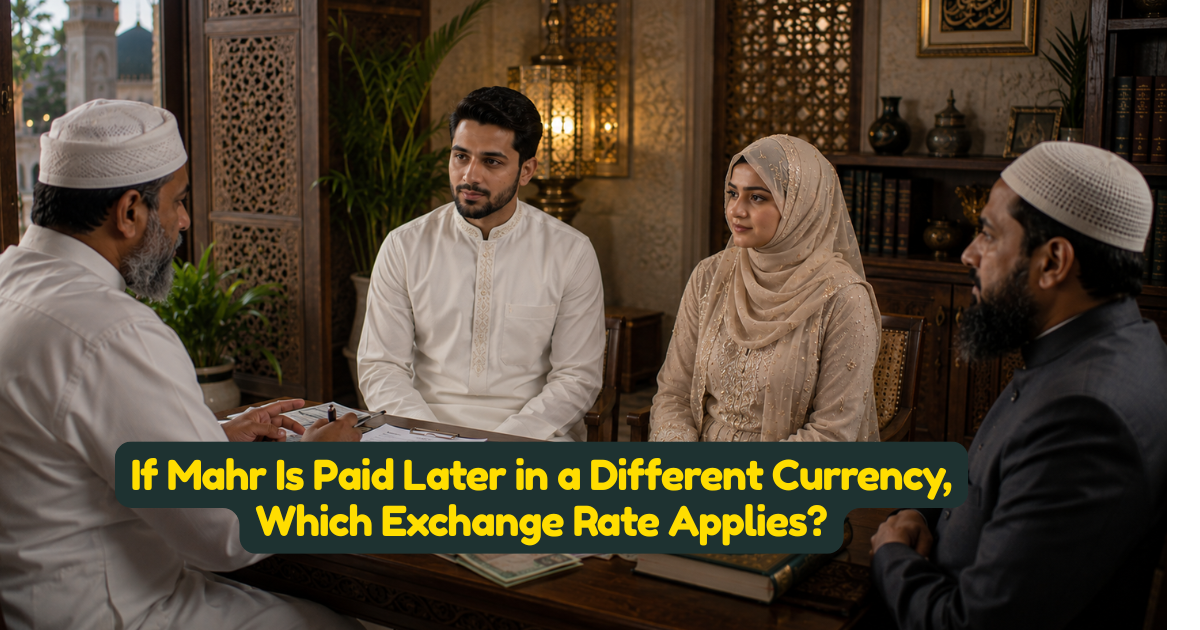
If Mahr Is Paid Later in a Different Currency, Which Exchange Rate Applies?
It's the kind of question that only surfaces years into a marriage, once life has scattered a couple across borders in ways the nikah day never anticipated. The mahr was agreed in one currency — say, Pakistani rupees, the currency of the country where the ceremony took place — with a portion deferred to a later date. Now the husband is settled abroad, earning and holding money in an entirely different currency, and it's time to pay the deferred portion. A specific, very practical question follows: does he convert using the exchange rate from the day of the nikah, or the exchange rate on the day he actually pays?
Why This Question Matters More Than It Might Seem
This isn't a trivial technicality. Currency values can shift dramatically over years, sometimes by a factor of several times over, particularly with currencies that experience significant inflation. Get the answer wrong, and a wife could end up receiving a fraction of what her mahr was actually meant to represent — or, less commonly, more than what either party originally intended. Since mahr is explicitly described in the Qur'an as an obligatory right belonging entirely to the wife, getting this calculation right isn't a minor administrative detail; it's a matter of actually fulfilling that right correctly.
The Clear Answer: The Rate on the Day of Payment
Scholars addressing this exact question have given a specific and well-supported answer: when mahr is paid in a currency different from the one specified in the marriage contract, the applicable exchange rate is the one in effect on the day the payment is actually made — not the rate that existed on the day the contract was signed. A detailed ruling on this states it plainly: converting to a different currency is permissible, so long as the exchange is calculated at the rate on the day it is given, provided the full equivalent value is handed over at that point, with nothing left outstanding once the exchange takes place.
The Reasoning Behind This Rule
This isn't an arbitrary administrative preference — it's grounded in a specific, well-known hadith about currency exchange more broadly. Ibn 'Umar, a companion of the Prophet ﷺ, described regularly selling camels for dinars and receiving payment in dirhams instead, and asked the Prophet ﷺ directly whether this was acceptable. The Prophet's ﷺ response, as this ruling cites, was that there is nothing wrong with using the exchange rate current on the day of the transaction, so long as the parties don't separate while any part of the payment remains outstanding. This principle — that currency conversion within a single, completed transaction should reflect the value at the actual moment of exchange — is what governs the mahr scenario as well. The mahr obligation itself doesn't change in nominal terms; what changes is simply the currency used to settle it, calculated fairly at the point it's actually settled.
What This Looks Like in Practice
Say a mahr of 500,000 in the local currency was agreed at the time of the nikah, with half paid immediately and half deferred. Years later, the husband is ready to pay the deferred 250,000. If he's paying in a foreign currency he now holds, the calculation isn't based on what 250,000 of the original currency was worth in that foreign currency back on the wedding day — it's based on what 250,000 of the original currency is worth in that foreign currency today, on the actual day of payment. This protects the real value of what was promised, rather than letting a wife's right erode simply because of how much time has passed or how currency values have shifted in the meantime.
A Complication Worth Naming: High Inflation
This same principle becomes especially significant — and sometimes especially difficult — in cases involving heavily inflated currencies. A mahr fixed decades ago in a currency that has since lost most of its value creates a real tension: technically converting the original nominal figure at today's exchange rate may produce an amount that no longer reflects what was genuinely intended or fair at the time of the agreement. This is precisely the kind of situation where couples are well advised to seek guidance directly from a knowledgeable scholar or sharia council familiar with the specific currencies and time span involved, since the underlying principle (today's rate) may need to be applied alongside broader considerations of fairness and the original intent behind the amount agreed.
What Couples Can Do at the Time of the Nikah to Avoid This Uncertainty
- Consider specifying the mahr in a stable reference, such as gold weight, rather than a nominal currency figure alone — since gold retains real value across time in a way that many currencies don't, this sidesteps much of the later conversion complexity entirely.
- Write the currency and amount clearly into the nikah contract, so there's no ambiguity later about what was actually agreed.
- If a deferred portion is involved, consider discussing in advance, and noting where possible, how currency conversion will be handled if payment eventually happens in a different country or currency than where the nikah took place.
Why This Matters for International Online Nikah Couples Specifically
This question comes up disproportionately often for couples who marry through an online nikah precisely because international, cross-border marriages are exactly the kind of situation where the bride, groom, and their respective currencies may not stay aligned for the rest of the marriage. A couple marrying across two countries, with mahr specified in one currency and eventual life built using another, benefits enormously from getting this principle right at the outset rather than facing ambiguity years later. Documenting the mahr clearly — in a currency, in gold weight, or with an explicit conversion mechanism noted — as part of a properly prepared online nikah contract is one of the more overlooked but genuinely valuable pieces of long-term protection a couple can build into their marriage documentation from day one.
Frequently Asked Questions
What if the couple agrees in advance to a fixed conversion rate, different from the market rate on the day of payment?
If both parties genuinely and freely agree to a specific arrangement, that mutual agreement generally governs — the market-rate principle applies as the default when no other agreement has been reached.
Does this same rule apply to the immediate (muqaddam) portion of mahr, or only the deferred portion?
The immediate portion is typically paid at the time of the ceremony itself, so a currency conversion question rarely arises for it in the same way — this issue is almost always specific to mahr that has been deferred to a later date.
Can a wife request the mahr be paid in gold instead of currency if that was how it was originally understood?
Yes — if gold, rather than a currency figure, was what was actually agreed at the nikah, that agreement governs, and the currency-conversion question addressed here wouldn't apply in the same way.
Authority References Used (Live & Clickable)
- Islam Question & Answer (islamqa.info) — ruling on mahr currency conversion, citing Fataawa al-Lajnah al-Daa'imah (the Permanent Committee for Islamic Research and Ifta)
Suggested Internal Links
- What Is Mahr in Nikah?
- How Much Mahr Is Enough?
- What If You Can't Pay Mahr Right Away?
- Mahr Agreed But Not Written in the Nikah Contract
- Book Your Online Nikah
Why This Article Is Different
Most mahr content covers what it is and how much is appropriate, but almost nothing addresses this very specific, very real cross-border complication — which is exactly the scenario international online nikah couples are most likely to encounter. Grounding the ruling in the actual hadith reasoning behind it, rather than presenting the exchange-rate rule as an unexplained fiat, gives readers (and AI answer engines) a complete, citable chain of reasoning rather than a bare assertion.
Zainab Butt
Author