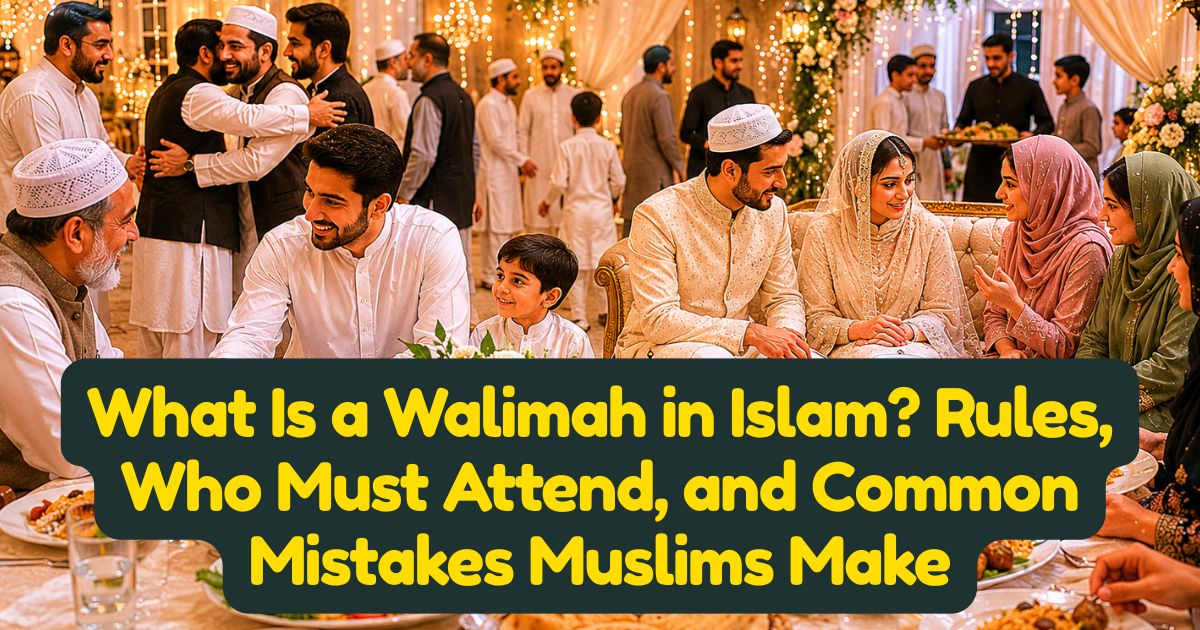
What Is a Walimah in Islam? Rules, Who Must Attend, and Common Mistakes Muslims Make
Of all the acts associated with Islamic marriage, the walimah sits in a peculiar place in Muslim consciousness. Most Muslims have attended one. Many have hosted one. But surprisingly few could tell you with confidence exactly what Islamic law says it requires, when it must happen, who is obligated to be there, and what turns a walimah from a blessed Sunnah act into something that falls short — or worse, into something the Prophet ﷺ himself would have declined to attend.
The walimah is not simply a party that happens to follow a Nikah. It is a specific religious act — one the Prophet ﷺ commanded, personally modelled, and described in terms that give it a significance far beyond its surface appearance as a celebratory meal. Understanding it properly is both an act of knowledge and an act of worship.
The Definition of Walimah and Its Unique Place in Islamic Law
Walimah — sometimes written as waleemah — comes from the Arabic root walama, meaning to gather or to assemble. In Islamic jurisprudence, the term refers specifically and exclusively to the feast or gathering held to celebrate and publicly announce a marriage. It is distinct from any other feast or celebration in Islamic tradition because of its direct connection to the Nikah — it is the public expression of a marriage that has taken place, and its conduct is tied to a specific set of scholarly rulings.
The Prophet ﷺ is reported in an authentic narration in Sahih al-Bukhari to have told Abd al-Rahman ibn Awf, upon learning of his marriage: "Give a walimah, even if only with one sheep." This narration does two things simultaneously: it establishes the walimah as a directed Sunnah act — something the Prophet ﷺ instructed his companions to perform — and it establishes that its validity does not depend on scale or extravagance. One sheep. A modest, sincere gathering. That is sufficient.
Is the Walimah Obligatory or Strongly Recommended?
This is a question on which classical scholars genuinely differed, and the difference matters practically:
The Position of the Majority — Strongly Recommended Sunnah
The Hanafi, Maliki, and Shafi'i schools hold that the walimah is a confirmed Sunnah — sunnah mu'akkadah — meaning it is strongly recommended to the degree that leaving it without reason is blameworthy, but it does not rise to the level of wajib (obligatory). A Muslim who does not conduct a walimah has left a significant Sunnah without justification, which carries its own spiritual weight, but has not committed a sin in the technical legal sense.
The Hanbali Position — Obligatory
The Hanbali school, and a number of individual scholars from other traditions, hold that the walimah is wajib — obligatory — based on the directness of the prophetic command. The narration "give a walimah" is, in their reading, a command in the imperative form, and commands in Islamic legal methodology carry an obligation unless specific evidence indicates otherwise. Under this view, deliberately omitting the walimah without excuse is sinful.
Regardless of which position a Muslim follows, the practical conclusion is the same: the walimah should be conducted. The scholarly disagreement is about the precise legal category, not about whether it should be done. Every school of thought treats conducting the walimah as the correct, praiseworthy, and Islamically sound action.
When Must the Walimah Be Held? The Question of Timing
This is one of the most practically misunderstood aspects of the walimah. In Muslim communities across South Asia, the Middle East, and the diaspora, wedding celebrations routinely happen weeks or months after the Nikah — sometimes because the civil wedding or reception has been planned independently, sometimes for logistical reasons, and sometimes simply out of cultural habit.
Islamic scholars addressed the timing of walimah explicitly:
- The earliest recommended time is on the day of the Nikah itself or the day after — the period immediately following the consummation of the marriage. This is based on the prophetic practice, as several narrations record the Prophet ﷺ hosting or ordering walimah celebrations in the immediate aftermath of marriage.
- The acceptable window according to the majority of scholars extends to three days after the marriage. Ibn Qudama in Al-Mughni and Imam al-Nawawi in Al-Majmu both discuss this three-day window as the outer limit of what is considered timely for a walimah.
- Beyond three days — a celebration held significantly after the marriage still carries blessing and is a good act, but most scholars do not consider it to fulfil the Sunnah of walimah specifically. It becomes a general feast of celebration rather than a walimah in the technical Islamic sense.
This has important implications for Muslims who conduct their Nikah through an online service or in a private ceremony, intending to hold a larger celebration later. The Sunnah of walimah is ideally fulfilled close to the Nikah — even if that walimah is a modest meal with a small number of people — rather than deferred to a large event months down the line.
Who Must Be Invited to the Walimah?
The Prophet ﷺ gave specific guidance on the guest list of the walimah — and it runs directly counter to the instincts of many Muslim families when planning celebrations.
In an authentic narration recorded in Sahih Muslim, the Prophet ﷺ said: "The worst food is the food of a walimah to which the rich are invited and the poor are left out." This statement is not a peripheral etiquette note. It is a direct prophetic warning about one of the most common failures in how Muslims conduct walimah celebrations — turning what should be a communal, inclusive announcement of marriage into an exclusive social display for the wealthy and influential.
Islamic guidelines on walimah guests include:
- The poor and needy should be included — this is not optional goodwill. It is a prophetically emphasised feature of the walimah that distinguishes it from a purely social gathering. Including people of lesser means in the celebration is part of what gives the walimah its Islamic character.
- Family, close friends, and community members should be invited in a spirit of genuine community announcement — the walimah is, among other things, a public declaration that the marriage has taken place, and its guest list should reflect that communal purpose.
- Those invited are obligated to attend — this is the other side of the walimah equation that is equally important and equally misunderstood.
The Obligation to Attend a Walimah Invitation
The Prophet ﷺ stated in an authentic narration in Sahih al-Bukhari and Sahih Muslim: "Whoever is invited to a walimah and does not attend has disobeyed Allah and His Messenger." This is one of the strongest prophetic statements about any social obligation in Islamic practice. Declining a walimah invitation without a valid excuse is treated by scholars as a serious matter — not a minor social discourtesy.
The scholars who discussed this narration established several important qualifications:
- The obligation is strongest for the first day of the walimah if it extends across multiple days. Attendance on the second day is recommended but carries less weight. Attendance on the third day, according to some scholars, carries no obligation.
- Valid excuses that permit declining include: illness, significant hardship in travelling to the venue, a prior commitment that cannot be moved, or — critically — the presence of prohibited elements at the walimah itself.
- If the walimah contains prohibitions — music, alcohol, gender mixing without separation, or other clear violations of Islamic law — a Muslim is not only permitted but in many scholarly opinions obligated to decline the invitation or leave if already present. The obligation to attend does not extend to attending an event that requires witnessing or participating in sin.
What Makes a Walimah Valid According to the Sunnah?
Beyond timing and guest list, the walimah has several features that distinguish it as a Sunnah-compliant act:
Food Must Be Provided
The walimah is, at its core, a feast — a meal provided by the host to the guests. The Prophet ﷺ specified "even if only with one sheep" — establishing that the minimum threshold is real food genuinely provided to guests, not merely a gathering where people bring their own food or where only sweets and drinks are served. The food does not need to be elaborate. It needs to be present and genuinely shared.
Scale Should Match Ability, Not Social Expectation
One of the clearest prophetic principles around the walimah is that it should reflect the host's genuine means — not social pressure, family expectation, or competitive display. A simple meal shared with neighbours and family members fulfils the Sunnah completely. A lavish banquet funded through debt to impress guests does not fulfil the Sunnah better — and may actually contradict it if it involves financial recklessness or showing off (riya).
The Gathering Should Be Gender-Appropriate
While scholars differ on the specific arrangements, the general principle is that a walimah should be conducted in a manner consistent with Islamic guidelines on gender interaction — separate spaces for men and women, or at minimum, arrangements that prevent the kind of free mixing that Islamic modesty guidelines prohibit. A walimah that involves unrestricted gender mixing, immodest dress, or environments that normalise prohibited social behaviour loses its character as a Sunnah act.
Music and Prohibited Entertainment
The question of music at wedding celebrations is one of the most debated topics in Islamic jurisprudence, and it is not the purpose of this guide to adjudicate that debate comprehensively. What is clear across the scholarly spectrum is that entertainment involving obscene content, the glorification of prohibited acts, or instruments whose prohibition is near-universally agreed upon has no place at a walimah. The event is a religious celebration — its atmosphere should reflect that.
The Walimah After an Online Nikah or Private Ceremony
For couples who have conducted their Nikah through an online service, a private ceremony, or a Nikah without an immediate large gathering, the walimah question is particularly relevant. The good news — from the Sunnah itself — is that the walimah does not need to be large, elaborate, or expensive to be valid.
A couple who has conducted their Nikah online and wishes to fulfil the Sunnah of walimah can do so through a simple shared meal with family members, close friends, or community members — held within the three-day window after the Nikah if possible. The announcement purpose of the walimah is also served: it publicly confirms that the marriage has taken place, which is particularly valuable for couples whose Nikah was conducted privately.
For Muslims using InstantNikah.com to conduct their online Nikah, we always encourage couples to fulfil the Sunnah of walimah in whatever form their circumstances allow. The Nikah itself is the essential religious act — and the walimah is its blessed public expression.
Learn more about our Nikah process, explore our available packages, or reach us through our contact page. These related guides may also be helpful:
- What Is Mahr in Nikah?
- Does Nikah Need to Be Announced Publicly in Islam?
- Same Day Online Nikah
- What Is Khitbah? Islamic Engagement Rules and Limits
The Most Common Mistakes Muslims Make With the Walimah
Drawing together the rulings above, the following are the most frequent errors Muslim families make when planning and conducting a walimah:
- Holding it weeks or months after the Nikah — and calling a delayed reception a walimah when it technically no longer fulfils the Sunnah of walimah in the scholarly sense.
- Inviting only wealthy relatives and social contacts — directly contradicting the prophetic warning about excluding the poor.
- Going into debt to fund an elaborate event — mistaking social display for religious fulfilment, when the Prophet ﷺ explicitly said one sheep is sufficient.
- Including prohibited entertainment — and then expecting the event to carry the blessing of a Sunnah act.
- Declining walimah invitations without valid excuse — underestimating the seriousness of the prophetic statement on this obligation.
- Skipping the walimah entirely for couples who married privately — assuming that because the Nikah was small or online, no walimah is needed. The walimah's announcement function is, if anything, more valuable in these circumstances.
- Treating the wedding reception as the walimah when the reception contains elements that disqualify it from being a Sunnah-compliant walimah — and therefore going without a genuine walimah entirely.
Conclusion: Simple, Sincere, and Soon
The Prophet ﷺ modelled the walimah as an act of gratitude, community, and public acknowledgement. He hosted walimah celebrations for his own marriages and instructed his companions to do the same — specifying not grandeur but sincerity, not exclusivity but inclusion, and not delay but timeliness.
The best walimah is not the most expensive one. It is not the one with the most guests or the most elaborate food. It is the one held promptly after the Nikah, shared generously with family and community including those of lesser means, conducted with an atmosphere appropriate to its religious character, and offered with the sincere intention of fulfilling a Sunnah that the Prophet ﷺ himself took seriously enough to command.
Simple. Sincere. And soon after the Nikah. That is the walimah as Islam intended it.
Admin User
Author