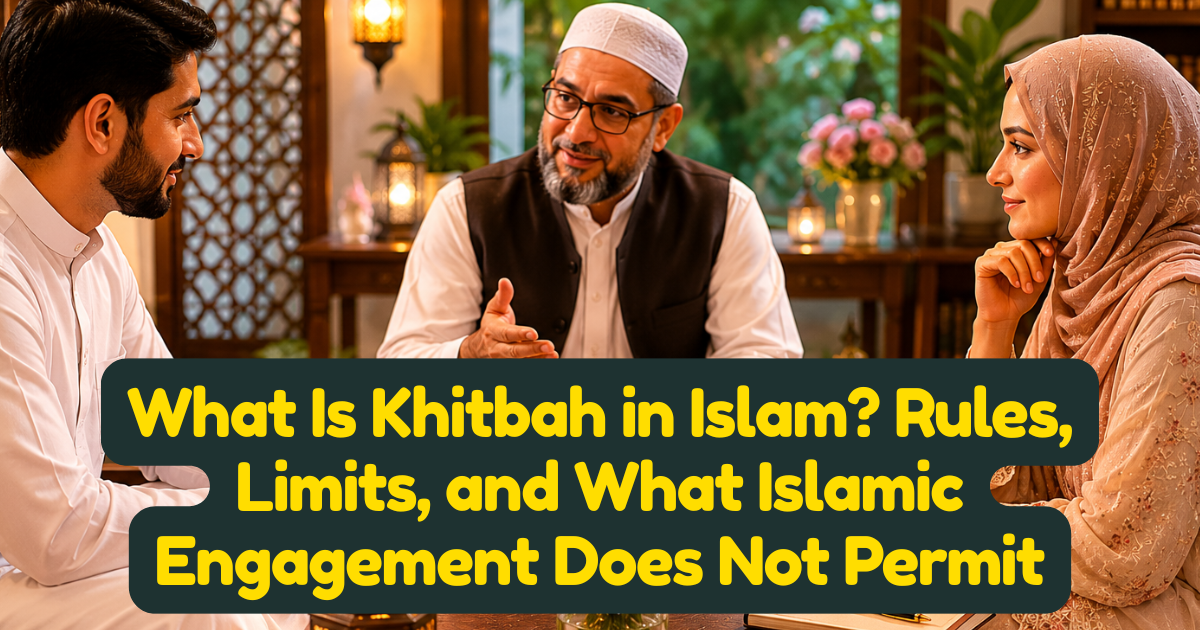
What Is Khitbah in Islam? Rules, Limits, and What Islamic Engagement Does Not Permit
Across Muslim families worldwide, the engagement celebration is often treated as a significant milestone — rings are exchanged, families gather, photographs are taken, and the couple is congratulated as though the marriage itself has already happened. The engaged couple may begin spending time together, messaging freely, meeting without a mahram present, or making major life decisions as though their status has fundamentally changed.
In Islamic law, it has not. Not even slightly.
Khitbah — the Islamic engagement or proposal period — is one of the most widely misunderstood concepts in Muslim family life. It is culturally loaded with significance that Shariah simply does not assign to it. Understanding what khitbah actually is, what it permits, what it strictly does not permit, and what legal status it carries under Islamic law is essential knowledge for any Muslim considering marriage — and for any family guiding a child through that process.
The Meaning of Khitbah and Its Place in Islamic Marriage
Khitbah comes from the Arabic root kha-ta-ba, meaning to propose, to seek, or to address. In Islamic jurisprudence, khitbah refers to the formal expression of a man's intention to marry a specific woman — a proposal made either directly to the woman herself or through her wali (guardian), which she or her guardian may accept or decline.
The period between a proposal being made and accepted, and the Nikah being conducted, is what is commonly understood as the engagement period. Islamic law recognises this as a preparatory phase — a time for both parties to make a considered decision, for families to meet and assess compatibility, and for practical arrangements around the Nikah to be made.
What khitbah is not — and this cannot be stated clearly enough — is a preliminary marriage. It is not a lesser form of Nikah. It does not make the man and woman halal to each other in any way. It does not permit physical contact, private meetings, unrestricted communication, or any of the other interactions that are only permitted between a husband and wife after a valid Nikah has been conducted.
Quranic and Prophetic Foundation of Khitbah
The Quran acknowledges the concept of khitbah directly. In Surah Al-Baqarah (2:235), Allah addresses the situation of men proposing to women who are in their iddah period: "There is no sin upon you for that to which you allude concerning a proposal to women or what you conceal within yourselves. Allah knows that you will have them in mind. But do not promise them secretly except for saying a proper saying."
This verse is remarkable in several ways. It confirms that indirect expressions of interest during a woman's iddah are permissible — but that formalising the proposal must wait. It distinguishes between internal feelings, indirect allusion, and a binding proposal. And it establishes that even at the stage of proposal, certain limits apply — "a proper saying" implies propriety, not familiarity or intimacy.
The Prophet ﷺ also addressed khitbah directly. In an authentic narration in Sahih al-Bukhari and Sahih Muslim, he stated: "A man should not propose over the proposal of his brother." This narration establishes that once a woman has accepted a proposal, it is prohibited for another man to approach her with a competing proposal — a ruling that reflects both the sanctity of the woman's decision and the social order that Islam wishes to preserve around the marriage process.
In another narration, the Prophet ﷺ permitted a man to look at the woman he intends to propose to — in a modest and purposeful way — before making the proposal. This was specifically to allow the man to make an informed decision. It does not open a door to extended courtship, private meetings, or physical interaction of any kind.
What Is Permitted During the Khitbah Period
Islamic scholars are clear that the khitbah period, while it carries social and emotional significance, is governed by the same rules that govern interactions between any non-mahram man and woman. The engagement ring, the family celebration, and the social acknowledgement of the proposal do not change the Shariah status of the relationship.
The following are permitted during khitbah under Islamic guidelines:
- Supervised meetings between the couple — the engaged man and woman may meet in the presence of a mahram to speak, ask questions, and get to know each other in a way that helps them make an informed decision about marriage. The presence of a mahram is a requirement, not a suggestion.
- Communication through appropriate channels — scholars permit written, telephone, or electronic communication between the engaged couple, provided the content remains appropriate and does not involve the kind of intimate or romantic language that belongs only within marriage.
- A purposeful initial viewing — as established by the prophetic permission, a man may look at the woman he intends to marry before proposing. Many scholars extend this to the woman as well — she has the right to see the man before accepting his proposal.
- Discussion of practical marriage matters — the couple may discuss the mahr, living arrangements, the Nikah date, conditions they wish to include in the Nikah contract, and other practical matters related to the upcoming marriage.
- The woman's right to accept or decline — khitbah is a proposal, not a contract. The woman — and her wali — retains the complete right to accept or decline the proposal at any point before the Nikah is conducted, without any Islamic obligation arising from her acceptance of the khitbah alone.
What Is Not Permitted During the Khitbah Period
This is where the gap between cultural practice and Islamic ruling is widest — and where Muslims, particularly younger Muslims in diaspora communities, most need clarity.
- Khalwah — private seclusion — a man and woman who are not yet married and are not mahram to each other may not be alone together in private, regardless of their engagement status. The Prophet ﷺ explicitly prohibited khalwah between non-mahram men and women. Engagement does not create a mahram relationship.
- Physical contact of any kind — shaking hands, embracing, kissing — none of this is permitted between an engaged couple who have not yet conducted their Nikah. The Nikah is what makes physical contact halal; the khitbah does not.
- Unrestricted socialising as though married — going out together alone, travelling together, spending nights in shared spaces — all of this remains prohibited during khitbah, regardless of family approval or cultural normalisation.
- Intimate or romantic digital communication — while general communication is permitted, messages or calls of an intimate, sexually suggestive, or romantically inappropriate nature between an engaged couple who are not yet married remain prohibited under the general Islamic prohibition on such communication between non-mahrams.
- Treating the engagement as a binding contract — socially or financially punishing a woman for declining a proposal she had initially accepted, or treating her acceptance of khitbah as an enforceable obligation to marry, has no basis in Islamic law.
Is Khitbah Legally Binding? What Happens If the Engagement Breaks
One of the most practically important points in Islamic engagement law is this: khitbah is not a contract. It is a promise of intent. It creates no legal obligations equivalent to Nikah. It does not make the couple husband and wife in any degree. And it can be broken by either party without this being treated as a major sin — though Islamic ethics encourage that promises be honoured wherever possible and that engagements not be broken frivolously or harmfully.
Classical scholars did discuss the question of gifts exchanged during khitbah and what happens to them if the engagement breaks. The general position across the schools is that gifts given specifically in anticipation of the marriage — particularly the engagement ring — may be returned if the engagement is broken by the woman or by mutual agreement, though the rulings vary by school and circumstance. This is a matter best addressed by a qualified scholar based on the specific situation.
What Islamic law is clear about is that no financial penalty, social coercion, or family pressure arising from a broken engagement has Shariah basis. A woman who changes her mind about a proposal she accepted is exercising a right that Islamic law fully protects — and any attempt to punish her for doing so is an injustice without Islamic sanction.
When Is It Prohibited to Propose? The Rules on Competing Proposals
Islamic law places specific restrictions on when a proposal may be made, to protect both the woman being proposed to and the man who has already proposed:
- Over an accepted proposal: As established in the prophetic narration from Sahih al-Bukhari and Sahih Muslim, it is prohibited for a man to propose to a woman who has already accepted another man's proposal. This prohibition applies until the first engagement is clearly broken or declined.
- During iddah — with restrictions: A man may make an indirect expression of interest to a woman in her iddah — as established in Surah Al-Baqarah 2:235 — but a direct, explicit proposal must wait until her iddah is complete. This is particularly relevant when proposing to a divorced or widowed woman.
- To a woman who has not yet been consulted: A proposal made to a family without the woman's knowledge or involvement — and accepted by the family without her input — carries all the consent problems discussed in Islamic law around forced and arranged marriages. A valid khitbah, like a valid Nikah, requires the woman's genuine informed participation.
Khitbah in the Context of Online Nikah and Modern Muslim Life
For Muslims navigating marriage in the modern world — including those considering online Nikah services, international marriages, or Nikahs conducted across distances — the khitbah period often takes on a different practical shape. Video calls replace supervised in-person meetings. Messaging apps replace letters. The family gathering that once formalised the proposal may now be a video conference across three time zones.
The medium changes. The Shariah rules do not.
Whether a couple is getting to know each other through supervised video calls or in-person family meetings, the same principles apply: the presence of a mahram or responsible third party during personal interaction, the maintenance of appropriate boundaries in digital communication, and the understanding that no amount of emotional investment during khitbah changes the Shariah status of the relationship until the Nikah is conducted.
The most responsible and Islamically sound approach for couples in the khitbah phase is to move toward Nikah with genuine intention and reasonable speed — not to extend the engagement period indefinitely while enjoying the social status of being "engaged" without the commitment and responsibility of marriage.
The Wisdom Behind Khitbah's Limits
At first glance, the restrictions on khitbah can seem strict — particularly to Muslims raised in cultural environments where engagement is treated as a social licence for the couple to spend time together freely. But the Islamic framework reflects a deep wisdom.
The engagement period is emotionally charged. Feelings are strong, hope is high, and the couple's judgment may be less than fully objective. If the rules of modesty and appropriate boundaries are abandoned during khitbah — on the basis that "we are going to get married anyway" — the couple becomes emotionally and sometimes physically entangled in ways that make it much harder to make a clear-headed decision about whether this marriage is actually right.
Islam's insistence that the boundaries of non-mahram interaction are maintained during khitbah is not a restriction on love. It is a protection of the decision-making clarity that both parties deserve before committing their lives to each other.
Moving From Khitbah to Nikah: The Right Time and How to Proceed
Islamic scholars consistently advise that the period between khitbah and Nikah should not be unnecessarily prolonged. Extended engagements — particularly where the couple is spending significant time together under the social cover of being engaged — carry real spiritual and practical risks that Islam's guidelines on khitbah are specifically designed to prevent.
Once both parties have made their decision with confidence, the Nikah should be conducted without undue delay. It does not need to wait for a grand wedding celebration. The Nikah itself is the essential religious act. The celebration, the reception, the photographs — these are cultural additions that can follow at whatever pace the family can manage.
For couples ready to move from khitbah to Nikah — including those managing international distances, family complications, or the need for a discreet and properly conducted ceremony — InstantNikah.com provides a fully Shariah-compliant online Nikah service facilitated by qualified scholars.
Learn about our Nikah process, explore our available packages, or speak with us through our contact page. You may also find these related guides useful:
- Questions Muslims Should Ask Before Nikah
- What Is Mahr in Nikah?
- What Conditions Can Be Included in a Nikah Contract?
- Islamic Ruling on Attraction and Feelings Before Marriage
Conclusion: Khitbah Is a Beginning, Not a Status
Khitbah marks the beginning of a journey toward marriage — not a destination in itself. It is a period of intention, deliberation, and preparation. It carries social meaning and emotional weight. But under Islamic law, it carries no marital rights, no halal status between the couple, and no binding obligation that overrides either party's freedom to reconsider.
Understanding this clearly — and conducting the khitbah period accordingly — is not a hardship. It is the foundation of a marriage that begins with integrity, clarity, and the genuine blessing that comes from following the guidance that Allah and His Prophet ﷺ have given us.
When the decision is made and the heart is settled — do not delay the Nikah. That is where the real journey begins.
Admin User
Author