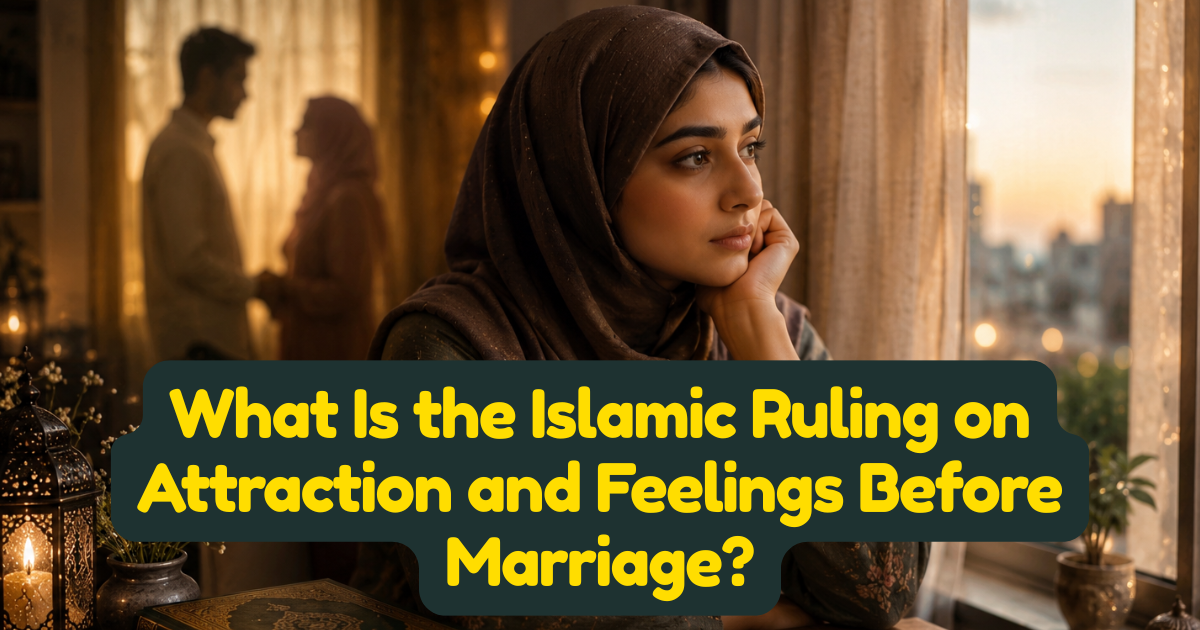
What Is the Islamic Ruling on Attraction and Feelings Before Marriage? A Honest Guide for Muslims
It is perhaps the most human of all experiences — and one of the least openly discussed within Muslim communities. A young Muslim man notices a woman at university and finds himself thinking about her constantly. A Muslim woman realises that a colleague she sees every day has become someone she looks forward to seeing. Two Muslims on the same hajj trip find themselves unexpectedly drawn to each other. A convert to Islam develops feelings for a longtime friend who is not Muslim.
In each of these situations, the person experiencing the feelings knows what they feel. What they often do not know — because no one has told them clearly, honestly, and without judgment — is what Islam actually says about those feelings. Not what to do about the relationship, but what to think about the feelings themselves. Are they sinful? Are they shameful? Should they be suppressed entirely? And if they are not suppressed, how should they be handled — in a way that honours the person's faith and the person the feelings are directed toward?
This guide answers these questions directly, completely, and with the genuine care that a question this personal deserves. It does not offer the shallow reassurance that feelings are fine as long as you do not act on them. It offers the actual Islamic framework — rooted in Qur'an, authentic Sunnah, and the careful reasoning of classical and contemporary scholars — for understanding attraction and feelings before marriage in all their complexity.
The Starting Point: What Islam Says About Human Nature and Attraction
The first and most important thing to establish is this: Islam does not regard attraction between men and women as inherently sinful. It does not regard feelings of romantic interest as evidence of moral failure. It does not require Muslims to be emotionally dead to the existence of other people before marriage.
On the contrary — the Qur'an itself acknowledges, describes, and works with the reality of human attraction in ways that are both honest and sophisticated. In Surah Yusuf (12), the Qur'an narrates the story of the Prophet Yusuf, peace be upon him, and the wife of Al-Aziz — a story that includes one of the most frank acknowledgements of human attraction in any sacred text. The Qur'an does not treat the wife of Al-Aziz's attraction to Yusuf as unmentionable. It narrates it, analyses it, and uses it to teach about the nature of desire, the importance of self-restraint, and the relationship between human emotion and divine protection.
The Qur'anic description of marriage itself — in Surah Ar-Rum (30:21) — speaks of love (mawaddah) and mercy (rahmah) as goods that Allah places between spouses. These are emotional realities, not merely contractual ones. The Islamic framework for marriage is not one in which emotional life is irrelevant or suppressed. It is one in which emotional life — including attraction and love — is honoured, protected, and channelled toward the nikah as the framework within which it can flourish legitimately and completely.
The Prophet Muhammad, peace be upon him, is authentically reported to have said: "We do not think that there is anything better for those who love one another than marriage." This hadith — narrated by Ibn Majah and graded as sound by scholars of hadith — establishes that when attraction and love exist between two people, the Islamic response is not suppression but marriage. The feeling is not the problem. The pathway matters.
What Islam Distinguishes: Feeling vs Acting
Islamic ethics makes a distinction that is foundational to understanding the ruling on attraction before marriage — a distinction between what a person feels and what a person does with what they feel. This distinction is not unique to Islam. It is a feature of any coherent ethical system that takes seriously both the involuntary nature of certain human experiences and the voluntary nature of the choices made in response to them.
Attraction itself — the initial noticing of someone, the involuntary awareness of their presence, the feeling that draws one person toward another — is not a matter of choice and is therefore not a matter of sin or virtue in Islamic ethics. It is a feature of human nature that Allah created and that the Qur'an acknowledges without condemnation. The person who feels attracted to someone has not sinned by feeling.
What becomes a matter of choice — and therefore a matter of Islamic ethics — is what the person does in response to that attraction. The gaze they choose to maintain or lower. The conversation they choose to pursue or decline. The thoughts they choose to dwell on or redirect. The action they choose to take — whether to pursue the relationship through permissible channels or through impermissible ones, whether to act on the attraction in ways that honour the other person or in ways that harm them.
This distinction is the foundation of the Islamic ruling on attraction before marriage. The feeling is human. The response to the feeling is where Islamic ethics engages.
The Three Stages Where Islamic Guidance Becomes Relevant
Understanding when and how Islamic guidance applies to attraction before marriage requires identifying the specific stages at which choice — and therefore ethics — enters the picture.
Stage One: The Initial Attraction
The first stage — the initial experience of attraction — is, as established above, not itself a matter of Islamic concern. A Muslim who notices that they are attracted to someone has not sinned. The prophetic instruction to lower the gaze is a guidance for what to do at this stage — not to suppress the feeling, but to avoid actively cultivating it through sustained, deliberate looking that goes beyond the initial involuntary awareness.
The instruction in Surah An-Nur (24:30-31) to lower the gaze — for both men and women — is best understood not as a prohibition on awareness but as a guidance on what not to feed. Sustained, deliberate attention to another person's physical appearance is an active choice that takes an involuntary initial awareness and transforms it into a cultivated fixation. The Islamic instruction is to decline to make that active choice — to redirect the attention rather than feeding the attraction through deliberate, sustained focus.
Stage Two: The Sustained Feeling
The second stage is where the initial attraction, whatever its origin, has become a sustained feeling — a consistent awareness of, interest in, and emotional connection to another person. This stage is also, in itself, not sinful in Islamic ethics. Feelings of this kind can arise and persist without the person having chosen them or having acted on them in any impermissible way.
What Islamic guidance addresses at this stage is the internal management of the feeling — specifically, the question of what a person does with it privately. The classical Islamic concept of khawatir — the thoughts and impulses that pass through the heart and mind — distinguishes between what arises involuntarily and what is actively cultivated and dwelt upon. Involuntary thoughts are not sins. Deliberately cultivating and feeding thoughts — returning to them repeatedly, imagining scenarios, building an internal romantic world around another person — moves into territory that Islamic ethics identifies as problematic for the well-being of the person engaging in it, regardless of whether any external action follows.
The Islamic guidance at this stage is not suppression but redirection: acknowledge the feeling honestly, bring it before Allah in du'a and istikhara, and channel it toward legitimate action — either moving toward the possibility of marriage or, where that is not possible, gently redirecting the emotional energy through the spiritual and practical mechanisms Islam provides.
Stage Three: The Decision About What to Do
The third stage is the one with the most direct ethical significance — the decision about what to do with the feeling. This is where the full range of Islamic guidance applies, and where the distinction between permissible and impermissible pathways becomes consequential.
Islamic ethics provides a clear and positive pathway for acting on attraction before marriage: express the interest in marriage — through oneself, through family, or through a trusted intermediary — and pursue the relationship through the proper channels of Islamic marriage consideration. This pathway honours both parties, involves the appropriate people, and moves toward the nikah as the framework within which the attraction can be fully and legitimately expressed.
What Islamic ethics identifies as problematic is the alternative pathway — pursuing the attraction through a private romantic relationship, through sustained intimate digital communication, through physical proximity and emotional entanglement that deepens outside the nikah's framework. Not because the feeling is wrong, but because this pathway removes the protections the Islamic framework provides, introduces the harms that Islamic ethics identifies with pre-nikah intimacy, and substitutes an informal emotional arrangement for the formal, rights-establishing contract of marriage.
What to Do When You Have Feelings for Someone
For a Muslim who has developed genuine feelings for someone and wants to handle them within the Islamic framework, the following practical guidance reflects the scholarly consensus on how attraction before marriage should be managed.
Make Du'a and Perform Istikhara
The first Islamic response to feelings of attraction is du'a — supplication to Allah — and istikhara — the prayer of seeking guidance from Allah about a matter of uncertainty. The salat al-istikhara, established in the authentic Sunnah and narrated in Sahih al-Bukhari, is specifically designed for situations where a person wishes to pursue something but is uncertain whether it is good for them. Feelings of attraction are precisely the context for which this guidance was given — a person who feels drawn toward another and who seeks Allah's guidance on whether to pursue it is using exactly the mechanism the Prophet, peace be upon him, established for exactly this situation.
Making du'a about one's feelings — asking Allah for clarity, for protection from harm, for facilitation if the path is good and for its removal if it is not — is not merely a ritual step. It is the genuine integration of the emotional experience into one's relationship with Allah, which is precisely what Islamic spirituality calls every believer toward in every dimension of their lives.
Express Interest Through Proper Channels
If, after reflection and istikhara, the person wishes to pursue the relationship, the Islamic path is to express that interest through proper channels — not through a private romantic approach that bypasses the appropriate people, but through a direct and honest communication about marriage intention.
This can take several forms depending on the specific circumstances. A man who has feelings for a woman may approach her family — or ask a trusted mutual contact to communicate the interest to her family — with the explicit intention of marriage. A woman who has feelings for a man may ask a family member or trusted person to make discreet enquiries about whether the man would be open to the possibility of marriage. In some contemporary Muslim community contexts, a direct conversation between the two individuals — expressing interest in marriage consideration, not in a romantic relationship — may be appropriate as an initial step before family involvement is formalised.
What distinguishes these approaches from impermissible ones is their honesty, their purpose, and their direction. The communication is about marriage — not about sustaining a private romantic connection. It involves the appropriate people. It moves toward the nikah rather than substituting for it.
Guard Against Emotional Escalation Before the Nikah
One of the most practically important pieces of Islamic guidance for Muslims with feelings for someone is the importance of guarding against emotional escalation before the nikah is contracted. This is not about suppressing feeling but about recognising the specific risks of deep emotional investment in a relationship whose future is uncertain.
A Muslim who allows a pre-nikah attraction to develop into a deeply entangled emotional relationship — through sustained private communication, through the sharing of intimate thoughts and vulnerabilities, through the progressive emotional dependence that characterises deep romantic involvement — has made themselves significantly more vulnerable if the relationship does not proceed to marriage. The emotional harm of a dissolved pre-nikah attachment that has been allowed to deepen without the nikah's framework is a very real human cost that Islamic guidance is specifically designed to prevent.
The Islamic instruction to keep pre-marriage interaction purposeful, bounded, and directed toward the nikah is not a restriction of emotional life. It is a protection of the very capacity for deep emotional connection — preserving it for the framework within which it can develop fully and safely.
What to Do When the Feelings Cannot Be Acted Upon
Not every attraction can or should be pursued. A Muslim may develop feelings for someone who is already married, for someone of a different faith where an Islamic marriage is not possible, for someone whose family circumstances make a proposal inappropriate, or for someone who, after proper consideration, has declined the interest. What does Islam say about managing feelings that cannot be legitimately acted upon?
The Islamic Concept of Sabr in Emotional Life
Sabr — patience and perseverance — is one of the most central virtues in Islamic ethics, and it applies directly to the experience of attraction that cannot be pursued. The Qur'an speaks of sabr not as the suppression of feeling but as the endurance of difficulty with reliance on Allah — the recognition that what one desires is not always what is best, and that accepting this with trust in Allah's wisdom is itself an act of worship.
The classical Islamic scholars who addressed the experience of unrequited or impermissible attraction — including Ibn al-Qayyim, whose writings on love and the heart remain among the most sophisticated Islamic engagements with emotional life — consistently distinguished between what the heart feels involuntarily and what the person chooses to do with those feelings. Ibn al-Qayyim's analysis in his work Rawdhat al-Muhibbin — the Garden of Lovers — acknowledges the reality and intensity of human love while providing a spiritual framework for its management that is sophisticated, compassionate, and entirely within the Islamic tradition.
Practical Steps for Managing Feelings That Cannot Be Pursued
For a Muslim managing feelings for someone they cannot or should not pursue, the following practical steps reflect the classical Islamic guidance on emotional management in this situation:
- Reduce contact where possible — not out of hostility but out of self-protection. The heart that has less to feed on has an easier time redirecting. Where reducing contact is not possible — a colleague, a classmate — establishing clear behavioural boundaries that prevent the relationship from deepening beyond its professional or social level
- Redirect the energy toward worship and spiritual development — the classical scholars consistently advised increased prayer, Qur'an recitation, and dhikr as the most effective spiritual tools for managing emotional pain and redirecting emotional energy toward Allah
- Seek out the nikah actively — where the feelings cannot be pursued, directing the marriage intention toward other possibilities — through family, through community, through halal matrimonial services — channels the desire for companionship toward its legitimate expression rather than leaving it directed at an unavailable person
- Seek support from a trusted person — a parent, a scholar, a trusted friend with good Islamic understanding — who can provide both practical guidance and emotional support without feeding the attachment through detailed discussion of its object
The Specific Challenge of Feelings for a Non-Muslim
A significant number of Muslims experience attraction to non-Muslims — a reality that is particularly common in diaspora communities where daily life, education, and work involve sustained interaction with people of all faith backgrounds. This situation requires specific and honest guidance because the emotional experience is real and the Islamic framework is clear.
For a Muslim woman who has developed feelings for a non-Muslim man, the Islamic ruling is unambiguous across all four madhabs: marriage between a Muslim woman and a non-Muslim man is not valid in Islamic law. The feelings are understandable. The marriage is not permissible. This is a situation where the Islamic framework asks the woman to accept a limitation that is genuinely difficult — and where the guidance of sabr, of du'a, and of actively redirecting the marriage intention toward permissible possibilities is the honest and complete Islamic response.
For a Muslim man who has developed feelings for a non-Muslim woman, the situation is more nuanced. Marriage to a woman from the People of the Book — a Christian or Jewish woman — is conditionally permitted in Islamic law. The feelings may therefore be legitimately actable upon through the proper channels — though with careful scholarly guidance about the specific conditions, responsibilities, and implications involved.
In both situations, the question of whether the non-Muslim partner might genuinely convert to Islam is one that requires great delicacy. A conversion genuinely motivated by sincere acceptance of Islam is something entirely different from a conversion motivated by the desire to be with a specific person. The Islamic validity of a shahada — and the Islamic validity of the marriage that follows it — depends on the sincerity of the conversion, not merely the fact of it. Honest self-examination about this distinction, and honest communication with the non-Muslim partner about it, is both Islamically necessary and humanly fair.
What Major Global Scholarly Institutions Have Confirmed
Dar al-Ifta al-Misriyyah — Egypt's official government fatwa authority — has addressed the question of pre-marriage feelings and attraction with a consistency that reflects the classical Islamic framework: the involuntary experience of attraction is not sinful, the management of that attraction through proper channels is the Islamic guidance, and the nikah is the framework within which attraction and love legitimately flourish. Dar al-Ifta has specifically addressed the situation of Muslims who have developed feelings for someone and wish to know whether the feelings themselves are problematic — consistently affirming that they are not, while providing guidance on the proper channels for acting on them.
Al-Azhar University has engaged with the question of human emotion and attraction within the Islamic framework through its broader engagement with Islamic spirituality and ethics. Al-Azhar scholars have consistently affirmed that human love and attraction are Allah-created realities that the Islamic framework accommodates rather than suppresses — and that the nikah is the institution through which these realities find their fullest and most protected expression. Al-Azhar has specifically noted that the Prophet's hadith about marriage being the best remedy for those who love one another reflects Islam's positive, rather than merely restrictive, engagement with human emotional life.
In the United Kingdom, the Muslim Council of Britain (MCB) has addressed the emotional and relational challenges facing British Muslim youth — including the experience of attraction in a cultural context where the Islamic framework for managing it is neither well-understood nor easily applied. The MCB has specifically called on British Muslim communities and families to create accessible, dignified, and genuinely supportive pathways toward marriage — so that the Islamic alternative to the surrounding dating culture is a genuinely available and attractive option rather than an impossibly demanding theoretical standard.
In North America, the Islamic Society of North America (ISNA) has published guidance specifically addressing the emotional dimensions of pre-marriage relationships for American and Canadian Muslim youth. ISNA scholars have consistently affirmed that attraction and feelings are part of human nature — not evidence of moral failure — and that the Islamic framework provides a coherent, humane, and practically workable pathway for managing them. ISNA has been particularly effective in addressing the distinction between the feeling and the response, providing young American Muslims with the precise guidance this distinction requires.
The Islamic Fiqh Academy of the Organisation of Islamic Cooperation (OIC) has addressed the challenges facing Muslim minorities in non-Muslim majority countries in managing their relational and emotional lives within the Islamic framework — affirming the importance of Islamic communities providing the supportive structures that make adherence to the Islamic framework practically achievable rather than merely theoretically required.
In Germany, the Zentralrat der Muslime in Deutschland has engaged with the specific challenges facing German Muslim youth — navigating attraction and pre-marriage emotional life within one of Europe's most secular social contexts. Their guidance consistently affirms the Islamic framework while acknowledging the genuine difficulty of the environment and calling on German Muslim communities to provide the positive structures — accessible marriage facilitation, community support, and family involvement — that enable young Muslims to pursue their emotional lives within Islam's framework.
In France, the Conseil Français du Culte Musulman (CFCM) has similarly engaged with the emotional and relational challenges facing French Muslim youth in a highly secular cultural context — affirming the Islamic framework's positive engagement with human emotional life and the importance of accessible Islamic marriage pathways as the community-level response to the surrounding cultural norms.
In Europe more broadly, the Council of Europe's research on Muslim communities has documented the specific challenges Muslim minority communities face in maintaining distinctive religious frameworks for personal relationships within European cultural contexts — providing high-authority European institutional context for the pressures this article's primary audience navigates daily.
The Spiritual Dimension: When Attraction Becomes a Path to Allah
Islamic spirituality offers a dimension of this question that purely jurisprudential discussions often miss — the understanding that the human capacity for attraction, love, and deep emotional connection is itself a sign of Allah's creative wisdom and generosity. In Surah Ar-Rum (30:21), Allah describes the love and mercy He places between spouses as one of His signs — an aya, a manifestation of divine reality in human experience.
The classical Islamic scholars who wrote most deeply about love — Ibn Hazm in Tawq al-Hamama (The Ring of the Dove), Ibn al-Qayyim in Rawdhat al-Muhibbin — did not treat human love as a problem to be managed. They treated it as a profound human reality that reflects something of the human capacity for depth, devotion, and transcendence — a capacity that finds its highest expression when directed first toward Allah and then, within the nikah's framework, toward a spouse.
A Muslim who experiences attraction before marriage and who brings that experience to Allah — honestly, in du'a and istikhara, with genuine trust that Allah knows what is good — is not merely complying with a rule. They are practising one of the most intimate dimensions of Islamic spirituality: the bringing of the full human experience, including its emotional complexity, into the relationship with the divine. This is not suppression of feeling. It is the integration of feeling into faith — which is precisely what Islamic ethics, at its deepest level, asks of every believer.
How InstantNikah.com Provides the Path From Feelings to Nikah
At InstantNikah.com, the distance between genuine feelings and a properly conducted Islamic marriage is smaller than most Muslims assume — and the practical barriers that prevent couples from making that journey are addressed directly and accessibly. A properly conducted, Shariah-compliant nikah is available through a verified video call, from anywhere in the world, with a qualified online qazi presiding, all Islamic conditions properly met, and a comprehensive nikah certificate issued immediately after the ceremony.
For couples who are ready to move from the stage of attraction and consideration to the nikah — who have made their istikhara, involved the appropriate people, and are ready to make the Islamic commitment — the instant nikah service and the same day nikah service provide properly structured, professionally overseen ceremonies with minimal advance notice required.
For those navigating the wali question — which is often the most complex practical element for couples approaching marriage from non-traditional starting points — the complete guidance on the wali requirement and alternatives provides the practical pathway through this dimension of the nikah preparation.
For converts who have developed feelings for someone and are navigating the nikah process without the cultural context that Muslim-born communities inherit, the complete pre-nikah checklist for Muslim converts provides the comprehensive guidance needed to approach the nikah with confidence and full Islamic preparedness.
Explore the full nikah process here, read verified reviews from couples worldwide, or book your nikah today — and take the step that transforms the feeling into the commitment.
Admin User
Author