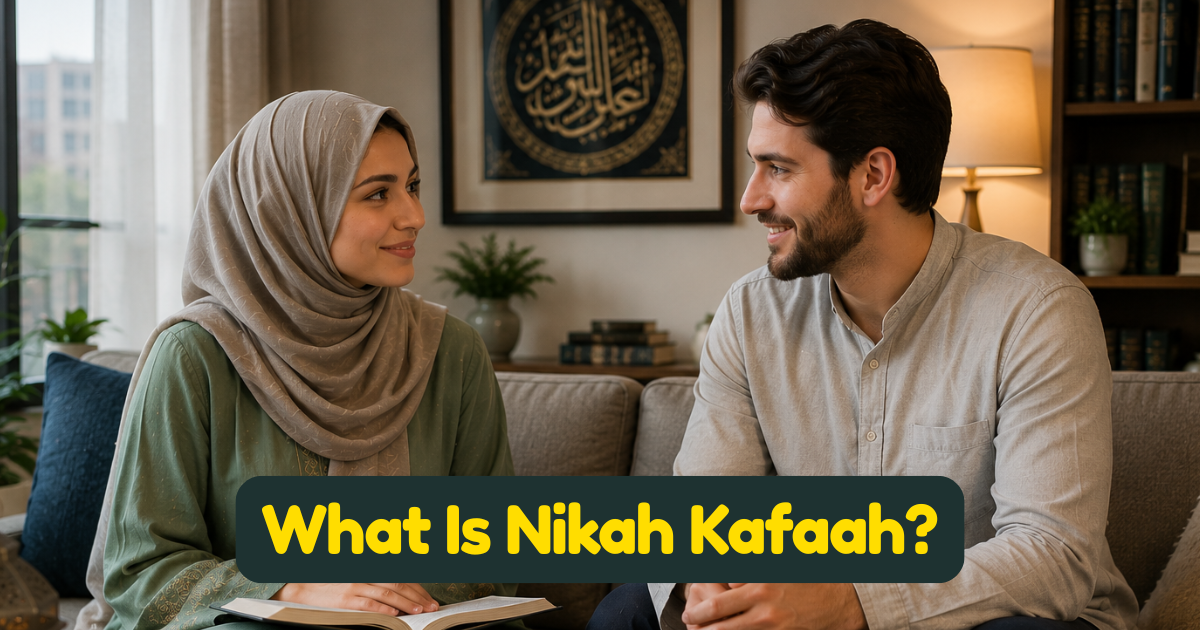
What Is Nikah Kafaah — Compatibility in Islamic Marriage and What It Actually Means
Few concepts in Islamic marriage law are invoked as frequently — or understood as poorly — as kafaah. Say the word in a matrimonial dispute and it functions almost like a key: it unlocks family vetoes, justifies parental refusals, and provides a veneer of religious authority to objections that are often rooted in something far more mundane than scholarly principle.
"He is not your kufu." "She is not from our level." "The families are not equal." These phrases are heard in drawing rooms from Karachi to Birmingham to Toronto, typically delivered by elders whose understanding of kafaah is cultural rather than classical — shaped more by caste consciousness and class anxiety than by anything the jurists of the four schools actually wrote.
The genuine Islamic concept of kafaah is more nuanced, more limited in scope, and more protective of individual marital choice than its popular usage suggests. Understanding it properly does not dissolve all questions about compatibility — it redirects them toward criteria that actually matter in an Islamic marriage, and away from the ones that do not.
The Linguistic Root and What It Signals
The Arabic word kafaah (also transliterated as kafa'a) comes from the root k-f-a, meaning equivalence, adequacy, or sufficiency. Its related form kufu — meaning an equal or a match — carries the same sense of proportionate balance rather than identical sameness.
Classical jurists used kafaah to describe a specific criterion for evaluating whether a proposed marriage was likely to be harmonious and sustainable. Critically, the concept was developed primarily as a tool to protect the wife and her wali — not to give families an unlimited right of refusal over a woman's choice of husband. This distinction, routinely lost in popular discourse, is the key to understanding why kafaah is so frequently misapplied.
What Kafaah Was Designed to Do — The Classical Purpose
The classical jurists — operating in societies where marriage was inseparable from social and tribal networks — developed the doctrine of kafaah as a safeguard against marriages that were likely to produce lasting harm: specifically, situations where a significant mismatch in social standing or religious character would expose the wife to contempt, instability, or a life that failed to meet the standard she was accustomed to.
The Hanafi, Maliki, Shafi'i, and Hanbali schools each engaged with kafaah, and their positions differ in meaningful ways — a fact often obscured when the concept is invoked as though it were a single, monolithic ruling.
The majority position is that kafaah is a right belonging to the wife and her wali — not an absolute condition of a valid nikah. A marriage contracted without kafaah is not automatically void. It is valid. The question is whether the wife or her wali can challenge it — and under what circumstances.
The Factors Classical Scholars Considered — And the Ones They Didn't
1. Religious Practice and Character (Deen)
This is the factor on which all four schools agree and which the Qur'an and Sunnah most clearly support as the primary criterion for marital compatibility. Allah says in Surah Al-Baqarah (2:221):
"And do not marry polytheistic women until they believe. And a believing slave woman is better than a polytheist, even though she might please you."
The Prophet ﷺ said: "A woman is married for four reasons: her wealth, her lineage, her beauty, and her religious commitment. Choose the one with religious commitment, may your hands be rubbed with dust [if you fail to do so]." (Sahih al-Bukhari, 5090; Sahih Muslim, 1466).
The religious character of the prospective spouse — their practice of Islam, their moral conduct, their honesty, their treatment of others — is the factor every school weighs most heavily and which the prophetic tradition most explicitly prioritises. A man of strong deen is considered a kufu for a woman of strong deen regardless of tribal origin, wealth, or profession. This is not a minority position. It is the mainstream scholarly position drawn directly from the primary sources.
2. Freedom From Servitude (Hurriyah)
Classical scholars discussed the distinction between free persons and those in conditions of bondage — a reality of the societies in which fiqh was originally developed. This criterion has no meaningful application in the contemporary world, where such conditions no longer exist in the form the jurists addressed. Scholars are in agreement that its practical scope in the modern era is negligible.
3. Lineage (Nasab)
This is the most contested and culturally loaded of the kafaah factors. The Hanafi and Hanbali schools gave weight to tribal and family lineage as a consideration — but even within these schools, the weight was qualified. The Maliki school gave lineage considerably less weight, and a number of prominent scholars across traditions argued that lineage kafaah was culturally contextual rather than universally binding.
Critically: the concept of lineage compatibility in classical fiqh was developed in the context of Arab tribal society, where specific family names carried specific social obligations and reputations. Transplanting this framework wholesale into the context of caste distinctions in South Asian Muslim communities — where the categories bear no relationship to the original tribal structures the scholars discussed — is a scholarly distortion, not a legitimate application of classical fiqh.
The Prophet ﷺ married Zaynab bint Jahsh (RA), a woman of noble Qurayshi lineage, to Zayd ibn Harithah (RA), a freed slave, before the marriage was later dissolved for unrelated reasons. The Prophet ﷺ himself arranged the nikah. Whatever conclusions scholars draw about the later dissolution, the initial arrangement by the Prophet ﷺ is itself a statement about the permissibility of a marriage across lineage lines — one the jurists cannot simply ignore.
Bilal ibn Rabah (RA) — a freed Abyssinian slave — was offered in marriage by the Prophet ﷺ to families of Arab lineage. The Prophet ﷺ described him as a man of Paradise. These prophetic precedents form part of the evidentiary landscape any honest discussion of lineage kafaah must engage with.
4. Profession and Financial Capacity (Hirfah and Yasaar)
Some classical scholars considered a man's profession and financial capacity as kafaah factors — the reasoning being that a woman accustomed to a certain standard of life should not be placed in a marriage that cannot sustain it. The Hanafi school gave this some weight; the Maliki school gave it considerably less.
Modern scholars have noted that profession-based kafaah, even where classically discussed, was never about prestige or social status in the contemporary sense — it was about the husband's genuine capacity to fulfil his obligation of nafaqa (financial maintenance). A man who can support his wife meets this criterion. His specific occupation is a separate matter from his financial adequacy.
5. Age
Age compatibility — broadly understood — has been discussed in Islamic scholarship as a consideration for marital harmony, though scholars differ on how much weight it carries as a formal kafaah factor versus a practical recommendation. Large age gaps between spouses are not prohibited, but scholars from multiple schools have noted that approximate generational compatibility tends to support marital stability.
What Kafaah Explicitly Does Not Include
This is where popular usage most severely departs from classical scholarship — and where the most damage is done to Muslim individuals and families.
Race and Ethnicity
Racial or ethnic incompatibility has no basis in classical kafaah doctrine. None of the four schools lists race as a kafaah factor. The Qur'an is explicit in Surah Al-Hujurat (49:13):
"O mankind, indeed We have created you from male and female and made you peoples and tribes that you may know one another. Indeed, the most noble of you in the sight of Allah is the most righteous of you."
The criterion of nobility before Allah is taqwa — righteousness — not ethnicity. A family that refuses a marriage proposal on the grounds that the prospective spouse is Arab, Pakistani, Nigerian, Turkish, or any other ethnicity that differs from their own and frames this as a kafaah concern is not applying Islamic scholarship. They are applying cultural prejudice with an Islamic label attached.
Caste
The caste system — whether in its Hindu, South Asian Muslim, or other cultural manifestations — has no foundation in Islamic law. The categories of Syed, Sheikh, Rajput, Ansari, Arain, Jat, and their equivalents were not what classical scholars meant when they discussed nasab. Treating caste as a kafaah criterion is not traditional Islamic scholarship. It is a cultural import that has been given a religious coating it does not deserve.
Ibn Hazm al-Andalusi (RA) — one of the most meticulous scholars in Islamic history — argued forcefully that the only kafaah criterion with genuine Qur'anic and prophetic support is religious character. His position, while not the majority view among the four schools on every detail, represents a significant scholarly tradition that deserves weight in any honest contemporary engagement with this topic.
Nationality
Nationality is a modern political construct that post-dates classical Islamic jurisprudence entirely. Using it as a kafaah criterion — "she cannot marry someone from that country" — is not an application of traditional scholarship. It is nationalism presented as religion.
The Wali's Right and Its Limits — Where Kafaah Becomes Most Contested
The doctrine of kafaah is most consequential in its interaction with the wali's role in the nikah. The Hanafi school — dominant in South Asian Muslim communities — holds that an adult woman of sound mind can contract her own nikah without her wali's consent, but that the wali retains the right to challenge the marriage if it is not kafaah in specified respects.
This ruling, however, operates within a framework that is often misrepresented. The wali's right of challenge in the Hanafi school applies to a limited set of kafaah factors — not to an unlimited parental veto. A wali cannot challenge a marriage simply because he personally dislikes the groom, disapproves of his ethnicity, or considers the family "not our type." The challenge must be grounded in a recognised kafaah deficiency — and as the analysis above shows, the recognised factors are considerably narrower than popular usage assumes.
The Maliki school, meanwhile, gives greater weight to the wali's role in the initial contracting of the nikah but is less expansive about kafaah factors. The Shafi'i school requires the wali's participation in the nikah contract but also holds that the wali cannot use kafaah as grounds to prevent a marriage to a man of good religious character without legitimate cause.
Across schools, the concept of adhl — the wrongful prevention of marriage — exists precisely as a check on wali authority. A wali who refuses a suitable marriage proposal without valid Islamic grounds is considered to have committed adhl, a wrong that can be remedied by transferring the wali role to the next qualified male relative or, in some scholarly positions, to the Islamic judge. This is not a fringe view. It is mainstream fiqh, addressed in every classical text on marriage.
Kafaah in the Context of Online and International Nikah
For Muslim couples navigating international marriages — where partners may be from different countries, cultural backgrounds, or ethnic communities — the question of kafaah sometimes surfaces as a parental objection dressed in religious language.
The scholarly analysis is clear: where a Muslim man and Muslim woman are both of sound deen, the marriage is islamically appropriate regardless of national origin, ethnic background, or cultural difference. These differences may present practical challenges of adjustment and communication — and those challenges are worth discussing honestly — but they do not constitute a kafaah deficiency in any classical sense.
A couple who have assessed their mutual religious compatibility, shared values, and capacity to build a life together, and who wish to contract their nikah through a Shariah-compliant process, are not obligated to obtain permission that Islamic law does not require. Where genuine family opposition constitutes adhl — wrongful prevention without Islamic grounds — the path forward exists within the Shariah itself.
For couples navigating this situation, understanding the full process of a properly conducted nikah — including the role of the wali, the witness requirements, and the mahr — is the starting point. You can explore how InstantNikah.com conducts every nikah ceremony with full Shariah compliance, or read our detailed guidance on online nikah without parents' consent and the Islamic ruling on nikah without a wali for the relevant scholarly detail.
The One Compatibility That Actually Determines Everything
After the scholarly debate is mapped, the evidence examined, and the schools compared, what emerges is a picture in which the classical jurists — for all their differences on the specific factors — converged on one underlying principle: the compatibility that matters most in a marriage is the compatibility that determines whether two people can build a life of mutual respect, shared faith, and genuine partnership.
Religious character — deen — is the only factor on which every school, every major scholar, and the primary sources themselves are in consistent, unambiguous agreement. A man who prays, who is honest, who treats people with dignity, and who can fulfil his marital obligations is a kufu for a woman who holds the same qualities. Everything else — lineage, profession, age, and certainly race, caste, and nationality — is secondary, qualified, disputed, or irrelevant.
This is not a modern liberal reinterpretation of classical Islam. It is what the Prophet ﷺ said, recorded in Sahih al-Bukhari and Sahih Muslim, repeated by scholars across fourteen centuries, and consistently confirmed by the lived reality of Muslim marriages: the ones that endure are not built on matching surnames or equivalent postcodes. They are built on shared faith, mutual respect, and the intention — made explicit at nikah — to treat the marriage as the solemn covenant Allah called it.
If you are planning a nikah and want it conducted in a way that honours both its Islamic integrity and its contractual completeness — including proper documentation of mahr and all contractual terms — explore our online nikah packages or read about whether online nikah is valid in Islam before taking the next step.
Admin User
Author