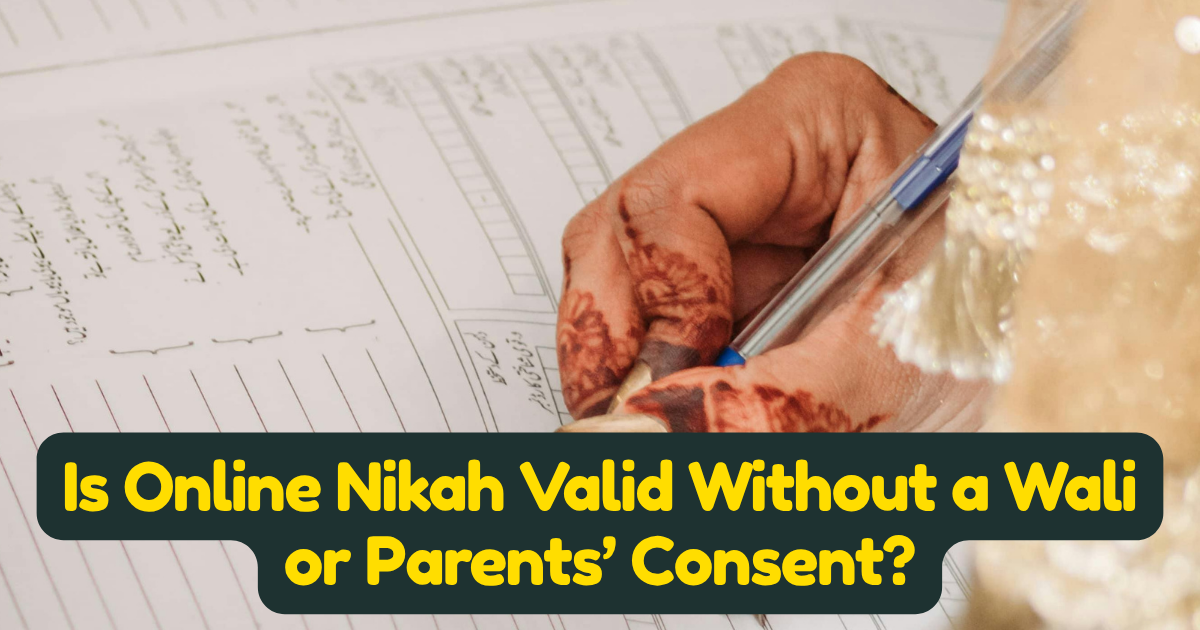
This is one of the most painful situations a Muslim can find themselves in. You have found someone you want to marry. You are both practising Muslims. The relationship is halal in intention, serious in nature, and ready to be formalised. And then — parents refuse. Or the Wali is absent. Or the family situation is complicated in ways that have nothing to do with Islamic criteria.
The question then becomes one of the most searched Islamic questions online: is a nikah valid without a Wali or without parents' consent?
The honest answer is: it depends — and the details matter enormously. This is not a topic where a one-line answer serves anyone well. The ruling differs between the four major Sunni schools of thought. The outcome depends on the reason for refusal, the madhab being followed, and whether a qualified Wali-e-Hakim has been properly appointed. Getting this right protects the validity of your nikah. Getting it wrong leaves you with unresolved religious doubt over one of the most important contracts of your life.
This guide walks through the full picture — clearly, honestly, and with the scholarly evidence behind every position stated.
Understanding the Wali Requirement First
Before examining whether a nikah is valid without a Wali, it is important to understand what the Wali requirement actually is and what purpose it serves under Islamic law.
The Wali is the bride's male guardian — typically her father, then paternal grandfather, then brother, then paternal uncle, following the established chain of guardianship. His role in the nikah is protective. He represents the bride's interests, satisfies himself that the groom is a suitable match, and formally participates in the marriage contract on her behalf. Islam frames this as a form of care and honour — not as control or ownership.
The Prophet ﷺ said, as narrated in Sunan al-Tirmidhi (1101), Abu Dawood (2085), and Ibn Majah (1881):
"There is no marriage except with a guardian (wali)."
— Sunan al-Tirmidhi, 1101 | Sunan Abu Dawood, 2085 | Sunan Ibn Majah, 1881
This hadith is the foundational evidence for the Wali requirement and is accepted as authentic across all four Sunni schools. The question — as scholars have debated for centuries — is what exactly this requires, whether it is a condition of validity or a condition of completeness, and what happens when the Wali is absent, unavailable, or unjustly refusing.
What the Four Sunni Schools Say — The Positions Stated Clearly
This is where the scholarship diverges — and understanding the differences is essential for any Muslim seeking to navigate this question correctly.
The Shafi'i, Maliki, and Hanbali Schools
The majority position across three of the four major Sunni schools — Shafi'i, Maliki, and Hanbali — is that a valid Wali is a condition of the nikah itself. Without a Wali, or a lawfully appointed Wali-e-Hakim substitute, the marriage contract is not considered valid under these schools. This is the relied-upon position of the majority of Islamic scholars historically and today.
IslamQA's ruling on marriage without a Wali clearly reflects this majority position, citing the hadith narrated in Tirmidhi, Abu Dawood, and Ibn Majah: "Any woman who gets married without the permission of her Wali, her marriage is invalid, her marriage is invalid, her marriage is invalid." Under these three schools, a woman who marries without any Wali and without any Wali-e-Hakim appointment has not entered a valid Islamic marriage contract.
The Hanafi School — The Important Exception
The Hanafi school — the dominant madhab followed by the majority of Muslims in the UK, USA, Canada, Europe, and South Asia — holds a different position. This is one of the most significant and frequently misunderstood distinctions in Islamic family law.
Daruliftaa's detailed explanation of the Hanafi position states it clearly: the relied-upon position in the Hanafi school is that a free, sane, and adult woman may contract her own nikah without her Wali's approval — provided the husband is a legally suitable match (kuf') to her. This means the marriage, while valid, is not encouraged without the Wali's blessing. It is described by Hanafi jurists as sinful if done without valid reason, going against the Sunnah, and generally blameworthy. But it is not invalid.
This position is supported by Qur'anic verses that address women directly as the contracting parties in marriage — notably Surah Al-Baqarah 2:232 — and by narrations from Ibn Abbas (may Allah be pleased with him). It is the relied-upon position of the major Hanafi jurisprudential references including Ibn 'Abidin's Radd al-Muhtar and al-Maydani's al-Lubab fi Sharh al-Kitab.
Critically, however, the Hanafi school is not saying that pursuing marriage without a Wali is recommended or even neutral. It is saying that, under specific conditions, the contract is valid even without the Wali's approval — but that doing so without a genuine and compelling reason remains sinful and contrary to the prophetic way. These two things — validity and recommendation — are distinct in Islamic law, and conflating them misrepresents the Hanafi position entirely.
When Parents Refuse Without a Legitimate Islamic Reason
This is the situation that affects the greatest number of Muslims asking this question — particularly those living in Western countries where cultural expectations sometimes drive parental refusal more than Islamic criteria.
Islamic law is precise on this point. A Wali has the right to refuse a marriage — but only on grounds that are Islamically legitimate. Refusing because the prospective spouse is of a different ethnicity, from a different cultural background, from a lower socioeconomic background, or simply because the parent prefers someone else, does not constitute a legitimate Islamic reason for refusal. These are cultural preferences, not Islamic criteria.
When a Wali prevents a lawful marriage without a valid Islamic reason, Islamic law classifies this as adl — unjust prevention. And when adl occurs, the consequences under fiqh are clear. As AboutIslam's scholarly guidance confirms, when a Wali refuses without a shari grounds, guardianship moves to the next eligible guardian in the chain. If the father refuses unjustly, authority passes to the grandfather. Then to the brother. Then to the paternal uncle. If all eligible guardians refuse without legitimate Islamic reason, authority transfers to the Wali-e-Hakim — the Islamic judge or qualified Imam acting in that capacity.
This principle is confirmed in the hadith narrated in Tirmidhi, Abu Dawood, and Ibn Majah: "If she does not have a guardian then the (Muslim) ruler is the guardian of anyone who does not have a wali." The Wali-e-Hakim mechanism exists precisely for this situation — so that no Muslim woman is trapped by a guardian's cultural bias or personal stubbornness.
What Are Legitimate Islamic Reasons for a Wali to Refuse?
It is equally important to be honest about the other side of this question. A Wali's refusal is not automatically unjust simply because it is inconvenient or unwanted. Islamic law does give the Wali the right to refuse in certain circumstances.
Legitimate Islamic grounds for a Wali's refusal include situations where the prospective spouse is not a practising Muslim or has serious concerns about his religious commitment, where there are genuine character concerns grounded in evidence, where the prospective spouse has financial obligations he has demonstrated he cannot or will not meet, or where there is a known Islamic impediment to the marriage. These are substantive, verifiable reasons — not personal preferences or cultural biases.
Before concluding that a Wali is refusing unjustly, it is worth examining honestly whether the concerns he has raised have any Islamic basis. A scholar's assessment of the specific situation is far more reliable than a couple's own conclusion about whether the refusal is legitimate.
The Wali-e-Hakim — The Correct Pathway When No Valid Wali Is Available
Across all four Sunni schools, when a Wali is genuinely absent, all Walis are refusing unjustly, or there is no Muslim male relative to serve in the role, the solution is not to simply proceed without any guardian. The solution is the Wali-e-Hakim.
The Wali-e-Hakim is a qualified Qazi or Imam who formally assumes the guardianship role when the normal guardianship chain has failed or is unavailable. This is not a workaround invented for convenience — it is a fiqh mechanism established by the Prophet ﷺ himself and applied in Muslim communities for over fourteen centuries.
SeekersGuidance confirms that even in the Hanafi school — where a woman technically has more autonomy — the Wali-e-Hakim pathway is strongly recommended over simply proceeding without any guardian at all. It provides scholarly accountability, proper documentation, and removes the sin attached to marrying entirely without any guardian process.
The situations in which the Wali-e-Hakim pathway applies include:
- All eligible male relatives have refused without legitimate Islamic grounds
- The bride is a Muslim convert whose family is non-Muslim — and therefore cannot serve as her Wali by scholarly consensus
- The Wali has passed away and no eligible male relative remains in the guardianship chain
- The Wali is genuinely unreachable despite reasonable efforts to contact him
What the Wali-e-Hakim pathway requires is a qualified scholarly assessment — not simply a declaration by whoever happens to be conducting the ceremony. The criteria for the appointment must be evaluated properly, and the basis for it must be documented. A reputable online nikah service handles this through proper pre-ceremony consultation with qualified scholars, not as a box to tick on a form.
A Specific Situation: Converts to Islam
For Muslim converts in the USA, UK, Canada, Europe, and Australia, the Wali question takes on a distinct character — and it deserves direct, clear guidance.
Scholarly consensus is that a non-Muslim cannot serve as the Wali of a Muslim woman. When a woman embraces Islam and her father, brothers, and all male relatives are non-Muslim, there is no natural Wali available. This is not a failure — it is simply the reality of her situation, and Islamic law provides directly for it.
For converts, the Wali-e-Hakim pathway is not a last resort — it is the correct and primary pathway from the outset. A qualified Imam formally assumes the guardianship role. The appointment is documented. The nikah proceeds with full scholarly legitimacy. IslamQA's ruling specifically addresses the situation of women in non-Muslim countries, confirming that when no qualified Wali exists, Islamic organisations, Imams, and qualified scholars in that country should step in to assume the Wali role. This is exactly the service a credible online nikah provider offers.
What "Parents' Consent" Means vs. What the Islamic Ruling Requires
It is worth separating two concepts that are often conflated in this discussion: the Wali's formal participation in the nikah contract, and parents' general approval and blessing of the marriage.
The Islamic nikah requirement relates specifically to the Wali — the bride's guardian's formal role in the contract. It is a specific legal condition, not a blanket requirement that every family member approves or is happy about the marriage.
A groom's parents, for instance, have no formal role in the nikah contract under Islamic law. Their approval is a matter of family harmony, good relations, and following the Sunnah of consulting family — not a legal condition of the marriage's validity. Similarly, a bride's mother has no formal Wali role in the contract, though her blessing and involvement are naturally encouraged.
The distinction matters practically. A couple asking "can we do nikah without our parents' blessing" is asking a different question from "can we do nikah without the Wali's participation." The first is a question about family relations and the Sunnah of consultation. The second is a question about the conditions of validity — and it is the second that this article addresses.
How InstantNikah.com Handles This Situation
At InstantNikah.com, every nikah begins with a proper conversation about the Wali situation — including situations where parents are refusing or where a Wali is unavailable. Our scholars assess each situation individually, not through a standard checklist.
If your Wali can participate via video call, we facilitate that and strongly encourage it. If your Wali is refusing without a legitimate Islamic reason and all eligible alternatives have also refused, our scholars assess whether the criteria for Wali-e-Hakim are met — properly, with documentation, and with full scholarly accountability. If you are a convert with no Muslim male relatives, we handle the Wali-e-Hakim appointment as a standard part of the service.
What we do not do is rush past this question to make the booking easier. The Wali situation determines how the ceremony is structured. It must be handled correctly — not because we are trying to make things difficult, but because the validity of your nikah depends on it being done properly.
You can read more about our process at InstantNikah.com/process or speak with one of our scholars directly before committing to anything. The consultation is free, private, and carries no obligation.
Frequently Asked Questions
Is nikah valid without a Wali in the Hanafi school?
Under the relied-upon Hanafi position, a nikah contracted by a free, sane, adult woman without her Wali's approval is valid — provided the husband is a legally suitable match (kuf'). However, Hanafi scholars unanimously stress that this does not mean the marriage is encouraged or free of sin if done without a compelling reason. Involving the Wali remains the Sunnah, and proceeding without him without a valid reason carries moral blame even if the contract itself is technically valid.
What happens if my father refuses my nikah but has no Islamic reason?
If your father refuses without a legitimate Islamic reason — refusing on cultural, ethnic, or purely personal grounds — Islamic law classifies this as adl: unjust prevention. Guardianship authority then passes to the next eligible guardian in the chain. If all eligible guardians refuse unjustly, the Wali-e-Hakim mechanism applies — a qualified scholar formally assumes the role with full documentation. This is a well-established fiqh principle confirmed across all four Sunni schools.
Can a convert do nikah without a Wali?
A convert does not proceed without a Wali — she proceeds with a Wali-e-Hakim, which is the correct pathway when no Muslim male relative is available. Scholarly consensus confirms that a non-Muslim cannot serve as Wali for a Muslim woman. A qualified Imam formally assumes the Wali-e-Hakim role, the appointment is documented, and the nikah is fully valid. This is not a workaround — it is the established Islamic solution for exactly this situation.
Does the groom's family need to give consent for the nikah?
No. The nikah contract requires the groom's consent and the bride's Wali's participation — the groom's parents have no formal legal role in the nikah contract under Islamic law. Their blessing is naturally desirable for family harmony and following the Sunnah, but their refusal does not affect the validity of the contract.
Is it sinful to do nikah without parents' blessing even if it is technically valid?
This is a question of context. If parents are refusing without a legitimate Islamic reason — on cultural or personal grounds — proceeding through the proper Wali-e-Hakim channel is not sinful. If parents have genuine Islamic concerns that have been dismissed without proper consideration, proceeding without addressing those concerns may carry moral weight beyond the nikah's technical validity. Our scholars can assess your specific situation honestly and help you understand which applies.
What madhab does InstantNikah.com follow for the Wali requirement?
Our scholars work within the madhab each couple follows, not a single blanket school. Before any ceremony, we establish which madhab is being followed, how the Wali situation is assessed under that school, and what the correct process is for that couple's specific circumstances. This is why the pre-ceremony consultation is non-negotiable — it is how we ensure your nikah is valid under the school you follow.
The Right Path — Not the Easiest One
Navigating a nikah without parental support is genuinely difficult. The emotional weight of it — the family tension, the longing for blessing, the uncertainty about whether you are doing the right thing — is real. This guide does not minimise any of that.
What it does do is give you the actual Islamic picture — not a simplified reassurance designed to make booking easier, and not an unnecessarily harsh verdict that ignores the nuance in Islamic scholarship. The truth is that Islamic law provides pathways for every genuine situation couples face. The Wali-e-Hakim exists precisely so that no Muslim woman is trapped by circumstances outside her control. The Hanafi school's position exists precisely so that adult women are not held hostage by a guardian's personal preferences.
What matters is that whichever pathway is correct for your situation is followed properly — with the right scholarly assessment, the right documentation, and the right intention.
At InstantNikah.com, our scholars are available to speak with you about your specific situation before you book anything. Contact our team here. No commitment. No judgment. Just qualified, honest guidance.
Admin User
Author