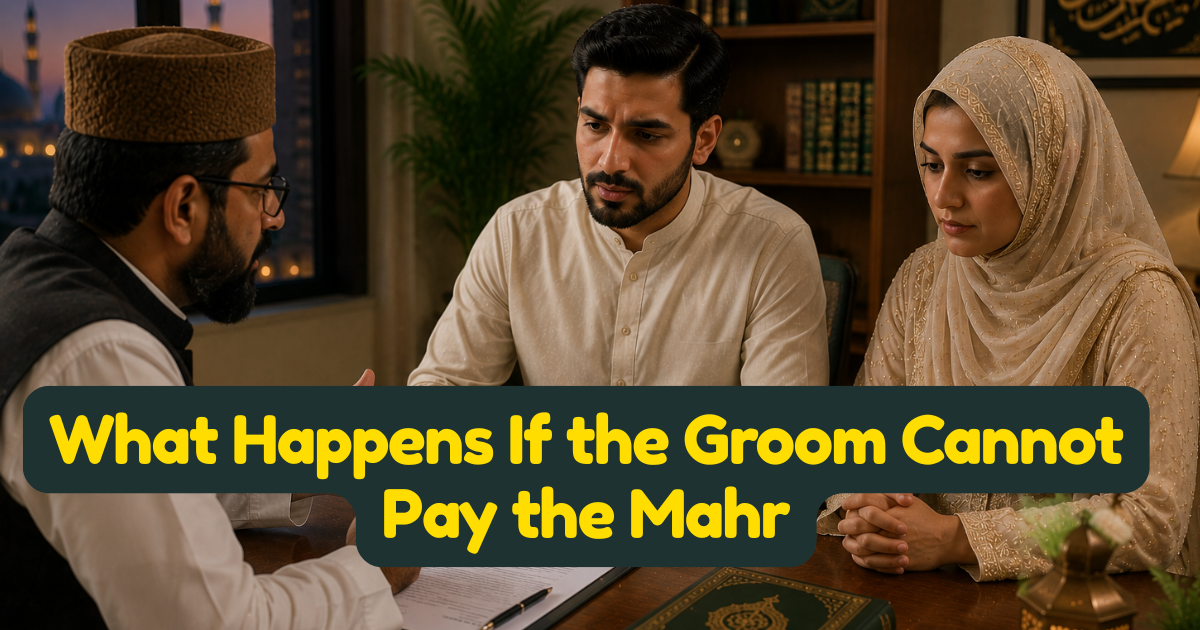
What Happens If the Groom Cannot Pay the Mahr — Islamic Rights, Solutions, and Scholarly Rulings
Mahr disputes are more common than most Muslim couples expect. A figure is agreed upon with good intentions, the nikah takes place, and then reality intervenes — financial hardship, changed circumstances, a groom who promised more than he could deliver, or a family that set an amount unrealistically high. What happens then? Does the marriage become invalid? Does the wife lose her right? Can the groom simply delay indefinitely? And what if the nikah was conducted without a mahr amount being specified at all?
These are questions with real, precise answers in Islamic jurisprudence — and understanding them is essential for any Muslim couple navigating this situation. This article covers every dimension: the validity question, the wife's rights, the protection mechanisms Islamic law built in, the solutions scholars endorse, and the one thing no one can pressure a wife to do without her genuinely free consent.
The Foundational Ruling: Does Non-Payment of Mahr Invalidate the Nikah?
The answer across all four major madhabs is clear and unanimous: non-payment of mahr does not invalidate the nikah. The marriage contract remains fully valid even when the mahr has not been paid, partially paid, or not yet specified in precise terms.
As confirmed in the detailed legal analysis at Khadija Law Associates: "Islamic jurists are unanimous that non-payment of mahr does not invalidate the nikah. The validity of a marriage depends on the following essential conditions: offer and acceptance, witnesses, and wali — mahr is not among the formal conditions for validity. Thus, if the mahr has been agreed upon — or even left unspecified with the understanding it will be determined later — the marriage remains valid and binding. The dower becomes a debt owed by the husband to the wife."
This ruling holds across all schools. Even in the Maliki madhab — which treats mahr as one of the pillars of the nikah rather than merely a condition — the contract does not automatically collapse when mahr is unpaid. What changes across the madhabs is not the validity of the marriage, but the rights and remedies available to the wife when mahr is withheld.
The Quran establishes mahr as a clear, individual right of the wife: "And give to the women their mahr with a good heart." (An-Nisa 4:4). This verse, as the Islamic Association of Raleigh's fiqh guidance explains, confirms two essential points: first, the mahr is a genuine obligation that must be honoured; and second, only the wife herself — freely and willingly — has the right to waive it.
Mahr Is a Debt, Not a Gift — What This Means Legally
One of the most important conceptual shifts that Islamic law makes on this question is treating mahr not as a wedding gift that can be given or withheld at will, but as a legal debt owed by the husband to the wife from the moment the nikah is contracted.
As the analysis at IslamicWrites makes clear: "Whether it is given immediately or deferred, it must be fulfilled with sincerity. Once the agreed time arrives, payment must be made without delay." The deferred portion of a mahr — agreed to be paid later — does not disappear simply because time passes or circumstances change. It remains a registered debt in Islamic law, enforceable through Islamic courts or mediation, and it does not expire.
This debt carries one of the highest priorities in Islamic inheritance law. If a husband dies without having paid all or part of the mahr, the outstanding amount must be settled from his estate before any inheritance is distributed — before children receive their shares, before other heirs benefit from the estate. As documented in the Wikipedia entry on Mahr in Islamic Law: "A deferred promise to pay does not make the full amount of the mahr any less legally required."
For the wife, this means that mahr never truly disappears — not through delay, not through the passage of years, not through the husband's financial difficulty, and not through social or family pressure. It remains her right until she herself chooses to waive it or receives it.
The Wife's Most Powerful Protection: The Right to Withhold Herself
Islamic law gives the wife a direct, personal remedy when the agreed prompt mahr (muajjal) has not been paid: she has the right to refuse consummation of the marriage until the immediate portion of her mahr is delivered.
This is not a minority opinion or a disputed ruling. It is the position of all scholars whose knowledge has been preserved. As the extensive ruling at IslamQA states, citing Ibn Qudamah and Ibn al-Mundhir: "Ibn al-Mundhir said: All of the scholars from whom we acquired knowledge are agreed that the woman has the right to refuse to let the husband consummate the marriage with her until he gives her her mahr."
The same ruling clarifies the boundaries precisely: "If some of it is to be paid immediately and some is deferred, then she has the right to refuse to let him be intimate with her before receiving the immediate portion, but not the deferred portion." The wife's right of refusal is proportional to what is immediately due — she cannot withhold herself over the deferred portion while that portion has not yet fallen due. But for what is owed now, her right is absolute and unanimously recognised.
This right is additionally confirmed in the Hanafi scholarly tradition by Amaliah's guide to the rights of Muslim wives in marriage: "The wife has the right to refuse sexual intercourse if the dowry is not paid."
What If the Nikah Was Conducted Without a Mahr Amount Being Specified?
This scenario is more common than many people realise — particularly in informal or unguided ceremonies, online nikah ceremonies where the mahr discussion was rushed, or cultural settings where family members conducted a nikah without proper scholarly guidance. The answer is one of the most reassuring in Islamic law: the nikah is still valid, and the wife's right to mahr is still fully intact.
When no mahr amount was specified, Islamic law applies what is called mahr al-mithl — a fair and customary mahr determined by the standard of comparable women in the bride's family and social context. As the IslamQA ruling at IslamQA — Is Marriage Valid Without Mahr? establishes clearly, citing Imam Ibn Uthaymin: "It is valid to do the marriage contract without mentioning the mahr or mentioning it without specifying it. The wife is entitled to a mahr like that of her peers by virtue of the marriage contract."
This protective mechanism was endorsed by the Prophet Muhammad (peace be upon him) himself. As recorded in an authentic hadith documented at this scholarly hadith resource (Sahih Abu Dawud 2117): when a question about mahr was brought to Ibn Masood (RA) regarding a man who married without setting a mahr and died before consummation, Ibn Masood ruled: "She will receive a mahr equal to that of women of her status — without any increase or decrease." The Prophet (peace be upon him) affirmed this ruling.
How is mahr al-mithl calculated? As explained by Sheikh Omar Subedar at Mathabah Institute Canada: "The standard is dictated by the amount her older siblings were given at the time of their marriage." If the bride's sisters or paternal aunts received a certain amount, that becomes the reference point. A judge or qualified scholar can determine the mahr al-mithl in cases of dispute.
What If the Groom Genuinely Cannot Afford to Pay?
Financial hardship is a real situation that Islamic law addresses with both firmness about the wife's rights and compassion toward the husband's circumstances. The starting point is recognising that mahr should never have been set beyond the groom's realistic means in the first place.
The Prophet Muhammad (peace be upon him) explicitly cautioned against excessive mahr. As Sayyiduna Umar ibn al-Khattab (may Allah be pleased with him) said — in a statement recorded in Sunan Tirmidhi 1114 and documented at Darul Iftaa's mahr guidance: "Do not stipulate excessive amounts as dowry for women. If (doing so) was a token of honour in this world or a source of piety by Allah, then the Messenger of Allah would have been more worthy of it than you."
When a husband genuinely cannot pay, the Islamic legal framework offers the following recognised solutions:
1. Formal Deferral by Mutual Agreement
The mahr can be formally deferred — or an unpaid portion restructured — by mutual agreement between husband and wife. This is entirely permissible and does not compromise the wife's right. The key word is mutual: the wife must genuinely agree to the deferral, not be pressured into it. The deferred amount remains a registered debt. As established at Darul Iftaa on deferred mahr: the mahr can all be immediate, all be deferred, or split between portions — provided both parties genuinely agree.
2. Voluntary Waiver by the Wife — With Strict Conditions
A wife may choose to waive all or part of her mahr out of genuine free will and generosity. This is a recognised and even spiritually praised act — but it must be entirely voluntary. As the Islamic Association of Raleigh ruling establishes: "The wife has the right to voluntarily forgo all or part of her mahr, only if she does so willingly and without compulsion. If she is pressured or made to feel emotionally forced, or is unaware of her right to demand the mahr, such forgiveness is not valid in the eyes of Shari'ah."
This condition is critical and frequently violated in practice. A wife who is told by family members to "forgive" the mahr, or who is made to feel selfish for claiming what is due to her, is being coerced — even if subtly. Coercion nullifies the waiver. The mahr remains outstanding. Scholars are emphatic that this is one of the wife's most important financial rights and must be protected from social pressure.
3. Symbolic or Non-Monetary Mahr
For couples who have not yet completed their nikah and are concerned about the groom's financial capacity, Islamic law permits mahr to take non-monetary forms. As noted in the scholarly analysis from Healthy Nikah: mahr can be gold, property, valuable items, or even a service — the Prophet (peace be upon him) in one famous incident accepted teaching the bride Quranic surahs as mahr when the groom had nothing of monetary value. The principle is that mahr must represent genuine value and sincere commitment — not a token that renders the obligation meaningless.
4. A Minimum Amount With Formal Acknowledgement of Remaining Debt
Where a groom has limited means at the time of the nikah, the correct Islamic approach is to agree on a realistic prompt mahr — even a small but genuine amount — while formally acknowledging the remaining portion as a registered deferred debt in the nikah contract. This is honourable, transparent, and legally sound. It does not pretend the obligation does not exist; it structures it responsibly. The Hanafi madhab specifies a minimum of ten dirhams (approximately 30 grams of silver) as the floor for mahr, below which the specified amount is considered invalid and mahr al-mithl applies.
What Happens to Unpaid Mahr at Divorce?
At divorce, the mahr rules depend on whether the marriage was consummated:
- If the marriage was consummated: The wife is entitled to the full agreed mahr — both the immediate and deferred portions. Any outstanding unpaid amount becomes immediately due. As the IslamWeb fatwa establishes: "The wife has the right for the whole mahr if the marriage is consummated, and if a part of it is appointed to a given time, then it remains as a debt on the husband to give it at its due time." (IslamWeb Fatwa on mahr at divorce)
- If the marriage was not consummated: The Quranic ruling in Surah Al-Baqarah 2:237 applies — "If you divorce them before consummation, but after the fixation of a dower for them, then the half of the dower is due to them, unless they remit it." Half the agreed mahr is due, unless the wife generously waives her share or the husband voluntarily gives the full amount.
A husband who initiates divorce while mahr remains unpaid is not relieved of this obligation by the divorce. As the scholarly ruling documented at Al-Islam.org's analysis of divorce and mahr confirms: "If the husband has not paid the mahr in full, then he will still be held liable for the remaining balance, despite the reasons for divorce." The reasons for divorce — including the husband claiming the wife was at fault — do not cancel the mahr obligation.
What Happens to Unpaid Mahr if the Husband Dies?
The wife's claim on unpaid mahr takes priority in the estate of a deceased husband. Before any inheritance shares are distributed — before children, parents, siblings, or other heirs receive anything — the outstanding mahr is treated as a debt owed by the estate and must be settled first. This is the same priority given to any other outstanding debt of the deceased.
This protection means that a deferred mahr that was never paid during the marriage does not simply dissolve upon the husband's death. The wife becomes a creditor of the estate, with the same legal standing as any other creditor. Heirs who try to distribute the estate without settling the mahr are acting in violation of Islamic law.
The Moral Dimension: What Scholars Say About Men Who Withhold Mahr
Beyond the legal framework, Islamic scholarship is clear about the moral gravity of withholding mahr. As documented in multiple scholarly sources including the comprehensive mahr analysis at Karamah — Muslim Women Lawyers for Human Rights: mahr is not an administrative formality. It is a statement of the husband's sincerity, his acknowledgement of the wife's dignity, and his commitment to honouring her rights. A man who agrees to a mahr with no intention of paying it — or who pays a token amount while knowing the wife expected more — has entered the marriage with a form of deception that Islamic law treats with seriousness.
The Prophet Muhammad (peace be upon him) said: "The most deserving of conditions to be fulfilled are those by which intimacy becomes lawful for you." (Bukhari, Muslim). Scholars have applied this hadith directly to mahr — a condition agreed at the nikah that must be honoured with at least as much seriousness as any other contractual commitment.
Protecting Your Mahr: Practical Steps for Every Couple
Whether your nikah is upcoming, already completed, or in a situation of mahr dispute, the following practical steps reflect the Islamic legal protections described in this article:
- Agree on a realistic mahr before the nikah — not an aspirational figure that the groom cannot genuinely pay. Moderation is a Prophetic value; a mahr the groom can actually honour is better than an impressive figure that becomes a source of conflict
- Specify both the prompt and deferred portions clearly — and ensure both are recorded in the nikah contract with precise amounts and agreed timelines
- Ensure the nikah certificate records the mahr — a properly issued nikah certificate creates an official record that is far harder to dispute than a verbal memory of what was agreed
- Never sign a nikah document claiming mahr was received when it was not — a common practice in some communities that creates a false record and weakens the wife's legal position in any future dispute
- If the groom cannot pay the prompt mahr, formalise a deferred arrangement — in writing, with amounts and timelines specified, before the nikah proceeds
- Know that any waiver of mahr must be genuinely free — if family pressure is involved, it is not legally valid in Islamic law
How InstantNikah.com Handles Mahr in Every Ceremony
At InstantNikah.com, every ceremony conducted by a qualified Islamic scholar includes an explicit, on-record confirmation of the mahr before the ijab and qabul proceed. The amount — both prompt and deferred portions — is stated clearly before witnesses and recorded in the nikah certificate. No ceremony proceeds without the mahr being confirmed.
For couples who have questions about setting an appropriate mahr, the team can advise on what is realistic, what is recorded in the certificate, and how to structure a deferred portion properly. This guidance is part of the service, not an afterthought.
To understand the full ceremony process, visit the process page. To learn more about mahr in Islamic law, read the detailed guide at What Is Mahr in Nikah, the related article on How Much Mahr Is Enough, and the guide covering What Happens to Mahr After Divorce in Islam. For specific questions about your situation, reach the team through the contact page. Booking options include Instant Nikah, Same Day Nikah, Express Nikah, and Essential Nikah.
Admin User
Author