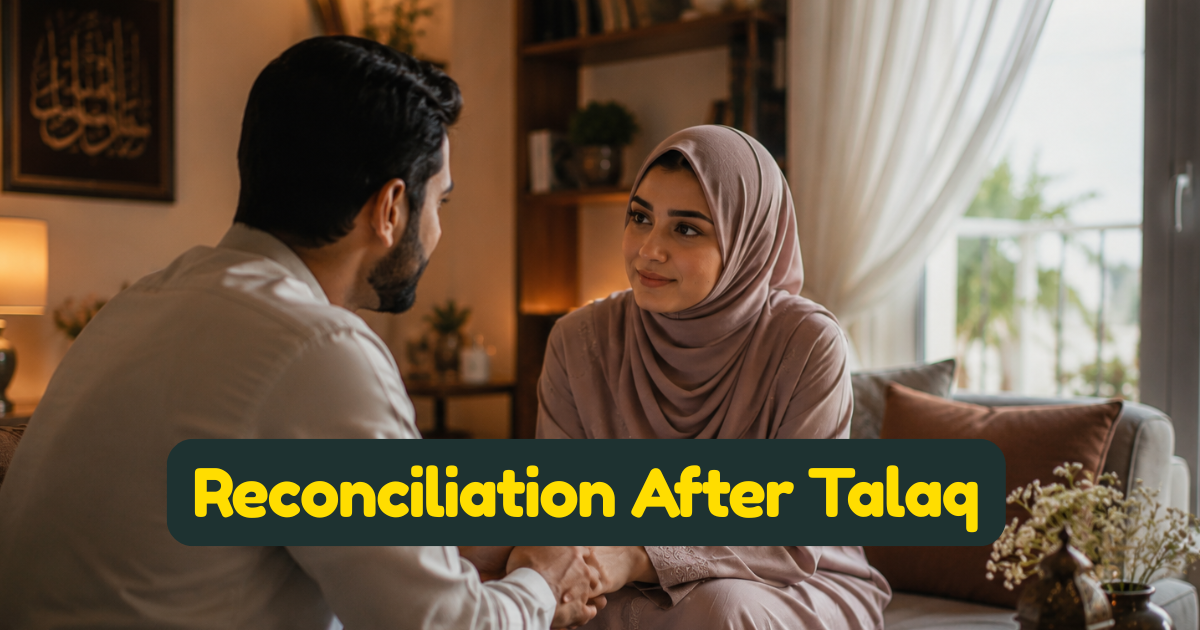
Reconciliation After Talaq: When a Couple Can Remarry Without a New Nikah, and When They Cannot
One of the most consequential — and most commonly misunderstood — aspects of Islamic divorce law is what actually happens after talaq is pronounced. Many people assume divorce is divorce: once the word is said, the marriage is over. In reality, Islamic jurisprudence draws a sharp and deliberate distinction between two very different outcomes, and which one applies determines whether a couple can simply resume their marriage or must start again from scratch with an entirely new nikah.
Talaq Raj'i: The Marriage That Isn't Quite Over
A revocable divorce — talaq raj'i — is what results from a husband's first or second pronouncement of talaq, made without the intention of an immediate, final, and irrevocable separation. As Jamiatul Ulama KZN's fatwa department explains, the wife becomes divorced and must observe the iddah waiting period — three menstrual cycles, three months if she does not experience menses, or until childbirth if she is pregnant. But critically, throughout this entire period, the marriage has not actually ended. As the contemporary jurisprudence resource DeenAtlas's comprehensive guide on triple talaq puts it, "the marriage is 'unraveling' but not yet 'broken.' The couple remains in a state of Nikah for the duration of the Iddah." The wife continues to live in the marital home, the husband remains financially responsible for her maintenance, and — as the Salafi scholar Abu Khadeejah notes in his explainer on divorce, iddah, and remarriage — it is in fact forbidden for the husband to remove her from the home during this time.
If the husband wishes to take his wife back during this waiting period — an act called raj'ah — he may do so without any new marriage contract, without paying a new mahr, and without requiring his wife's separate consent to the reconciliation itself. As confirmed by the Islamic legal research platform Islamiqate's analysis of raj'ah procedure, scholars across the schools recognise two possible methods for this act of taking back: through clear words indicating his intention to resume the marriage (for example, telling her "I take you back" or "I return you to wedlock"), or — according to the Hanafi and Maliki schools specifically — through resuming sexual relations or its preliminaries with the intention of raj'ah. The Shafi'i school takes a stricter position, holding that raj'ah must be effected by spoken word or in writing and cannot be accomplished through intercourse alone, even where that intention exists.
If the iddah period expires without any such reconciliation taking place, the revocable divorce becomes what is known as a minor irrevocable divorce — and the legal picture changes considerably.
Talaq Ba'in: Where a New Nikah Becomes Necessary
An irrevocable divorce — talaq ba'in — arises in two distinct circumstances, each carrying different consequences for reconciliation.
Minor irrevocable divorce (talaq ba'in al-sughra) occurs when the iddah of a first or second talaq raj'i expires without the husband having taken his wife back. As DeenAtlas confirms, at this point "the marriage is over, but the couple can remarry each other if they both agree to a NEW contract and NEW Mahr." This is a meaningfully different process from raj'ah — it requires the full machinery of a fresh nikah: a new offer and acceptance, new witnesses, a newly agreed mahr, and the wife's genuine, separate consent to remarry, exactly as if she were marrying for the first time. There is no automatic right of return; both parties must actively choose to remarry.
Major irrevocable divorce (talaq ba'in al-kubra) is the consequence of a third and final talaq — whether pronounced across three separate occasions following the Hasan method, or all at once as a triple talaq under those schools that recognise its validity. Here the consequences are categorically more severe. As The Lawyers PK's comparison of talaq-e-raji and talaq-e-bain confirms, "remarriage between the divorced couple is not possible without the process of Halala" — meaning the wife must first contract and consummate a genuine, independent marriage with a different man entirely, one undertaken in good faith and not as a contrivance to enable the original couple to remarry. Only if that second marriage subsequently ends, whether through the second husband's death or his own independent divorce of her, may the original couple remarry — and even then, only through a fresh nikah with a new contract and new mahr.
It is worth noting that classical scholarship treats arrangements specifically designed to engineer this outcome — a so-called nikah tahlil, where a second marriage is contracted purely as a technical device to make the first husband eligible to remarry his wife, with no genuine intention behind it — as invalid and explicitly prohibited. As the Islam Question & Answer platform notes, citing established hadith, "the Prophet cursed those who do that." The second marriage must be entered into in genuine good faith for its own sake.
Why This Distinction Matters in Practice
The practical stakes of correctly identifying which category applies are considerable, and confusion here causes real harm. A couple who mistakenly believes their marriage has ended irrevocably, when in fact a revocable talaq raj'i is still within its iddah period, may walk away from a marriage that could have been preserved with nothing more than a clear statement of reconciliation. Conversely, a couple who assumes they can simply resume their marriage after a third talaq, without understanding that an intervening marriage is religiously required, risks living in a relationship that is not validly recognised under Islamic law at all.
This is precisely the kind of situation in which a documented, properly witnessed marriage history matters enormously — knowing exactly how many times talaq was pronounced, under what circumstances, and whether any act of raj'ah took place during a valid iddah, are all questions that depend on clear records and credible witnesses. A couple uncertain about their own marital status following a divorce, or considering remarriage after a divorce, should consult a qualified scholar to confirm precisely where they stand before proceeding. Our guide on the role of the imam in matters of marriage and divorce covers how a qualified scholar approaches exactly this kind of clarification, and where a fresh nikah is genuinely required, our guide on whether an online nikah is valid in Islam explains how a properly conducted remarriage ceremony can be arranged, including for couples separated by distance.
Quick Answers
Can a couple remarry without a new nikah after talaq? Yes — but only if the divorce was revocable (talaq raj'i, the first or second pronouncement) and the husband takes his wife back during the iddah waiting period. After the iddah expires, or after the third and final talaq, a new nikah is required.
Does a wife need to consent to raj'ah (being taken back)? No, according to the majority view — raj'ah during a valid iddah is the husband's unilateral right and does not require the wife's separate consent or a new mahr, unlike a fresh nikah following an irrevocable divorce.
What is required to remarry after a third (final) talaq? The wife must first contract and consummate a genuine marriage with a different man, entered into in good faith. Only if that marriage subsequently ends — through death or a separate divorce — may the original couple remarry, and only through a new nikah with a new contract and mahr.
Is a marriage arranged purely to enable remarriage to the first husband (nikah tahlil) valid? No. Classical scholarship, citing hadith in which the Prophet condemned this practice, treats such arrangements as invalid where the second marriage was never genuinely intended.
Questions about marital status following a divorce carry serious religious and personal consequences, and the specific facts of any individual situation — including the applicable madhab, the exact wording used, and whether any act of raj'ah occurred — should always be confirmed with a qualified Islamic scholar before either party proceeds on an assumption.
Admin User
Author