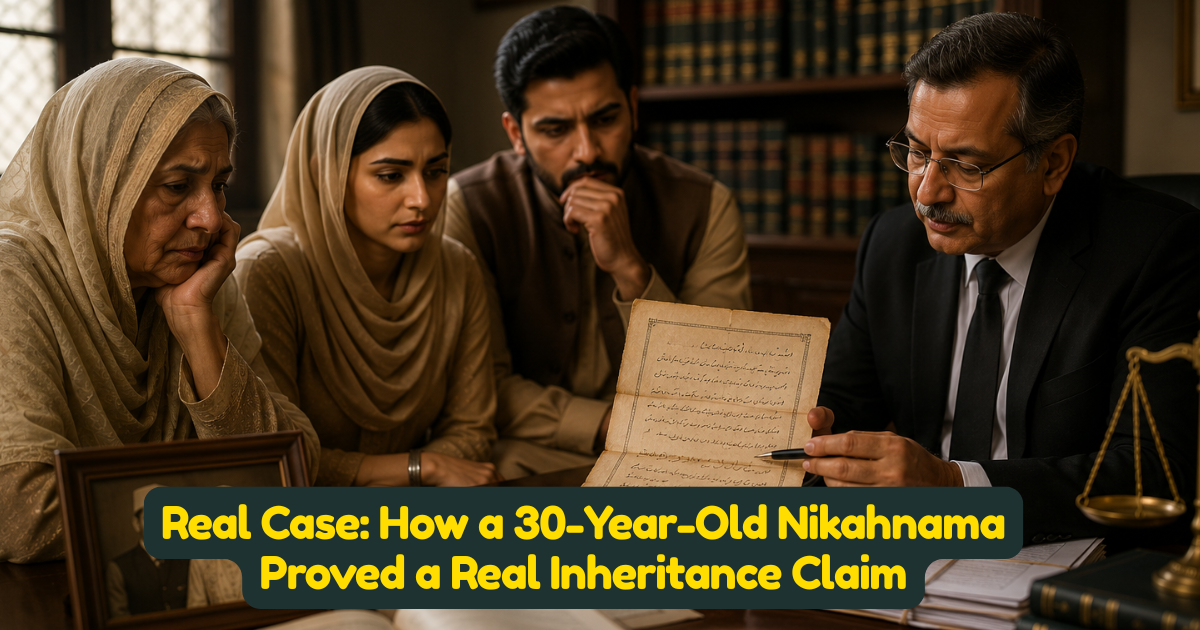
Real Case: How a 30-Year-Old Nikahnama Proved a Real Inheritance Claim
Most advice about Nikah documentation focuses on the wedding day itself. A real, decades-later case shows why that documentation's real value often isn't realised until much later — sometimes not until the couple themselves are gone, and their grandchildren are the ones relying on a marriage certificate to establish who legally inherits what.
The Real Case: A Marriage Disputed Decades After the Fact
This is a genuine, documented real dispute worth understanding in full. Academic legal research on Nikahnama reform in Pakistan confirms that in Haji Peeran Ditta v Shams-ud-Din, the respondents claimed entitlement to inherit property from their paternal grandmother, who had contracted marriage with Rahim Bakhsh — while the petitioners disputed this entirely, stating no such marriage had ever taken place. This is precisely the kind of dispute that can only arise long after everyone directly involved in the original ceremony has passed away, when the marriage's very existence becomes the central legal question.
The Real, Specific Evidence That Settled It
This is the genuinely important detail worth understanding directly. The same research confirms that the respondents presented the Nikahnama, which was thirty years old, as evidence — a single, properly executed document, decades old, standing as the real, decisive proof that the marriage genuinely occurred.
The Real Legal Doctrine Behind Why This Worked
This is worth understanding precisely, since it's a genuine, specific legal principle, not a general assumption that old documents are trustworthy. The same research confirms that a Nikahnama, as a public document, carries a presumption of truth attached to it by the courts — a principle that holds true specifically in cases where the Nikahnama is over, or nearly, thirty years old. This "presumption of truth" is a real, recognised evidentiary doctrine — it means courts start from the position that a properly executed marriage document, once it has aged into this category, is genuinely what it claims to be, rather than requiring the parties to independently re-prove its authenticity decades later.
Why This Real Doctrine Exists at All
This makes real, practical sense once you consider what the alternative would require. By the time a marriage certificate is thirty years old, the officiant, the original witnesses, and often the couple themselves may no longer be available to testify directly. A legal system that required fresh, contemporary proof of a decades-old marriage's authenticity every time it became relevant would make long-term inheritance planning genuinely unworkable. The presumption of truth doctrine exists precisely to solve this — treating a properly executed, aged document as reliable evidence on its own.
A Second, Real Case Showing the Same Document's Ongoing Power
This is a separate, genuinely real, and more recent case worth knowing about, showing the same underlying document type doing real work in a very different dispute. Real Sindh High Court case records confirm that in a matter before Family Court-II, Peshawar, after 16 years of marriage, a wife named Mehreen filed suit claiming a house measuring one kanal, or its market value of thirty-three million rupees, as part of her dower (mahr) specifically because it had been recorded in clause 16 of her Nikahnama — with the Family Court ultimately deciding in her favour, and the decision upheld through multiple levels of appeal. This is a real, substantial, decades-relevant financial outcome, entirely dependent on a specific clause having been properly written into the original marriage document.
Why the Specific Column Actually Matters, According to Real Case Law
This is genuinely useful, real detail worth understanding precisely. Detailed legal analysis cataloguing multiple real Pakistani judgments confirms courts treat different Nikahnama columns with genuinely different legal weight: in Muhammad Aslam v. Ishrat Bibi (2019), properties listed in column 16 as "Atiya" (gifts) were held to fall outside Family Court jurisdiction entirely, belonging instead to civil courts — while in Muhammad Ahmad v. Additional District Judge (2019), an entry in column 17 regarding compensation upon divorce was upheld as enforceable directly through the Family Court. This confirms that which specific column a stipulation is recorded in is not a minor technicality — it genuinely determines which court has authority to enforce it decades later.
What This Means for a Properly Documented Online Nikah Today
Given these real cases, the practical lesson for any couple completing an online Nikah is genuinely long-term, not just about the wedding day itself: a properly executed, thoroughly documented certificate — correctly recording mahr, any specific property or gift stipulations in the appropriate column, and full identifying details — is an asset that may not be needed for years or decades, and then suddenly becomes the single piece of evidence an entire inheritance claim depends on. This is precisely why this site has consistently emphasised thorough documentation as protective, not just for the couple themselves, but for their children and grandchildren decades later.
What This Means for Structuring Your Own Nikah Certificate
Couples completing an online Nikah should ensure any specific financial stipulations — particularly property or gifts intended as mahr — are recorded clearly and in the correct, legally recognised section of the marriage contract, exactly as these real cases show matters decades later, and should keep the original document, or a properly certified copy, genuinely safe and accessible for the long term, not just the near future.
Frequently Asked Questions
What is the "presumption of truth" doctrine for old Nikahnamas? A real legal principle where courts treat a properly executed Nikahnama, particularly once it is around thirty years old or older, as reliable evidence of the marriage's existence without requiring fresh independent proof.
Can a Nikahnama actually settle an inheritance dispute decades later? Yes — the real case of Haji Peeran Ditta v Shams-ud-Din shows a thirty-year-old Nikahnama serving as the decisive evidence in a genuine inheritance dispute between grandchildren.
Does it matter which specific column a property or mahr stipulation is recorded in? Yes — real case law shows different columns carry different legal weight and fall under different courts' jurisdiction, making correct recording a genuinely practical concern, not a formality.
Suggested Internal Links
Zainab Butt
Author