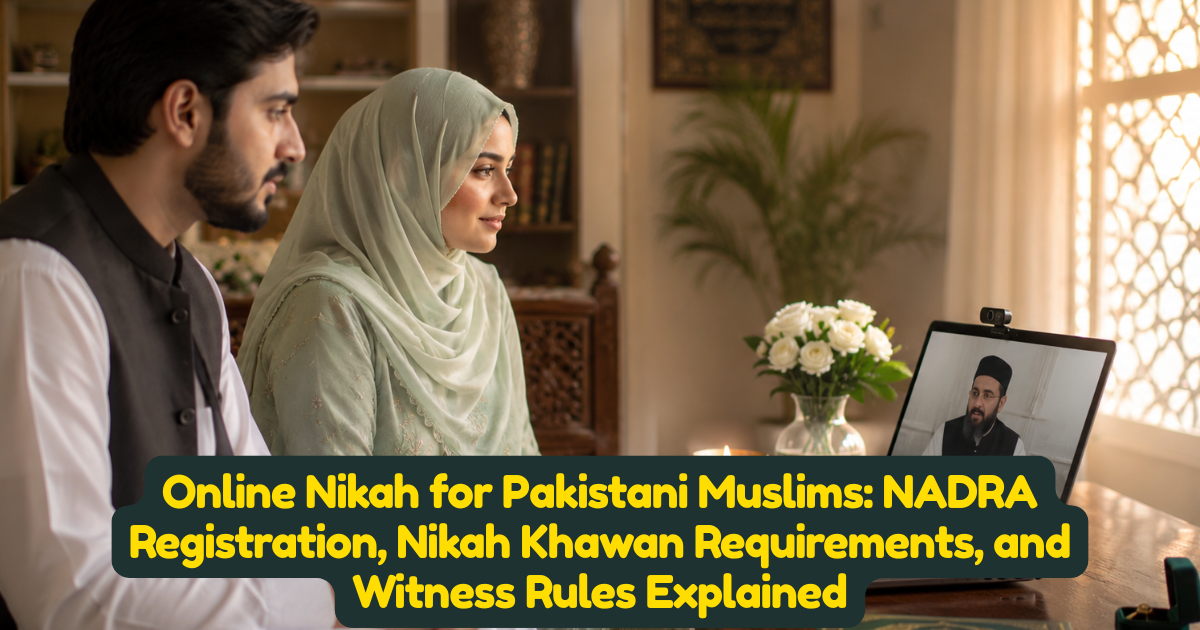
Online Nikah for Pakistani Muslims: NADRA Registration, Nikah Khawan Requirements, and Witness Rules Explained
Pakistan runs one of the most codified, formally regulated Nikah registration systems anywhere in the world — and for Pakistani couples, both at home and across the diaspora, understanding exactly how it works is the difference between a certificate that opens doors and one that quietly creates problems years later. An online Nikah conducted for a Pakistani couple sits directly on top of this legal framework, and getting the sequence right matters.
The Legal Foundation: The Muslim Family Laws Ordinance, 1961
Pakistan's entire Nikah registration system traces back to a single piece of legislation. The official text, published on the Punjab government's own legislation portal, confirms the ordinance grants licences to specific individuals, to be called Nikah Registrars, with no more than one Nikah Registrar licensed for any single Ward, and specifically restricts polygamous marriage from being registered without prior written permission from an Arbitration Council. This is the foundational law every Nikah conducted for a Pakistani national, wherever they are in the world, ultimately needs to satisfy for civil recognition.
Registration Is Mandatory, Not Optional — And the Law Says So Explicitly
This is the single most important legal fact for Pakistani couples to understand clearly, and it differs meaningfully from several Western jurisdictions covered elsewhere on this site. Detailed legal guidance confirms that under Section 5 of the Muslim Family Laws Ordinance, every marriage solemnized under Muslim law must be registered, and failure to register can lead to a fine or imprisonment for the Nikah Registrar or the responsible party — a genuinely stricter penalty structure than most countries impose for non-registration. Islam recognises a valid Nikah with proper consent and witnesses regardless of civil registration, but Pakistani civil law does not treat registration as optional the way many Western jurisdictions do.
The Nikah Khawan: A Genuinely Specific Role
Pakistan's system centres on a specific, licensed role: the Nikah Khawan, also called the Nikah Registrar. Detailed guidance on the process confirms that registration is performed by an authorised Nikah Khawan who prepares and submits the Urdu Nikah Nama with the local Union Council, Cantonment Board, TMA, or Arbitration Council on or shortly after the day of the ceremony. This is a genuinely important detail for couples arranging an online Nikah with Pakistani civil recognition in mind: the officiant needs to hold this specific licence — not just general Islamic scholarly qualification — for the ceremony to translate directly into a registrable Nikah Nama.
What Happens If the Nikah Khawan Isn't the One Registering It
Pakistan's law explicitly anticipates situations where the person conducting the ceremony isn't the licensed Nikah Registrar themselves — a genuinely common scenario for online Nikah, where a couple's religious officiant may be based abroad. The ordinance's own text confirms that every marriage not solemnized by the Nikah Registrar must, for registration purposes, be reported to him by the person who solemnized it. This creates a genuinely workable path for diaspora couples: the religious ceremony itself can be conducted by a qualified officiant anywhere, provided the marriage is then properly reported to and registered by a licensed Nikah Registrar in Pakistan.
The Nikah Nama: More Than a Formality
The Nikah Nama itself is a standardised legal document, not a symbolic certificate. Detailed guidance on its requirements confirms it must specifically record the amount of dower (mahr) agreed, the manner of its payment, and full identifying details of both bride and groom including whether either party's father is living. Crucially, without a properly executed Nikah Nama, a marriage is not legally recognised for passport applications, visa processing, or property matters in Pakistan — even though it remains religiously valid.
NADRA Registration: A Genuinely Separate Second Step
Here's a detail that catches many couples off guard: Nikah Nama registration with the Union Council and NADRA registration are two distinct steps. Research published by the Center for Economic Research in Pakistan confirms plainly that all marriages, regardless of whether conducted under Muslim law or otherwise, must additionally be registered with NADRA, which issues a Certificate of Marriage that is not a substitute for the Nikah Nama itself. For a couple's marriage to function fully in Pakistan's digital identity and civil records system — CNIC updates, passport applications, and formal government recognition — both the Union Council Nikah Nama registration and the separate NADRA registration need to be completed.
Witness Requirements: What the Nikah Nama Actually Records
Pakistani Nikah practice, consistent with the majority Islamic legal position, requires the presence of witnesses at the time of ijab and qabul, and the standardised Nikah Nama form includes dedicated fields for witness identification alongside the Nikah Khawan's own signature and seal. For an online Nikah involving a Pakistani couple, this means witness placement needs the same careful structuring emphasised throughout this site's guidance: witnesses genuinely present with the bride and groom respectively, properly identified on the Nikah Nama, rather than merely observing passively over a video connection.
Fees and Realistic Timing
Real, published figures give a useful planning reference: standard Union Council registration fees range from roughly PKR 300 to PKR 1,500 depending on the issuing authority and city, with the historical rules setting a base registration fee and additional charges scaling with the dower amount recorded. Late registration of an already-completed Nikah remains possible in Pakistan, but detailed guidance is consistent that it involves higher fees and additional verification compared to registering at the time of the ceremony — a genuinely strong incentive to complete registration promptly rather than deferring it.
Polygamy: A Specific, Court-Adjacent Requirement
Pakistan's ordinance treats polygamy differently from most jurisdictions covered on this site: rather than a blanket prohibition, it requires prior written permission from an Arbitration Council before a second or subsequent marriage can even be registered, and explicitly states that a marriage contracted without that permission cannot be registered under the Ordinance at all. This is a specific, mandatory procedural step that Pakistani couples in this situation need to complete before, not after, any additional Nikah.
What This Means for Diaspora Couples Specifically
For Pakistani nationals living abroad completing an online Nikah, the practical sequence that respects this legal framework looks like this: complete the religious ceremony with a properly qualified officiant, ensure witnesses are correctly placed and identified, then have the marriage formally reported to and registered by a licensed Nikah Registrar in the relevant Pakistani jurisdiction — followed by the separate NADRA registration step to bring the marriage fully into Pakistan's civil identity system.
Frequently Asked Questions
Is an unregistered Nikah valid in Pakistan? Religiously, yes — Islam recognises a valid Nikah based on consent and witnesses regardless of civil registration. Legally, an unregistered Nikah cannot be used for CNIC updates, visa applications, inheritance claims, or court proceedings.
Is NADRA registration the same as Nikah Nama registration? No — they are two separate steps. The Nikah Nama is registered with the local Union Council or equivalent authority; NADRA separately issues its own Certificate of Marriage, and both are needed for full civil recognition.
Can someone other than the licensed Nikah Registrar conduct the religious ceremony? Yes — the ordinance specifically provides for this, requiring the marriage to be reported to a licensed Nikah Registrar for registration afterward if the ceremony itself was conducted by someone else.
Suggested Internal Links
Admin User
Author