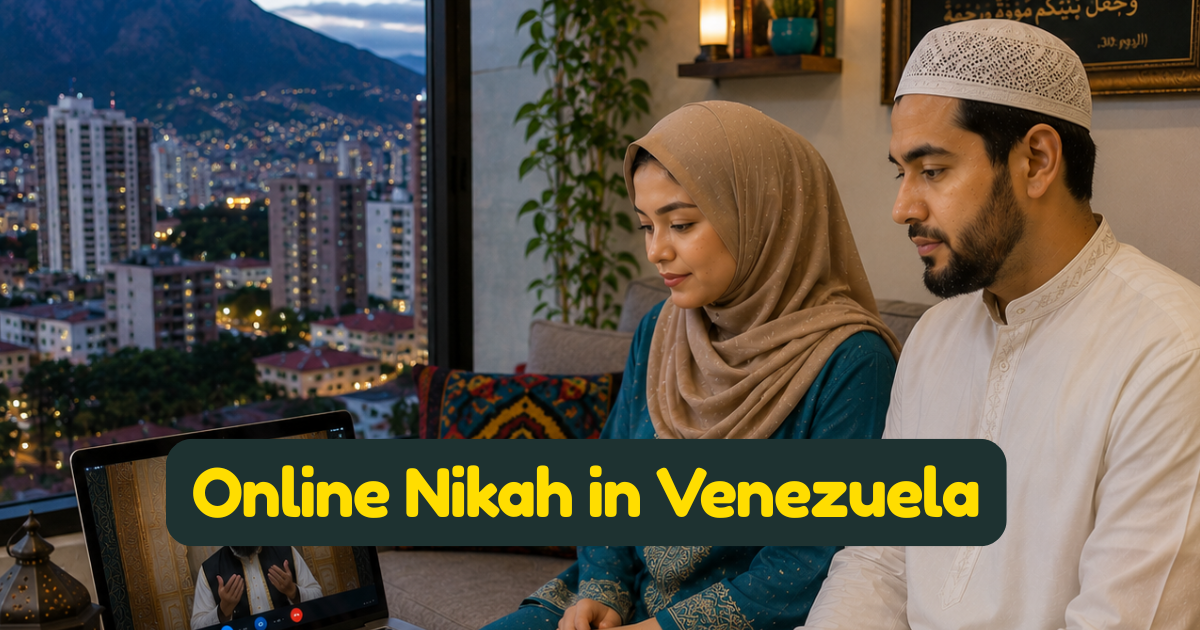
Online Nikah in Venezuela: Arab Diaspora Communities, Latin America's Tallest Minaret, and How Muslims Marry Islamically in a Civil-Only State
In the El Recreo neighbourhood of Caracas, a white dome rises above the city's skyline, capped by a single minaret that stretches 113 metres into the Venezuelan sky — the tallest minaret in Latin America. The Sheikh Ibrahim Al-Ibrahim Mosque, completed in 1993 with Saudi philanthropic funding and designed by architect Zuhair Fayez, can accommodate 3,500 worshippers and serves as the religious, educational, and social heart of Venezuela's Muslim community. As Hawzah News Agency documents in its history of Islam in Venezuela, the mosque hosts libraries, conferences, sports activities, and social services — making it far more than a place of prayer. It is an institution.
Venezuela's estimated 100,000 Muslims — approximately 0.4 percent of the national population — are predominantly of Lebanese, Palestinian, Syrian, and Turkish descent, descendants of Arab immigrants who arrived in the late nineteenth and early twentieth centuries carrying Ottoman passports and were locally nicknamed "Turcos." As the Al Mujtama Islamic Magazine notes, more than twenty-two Islamic associations and centres operate formally across Venezuela, with Muslim communities particularly concentrated in Caracas, Margarita Island, Maracaibo, and Valencia. On Margarita Island, Islamic cultural markers — hijab, Quranic inscriptions on shop walls — are visible features of everyday commercial life.
And yet this community faces a marriage challenge that the mosque's magnificent minaret cannot resolve: Venezuela is a secular state, and only a civil ceremony at the Registro Civil creates a legally recognised marriage. A nikah conducted at the Sheikh Ibrahim Al-Ibrahim Mosque, however beautiful and properly witnessed, carries no legal standing in Venezuela without a separate civil registration. Both steps are necessary, and for a community whose extended families are increasingly dispersed by Venezuela's ongoing economic and political crisis, assembling all the required parties for either step has become genuinely difficult.
Venezuela's Economic Crisis and Its Impact on Muslim Families
Since 2014, Venezuela has experienced one of the largest peacetime emigration crises in Latin American history. According to data from the United Nations and regional migration bodies reported by major international news organisations, more than 7 million Venezuelans have left the country — settling in Colombia, Peru, Chile, Ecuador, the United States, and beyond. The Muslim community has not been immune. Lebanese-Venezuelan and Palestinian-Venezuelan families, many of them in the merchant and trading classes, have relocated businesses and family members to safer economic environments. Young Muslims who grew up in Maracaibo or Valencia may now live in Bogotá or Lima, their parents still in Venezuela, their prospective spouses in Beirut or Ramallah.
This geographic dispersal creates a precise marriage problem: the Islamic contract requires a wali who may be in Caracas, a bride who may be in Colombia, and a groom who may be working in Chile. The Venezuelan Registro Civil cannot solve the distance. An online nikah, properly conducted, can.
Venezuela's Civil Marriage System: The Registro Civil
Venezuela's civil marriage is governed by the Venezuelan Civil Code and administered through the local Registro Civil in each municipality. As confirmed by the U.S. Department of State's reciprocity schedule for Venezuela, marriage records are kept by the local civil registry or the National Electoral Council (Consejo Nacional Electoral — CNE), and a civil marriage is the only legally binding form of union in the country. Religious ceremonies may follow but hold no independent legal effect.
The civil marriage process requires both parties to attend the Registro Civil in person with valid identification, birth certificates, proof of single status, and — for foreign nationals — these documents with official Spanish translation where necessary. Two witnesses must be present at the ceremony. The marriage certificate issued by the Registro Civil is the document required for all subsequent legal, immigration, and inheritance purposes. Venezuela joined the Hague Apostille Convention, meaning the Apostille can be used to authenticate Venezuelan documents for international use, though practical bureaucratic challenges in obtaining apostilled documents from Venezuela's current government agencies have been widely reported and couples are advised to plan document preparation well in advance.
What the Registro Civil Cannot Provide — and What Islam Requires
Venezuela's Registro Civil makes you legally married in Venezuela. It does not conduct a nikah. The civil registrar does not ask about the wali's consent, does not recite the ijab and qabul, does not enquire about the mahr, and does not arrange for Muslim witnesses to hear an Islamic contract. For a practising Muslim, these are not optional details — they are the substance of the marriage itself under Shariah.
A valid nikah requires the same four conditions regardless of which Venezuelan city or which continent the parties are located in:
- A wali — the bride's male Muslim guardian — whose presence and consent give the contract its Islamic validity.
- Two Muslim witnesses who genuinely hear the offer (ijab) and acceptance (qabul) as spoken.
- Agreed mahr, stated and documented as the bride's exclusive right.
- Free consent from both parties without coercion.
None of these conditions require physical proximity. A wali in Caracas, a bride in Bogotá, and a groom in Santiago can all participate in a properly conducted online ceremony without any of them moving from where they are. The contract is exactly as binding as one conducted in the Sheikh Ibrahim mosque — because what makes it binding is the fulfilment of its conditions, not the building in which they are fulfilled.
How an Online Nikah Works for Venezuela's Muslim Community
InstantNikah.com conducts Shariah-compliant online nikah ceremonies over a secure live video connection. A qualified qazi or Islamic scholar officiates. The bride's wali participates from wherever he is located — Caracas, Beirut, or any other city. Two Muslim witnesses are confirmed on the call and explicitly state that they have heard the offer and acceptance. The mahr is agreed, documented, and recorded. A nikah certificate is issued following the ceremony.
For Venezuelan Muslim couples scattered across Latin America by the emigration crisis, this is not a convenience — it is in many cases the only way to marry Islamically while the civil registration is arranged on a separate, practical timeline. For those whose wali cannot travel or who wish to appoint a proxy, our guide on how to appoint a wakeel in nikah explains the process. For Venezuelan Muslim women with no Muslim guardian accessible, a qualified imam can serve as wali — a provision addressed in our guide on finding a wali for nikah. For the scholarly basis of remote ceremonies, our guide on the video-call nikah ruling covers each madhab's position directly.
After the Nikah: Civil Registration in Venezuela or Abroad
Once the nikah is conducted, the civil registration path depends on where the couple is located.
For couples in Venezuela: Proceed to the local Registro Civil with valid identification, birth certificates, proof of single status, and two witnesses for the civil ceremony. The nikah certificate from InstantNikah.com provides supporting evidence of the Islamic contract.
For Venezuelan Muslims now living abroad: The marriage can be registered in the country of current residence — Colombia, Peru, Chile, or elsewhere — using the civil marriage laws of that country. The nikah certificate supports this process as the Islamic foundation of the union. For Venezuela's emigrant Muslim community, marrying civilly in their country of current residence is often more practical than attempting to navigate Venezuela's current bureaucratic challenges remotely.
Our comprehensive resource on registering a nikah civilly after the Islamic ceremony covers the major country-by-country sequences.
Who This Particularly Serves in Venezuela's Muslim Community
- Venezuelan Muslim families dispersed by emigration — where the bride is in one country, the groom in another, and the wali in a third. The online nikah reunites them islamically without requiring travel.
- Lebanese-Venezuelan and Palestinian-Venezuelan couples whose future spouse or wali is still in the Middle East and who cannot easily travel to Venezuela given the country's current conditions.
- Venezuelan Muslim women whose male guardian is unavailable, deceased, or unreachable, who need a qualified alternative arranged.
- Venezuelan converts — the community has reported over 3,000 local conversions in recent decades — whose families are non-Muslim and who need a wali appointed.
Quick Answers for Muslims in Venezuela
Is a nikah legally recognised in Venezuela? No. Only a civil ceremony at the Registro Civil creates a legally recognised marriage in Venezuela. A nikah conducted at a mosque carries no legal standing without civil registration.
Is an online nikah Islamically valid from Venezuela? Yes — when the wali participates, two witnesses genuinely hear the contract, mahr is agreed, and consent is free. Venezuela's civil requirements do not affect the Islamic validity of the nikah.
What if my wali is in Lebanon or Palestine? He can participate in the online ceremony remotely, or appoint a wakeel — a proxy — to represent him. Both approaches are recognised under Islamic jurisprudence.
Can Venezuelan Muslims living abroad register their marriage outside Venezuela? Yes. The marriage can be registered civilly in the country of current residence using local civil marriage law, with the nikah certificate supporting the process as evidence of the Islamic contract.
The Tallest Minaret in Latin America — and a Gap It Cannot Bridge
The Sheikh Ibrahim Al-Ibrahim Mosque stands as a symbol of Islam's permanent, dignified presence in Venezuela — an architecture of faith in a country that has welcomed Arab Muslim merchants and their descendants for over a century. But even the tallest minaret in Latin America cannot reunite a wali in Caracas with a bride in Bogotá and a groom in Santiago. Distance is the challenge that geography creates and that a properly conducted online nikah resolves. InstantNikah.com brings the qualified officiant, the witnesses, and the wali arrangement to wherever Venezuela's dispersed Muslim community finds itself today. When you are ready, book your online nikah and speak with our team about your circumstances.
Admin User
Author