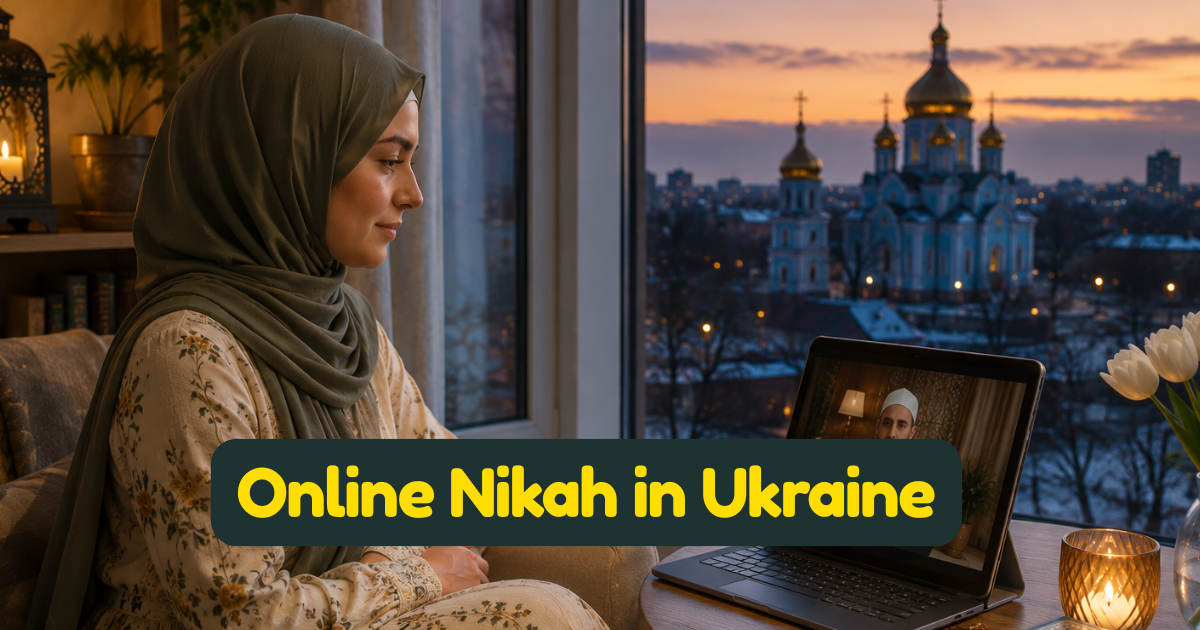
Online Nikah in Ukraine: Eight Hundred Years of Crimean Tatar Islamic Heritage, Wartime Displacement, and How Muslim Couples Marry When the Registry Office Is Unreachable
In 1223, when the Golden Horde's Mongol armies first reached the shores of the Black Sea, Islam had already been present in the Crimean Peninsula for centuries. When the Crimean Khanate was formally established in the 15th century — under Ottoman protection, governing from the magnificent palace complex at Bakhchisarai — it became one of the major Islamic powers of Eastern Europe, a state with its own mosques, madrasas, scholars, and legal institutions that endured for three hundred years. The Crimean Tatars who emerged from this history are not immigrants to Europe. They are, as the Religious Administration of Muslims of Ukraine describes them, indigenous inhabitants of European soil — the indigenous people of the Crimean Peninsula — whose Islamic faith is older than most of the nations that now surround them.
By the early 2022 estimates cited in the U.S. State Department's International Religious Freedom Report and documented by Vox Theologia's analysis of Ukraine's wartime Muslim community, approximately one million Muslims lived in Ukraine — representing around two percent of the total population — making Islam the country's second religion after Christianity. Of those, at least 300,000 were Crimean Tatars, with additional communities of Volga Tatars, Arab students and professionals, Azerbaijanis, Turks, Uzbeks, and other Muslim workers in Kyiv and major cities. When Russia annexed Crimea in 2014 and launched the full-scale invasion in February 2022, approximately 700,000 of those Muslims found themselves in occupied territory or in active conflict zones. The Research for Internal Displacement platform documents how this transformed the geographic distribution of Ukrainian Islam almost overnight — displacing communities that had maintained mosques, madrasas, and Islamic institutions for centuries into the temporary accommodations of Lviv, Warsaw, Berlin, and beyond.
The Crimean Tatar Story: Deportation, Return, and Displacement Again
The 2014 and 2022 displacements were not the first time the Crimean Tatars were driven from their homes. In 1944, Stalin accused the entire Crimean Tatar population of collaborating with Nazi Germany and ordered the mass deportation of at least 200,000 people to Central Asia — primarily Uzbekistan — in sealed cattle wagons. Mosques were demolished, schools were closed, libraries were burned, and the Tatar language was suppressed. Only after the Soviet Union's collapse in 1991 were the surviving Tatars and their descendants able to return to Crimea and begin rebuilding what had been systematically destroyed. They had been gone for nearly fifty years. They came back to a peninsula where their mosques were ruins and their history had been erased from official records.
The return was followed by three decades of painful reconstruction — rebuilt mosques, re-established communities, renewed Islamic institutions — and then, in 2014, Russia annexed Crimea again. And in 2022, the full invasion came. As Middle East Eye has documented, Ukraine once had nearly 1,500 mosques — a testament to the depth of Crimea's Islamic heritage. That heritage is now, once again, under occupation.
What the War Has Done to Islamic Marriage in Ukraine
For Muslim couples in Ukraine's current circumstances, the practical challenge of contracting a valid nikah has never been more acute. Consider the situations that now exist simultaneously across Ukraine's diaspora:
- A Crimean Tatar groom is serving in the Ukrainian armed forces, defending the country whose citizenship his family reclaimed after decades of exile. His fiancée is in Germany as a refugee. Her father — the wali — is in occupied Crimea, unable to leave and unable to communicate freely. The DRACS civil registry office they would normally attend is inaccessible. Their circumstances demand a solution the Ukrainian state cannot currently provide.
- A displaced Crimean Tatar family has settled in Poland. The couple wants to marry Islamically before completing the Polish civil registration. The family's wali — the bride's uncle — is in Turkey, where many Crimean Tatars fled in previous generations. Finding a qualified imam in Poland is possible but finding one who can also ensure all Islamic conditions are met is more difficult.
- An Arab Muslim student who was studying in Kharkiv when the invasion began has relocated to western Ukraine. His fiancée is in Egypt. The normal civil registry process — requiring several months of presence in Ukraine and a complex document chain — is essentially impossible under current conditions.
An online nikah conducted through InstantNikah.com does not resolve the civil registration challenge — that remains a process that must eventually be completed through DRACS or through the civil registry of the country where the couple is currently living. But it resolves the Islamic side immediately and properly, ensuring the couple is Islamically married while the civil process follows at whatever pace circumstances allow.
Ukraine's Civil Marriage System: DRACS and the Wartime Adaptations
Ukraine recognises only state-registered marriages — religious ceremonies including a nikah have no legal standing under Ukrainian law, as confirmed by VKP Ukrainian legal practice. Marriage is registered through the DRACS (State Registration of Civil Status Acts) at local civil registry offices. The standard procedure requires a one-month waiting period after the joint application is submitted, with documents including both parties' passports (translated into Ukrainian), a certificate of no impediment to marriage from the home country (apostilled), and documentation of any prior marriages.
Ukraine has been a Hague Apostille Convention member since 1992, meaning documents from most Muslim-majority countries — including Turkey, Egypt, Pakistan, and the Central Asian states — can be apostilled rather than requiring full consular legalisation. As the Visit Ukraine blog documents, since 2016 a paid same-day marriage registration option exists in certain Ukrainian cities, and the Ministry of Justice has expanded digital services through the Diia app — even during wartime, marriages can be registered electronically in some circumstances.
Critically, Ukraine has also simplified marriage registration for military personnel during the conflict. As documented by Visit Ukraine's wartime guidance, civil registry offices are obliged to accommodate marriages involving servicemen, with simplified procedures in place for 2025. For Crimean Tatar soldiers at the front who wish to marry before deployment or during brief leave, these wartime simplifications exist — but they address the civil side only, not the Islamic contract.
For Couples Now in Europe: Civil Registration Outside Ukraine
The majority of Ukrainian Muslim refugees in Europe — in Poland, Germany, the Czech Republic, and beyond — will complete their civil registration in their country of temporary or permanent residence rather than in Ukraine. As the Visit Ukraine guidance confirms, marriages contracted abroad in compliance with the laws of both parties' home countries are recognised in Ukraine once the foreign marriage certificate is apostilled, officially translated into Ukrainian, and submitted to DRACS for registration.
For a Crimean Tatar couple now living in Germany, this means: an online nikah for the Islamic contract, a German civil registry (Standesamt) ceremony for the German legal marriage, and subsequent registration of that German marriage in Ukraine's DRACS system when possible. For detailed guidance on the civil registration sequence across major European countries, see our resource on registering a nikah civilly after the Islamic ceremony.
How an Online Nikah Serves Ukraine's Displaced Muslim Community
InstantNikah.com conducts Shariah-compliant online nikah ceremonies over a secure live video connection. A qualified qazi officiates. The bride's wali participates from wherever he is — Turkey, Poland, Germany, or any other country where displaced Crimean Tatars and Ukrainian Muslims have settled. Two Muslim witnesses confirm on the call that they have heard the offer and acceptance. The mahr is agreed and documented. A nikah certificate is issued after the ceremony.
For the Crimean Tatar soldier at the front, the displaced family in Warsaw, or the Arab student in Lviv — the online nikah provides the Islamic contract with certainty, proper documentation, and without requiring any party to be physically present in a specific location. Where the wali cannot attend or needs to appoint a proxy, our guide on appointing a wakeel in nikah explains the process. For the scholarly basis of remote ceremonies, our guide on the video-call nikah ruling covers each major madhab's position. For Muslim converts among Ukraine's small but present Ukrainian convert community who have no Muslim wali, our guide on how a convert finds a wali for nikah addresses the appointment process.
Quick Answers for Ukrainian Muslims and the Diaspora
Is a nikah legally recognised in Ukraine? No. Ukraine recognises only marriages registered through DRACS civil registry offices. Religious ceremonies including a nikah have no independent legal standing under Ukrainian law.
Is an online nikah Islamically valid from Ukraine or from the diaspora? Yes — when the wali participates, two witnesses genuinely hear the contract, mahr is agreed, and consent is free. The location of the parties does not affect the Islamic validity of the contract.
Can a Ukrainian couple register their civil marriage outside Ukraine? Yes. A marriage contracted abroad in compliance with the laws of the country where it was registered is recognised in Ukraine after the foreign certificate is apostilled, translated into Ukrainian, and submitted to DRACS for registration.
Are there wartime simplifications for marriage registration in Ukraine? Yes. Simplified civil marriage registration procedures exist for military personnel, and same-day registration is available in some cities through a paid service. Digital registration through the Diia app has also been expanded.
Eight Hundred Years, Three Deportations, One Community Still Standing
The Crimean Tatars have survived the Russo-Turkish wars, the Russian annexation of 1783, the 1944 Soviet deportation, the 1991 return, the 2014 annexation, and the 2022 full invasion. Through all of it they have remained Muslim — not because the state protected their Islam but because the community carried it themselves, in prayer circles in Uzbek exile, in rebuilt mosques in post-Soviet Crimea, in improvised Friday prayers in Polish refugee centres. The nikah has never been something they needed the Ukrainian state to conduct. It is something the community has always conducted for itself. InstantNikah.com makes that possible from anywhere in the world — with a qualified qazi, proper witnesses, a participating wali, and the documentation to support whatever civil process follows. When you are ready, book your online nikah and speak with our team about your circumstances, wherever in Ukraine or Europe you currently are.
Admin User
Author