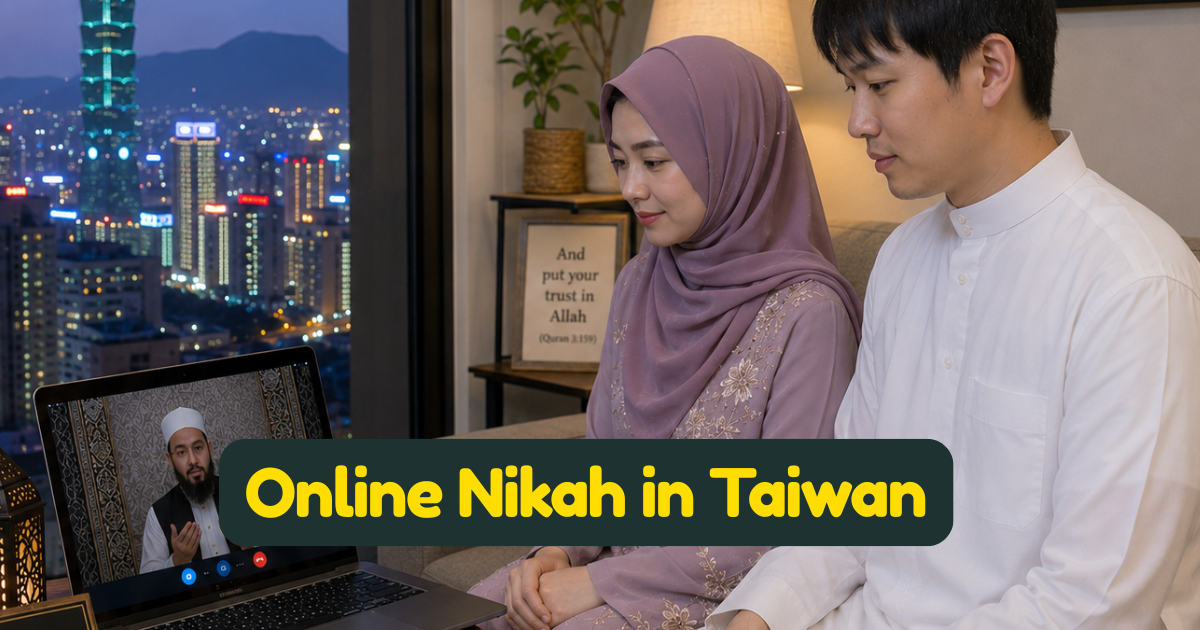
Online Nikah in Taiwan: Household Registration, the Indonesian Muslim Worker Community, and How to Marry Islamically in a Country With No Shariah Court
The Taipei Grand Mosque sits in the Da'an district of Taipei, a white-domed building that has stood since 1960 and remains the most recognisable symbol of Islam in Taiwan. On Fridays it fills with worshippers from across the island's diverse Muslim community — Hui Chinese Muslims whose families came with the Kuomintang retreat in 1949, Yunnanese Muslims descended from nationalist soldiers who fled mainland China through Myanmar and Thailand, and the much larger and more recent community of Indonesian migrant workers who now make up the largest Muslim group in the country. According to the U.S. Department of State's 2023 Taiwan International Religious Freedom Report, there were approximately 264,300 Indonesian nationals working in Taiwan as of 2022, the vast majority of them Muslim, representing the single largest group of foreign workers in the country.
Research published by Grokipedia citing official labour data places the total Muslim population in Taiwan at approximately 250,000 to 300,000 as of 2024 — roughly one percent of the island's total population of 23.4 million — when foreign workers, marriage migrants, students, and the smaller indigenous Taiwanese Muslim community are counted together. These are people who worship, work, and form families in Taiwan. And for the large share of them who want to marry Islamically, the situation is both simpler and more complicated than it might first appear.
How Marriage Legally Works in Taiwan — and Why It Is Different from Every Other Country in This Series
Taiwan's marriage system is unlike any other country covered in this Gulf and Asia series. There are no courts that conduct or register marriages. There are no civil registry offices equivalent to Mexico's Registro Civil or Brazil's Cartório. Marriage in Taiwan is administered through the island's network of household registration offices — the same offices that handle birth, death, and residence records — under the Household Registration Act of Taiwan, which explicitly states that any marriage shall be subject to marriage registration and that household registration offices in each jurisdiction are responsible for processing it.
A marriage in Taiwan requires a marriage contract bearing the signatures of two witnesses, both parties' identification documents, and for foreign nationals, a certified marital status certificate from the home country verified by a Taiwan representative office (embassy or representative office) abroad. As confirmed by the Taipei City Department of Civil Affairs, both parties must apply at the household registration office in person. There is no mandatory waiting period equivalent to Brazil's thirty-day habilitação — in straightforward cases, registration can be processed in a single visit.
The complication for many Muslim migrant workers — particularly Indonesians and Pakistanis — is a specific additional requirement. The Taiwan Ministry of Foreign Affairs maintains a list of "particular countries" whose nationals must complete the marriage registration in their home country first, then bring the verified marriage documents to a Taiwan representative office abroad for verification and interview, before completing household registration in Taiwan. This interview process, documented by the Taoyuan City Government's marriage registration guidance, exists to prevent fraudulent marriages and applies to a number of Southeast Asian and South Asian nationalities. For a Muslim couple where one or both parties are from such a country, the civil process is not a single Taiwan-based visit — it is a multi-step process that may involve home-country registration first.
Critically, like every other country in this series outside the Gulf states, religious ceremonies in Taiwan have no legal effect whatsoever. A nikah conducted at the Taipei Grand Mosque, however properly witnessed and observed, creates no legal marriage under Taiwan's Household Registration Act. The nikah and the household registration are entirely separate steps, both of which a practising Muslim couple needs to complete.
The Indonesian Migrant Worker Reality: Taiwan's Largest Muslim Group
Of Taiwan's estimated 280,000 to 300,000 Muslims, the majority are Indonesian. As the Taipei Times has documented, Indonesian workers first arrived in significant numbers after Taiwan's 1989 labour market liberalisation, with Indonesian Muslim women now forming 77 percent of Taiwan's foreign domestic care workers. Many of these women are employed in private households across Taipei, Taoyuan, Kaohsiung, and New Taipei, working in elderly care and childcare roles on two-year contracts that can be renewed.
For an Indonesian Muslim woman working as a caregiver in Taipei, the barriers to a properly conducted nikah are layered and real. Her employer may not grant extended leave for a home visit. Her wali — her father or next closest male guardian — is in Java or Sumatra. The Taiwan Ministry of Foreign Affairs may require her marriage to be registered in Indonesia first before it can be recognised in Taiwan. And finding a qualified Islamic scholar in Taiwan who can properly conduct all elements of a nikah — wali, two Muslim witnesses, mahr agreement, offer and acceptance — is not guaranteed even in Taipei.
An online nikah conducted by InstantNikah.com resolves every one of these layers simultaneously. The wali joins the ceremony from Indonesia. Two qualified Muslim witnesses confirm on the call that they heard the offer and acceptance clearly. The mahr is agreed and documented. The nikah certificate issued afterwards can support both the Indonesian civil registration process and the subsequent Taiwan household registration verification. The contract itself is Islamically valid from the moment it is concluded — the civil paperwork catches up in its own time.
The Islamic Conditions That Apply in Taiwan As Everywhere Else
Taiwan's household registration office asks about names, nationalities, and marital status history. It does not ask about the wali, the mahr, or whether two Muslim witnesses heard the ijab and qabul. These conditions belong entirely to the Islamic side of the marriage and must be arranged independently of whatever the household registration office requires.
A valid nikah requires the same four elements it has always required:
- A wali — the bride's male Muslim guardian — whose presence and consent give the contract its validity. Where no natural wali is accessible, a qualified imam or Muslim scholar can be appointed to fill this role, as our guide on finding a wali for nikah explains.
- Two Muslim witnesses who genuinely hear the offer (ijab) and acceptance (qabul) as spoken. Their location at the time of hearing — whether in the same room or on a live video call — is secondary to the quality of their hearing and understanding.
- Agreed mahr, stated as the bride's exclusive right and documented in the contract.
- Free consent from both parties without coercion.
For the scholarly basis of remote nikah ceremonies across the Shafi'i and Hanafi schools — both of which are followed within Taiwan's Indonesian and Pakistani Muslim communities respectively — our detailed guide on the video-call nikah ruling provides a madhab-by-madhab treatment. The specific question of whether witnesses can be appointed to attend remotely is addressed in our analysis of whether nikah witnesses can be appointed remotely.
Taiwan's Muslim Community Beyond the Indonesian Workers
While the Indonesian worker community dominates the numbers, Taiwan's Muslim landscape includes several other groups whose marriage situations differ in important ways.
Hui Chinese Muslims — whose families arrived with the Kuomintang retreat in 1949 — are naturalised Taiwanese citizens with full household registration rights. For them, the Islamic marriage question is purely about the nikah itself, since their civil registration as Taiwanese citizens is already established. Finding a qualified qazi for a nikah in Taiwan can still be logistically difficult outside Taipei.
Yunnanese Muslims from Myanmar and Thailand, who migrated to Taiwan from the 1980s onward, sit in a similar position — long-term residents whose Islamic marriage needs may not be met by the limited number of qualified scholars available on the island.
Malaysian and Pakistani students and professionals form a smaller but growing community in Taiwan's universities and technology sector, many of whom plan to marry while working or studying here. For them, the interview requirement for Pakistani nationals before Taiwan household registration adds procedural complexity.
For all of these groups, an online nikah conducted by a qualified qazi provides the Islamic contract with certainty and proper documentation, regardless of what the civil process requires.
After the Nikah: Civil Registration in Taiwan
Once the nikah has been conducted and the nikah certificate issued, the civil registration path depends on the couple's nationalities and circumstances.
For couples where one party is a Taiwanese citizen: The marriage contract and supporting documents — including the foreign spouse's passport, marital status certificate verified by the Taiwan representative office, and Chinese name declaration — are submitted to the household registration office. The Taipei Household Registration Office confirms both parties must apply in person where possible.
For couples where the foreign national is from a "particular country": Complete the marriage registration in the home country first, then have the marriage certificate verified at the Taiwan representative office abroad, pass the interview, and then complete household registration in Taiwan with the verified documents. The nikah certificate from InstantNikah.com supports the home-country registration step as evidence of the Islamic contract.
For couples both of whom are foreign nationals: Taiwan's government portal confirms that the household registration office handles marriage and related civil status registrations. For two foreigners both resident in Taiwan, the relevant local office handles the application. Our guide on registering a nikah civilly after the Islamic ceremony covers the broader framework.
Situations an Online Nikah Resolves in Taiwan
- Indonesian domestic workers on two-year contracts whose wali is in Java or Sumatra and who cannot take home leave for a mosque ceremony. The online nikah completes the Islamic marriage now; the Indonesian civil registration and Taiwan interview process follow.
- Pakistani or Malaysian professionals and students whose fiancée is abroad and whose civil registration requires an interview process that takes additional weeks to complete.
- Hui Chinese or Yunnanese Muslims with full Taiwanese residency who want a properly conducted nikah but cannot find a qualified qazi for the ceremony in their city.
- Long-distance couples where one partner is in Taiwan and the other is in a Muslim-majority country — the online nikah creates the Islamic marriage contract across any distance.
- Muslim converts — including Taiwanese who have embraced Islam — who have no Muslim wali and need a qualified alternative arranged before the nikah can proceed.
Quick Answers for Muslims in Taiwan
Is a nikah at the Taipei Grand Mosque legally recognised in Taiwan? No. Religious ceremonies have no legal standing in Taiwan. Only registration at a household registration office creates a legally recognised marriage.
Is an online nikah Islamically valid from Taiwan? Yes — when the wali participates, two witnesses genuinely hear the contract, mahr is agreed, and consent is free. Taiwan's civil requirements do not affect the Islamic validity of the contract.
Do Indonesians need to marry in Indonesia first before Taiwan recognises the marriage? For nationals of countries on Taiwan's Ministry of Foreign Affairs list of "particular countries," the marriage must be registered in the home country first and then verified at a Taiwan representative office before household registration in Taiwan can be completed.
Can my wali in Indonesia join the nikah ceremony remotely? Yes. He participates in the online ceremony from wherever he is located, or can appoint a proxy (wakeel). Our guide on appointing a wakeel in nikah explains the process.
A Muslim-Friendly Island — and a Gap Only the Nikah Can Fill
Taiwan has earned a genuine reputation for Muslim-friendliness — the Halal in Travel Awards named it the most Muslim-inclusive destination for any non-OIC country in 2022, according to reporting by the Taipei Times. Prayer rooms appear in airports and shopping centres. Halal restaurants are available across major cities. The state offers religious freedom without bureaucratic interference. What it does not offer is an Islamic marriage contract — and no amount of Muslim-friendliness changes that. The nikah belongs to the couple, arranged between them and a qualified scholar. InstantNikah.com brings that scholar, the witnesses, the wali, and the documentation to wherever you are in Taiwan — in a ceremony that is complete, valid, and properly recorded. When you are ready, book your online nikah and let our team guide you through every step.
Admin User
Author