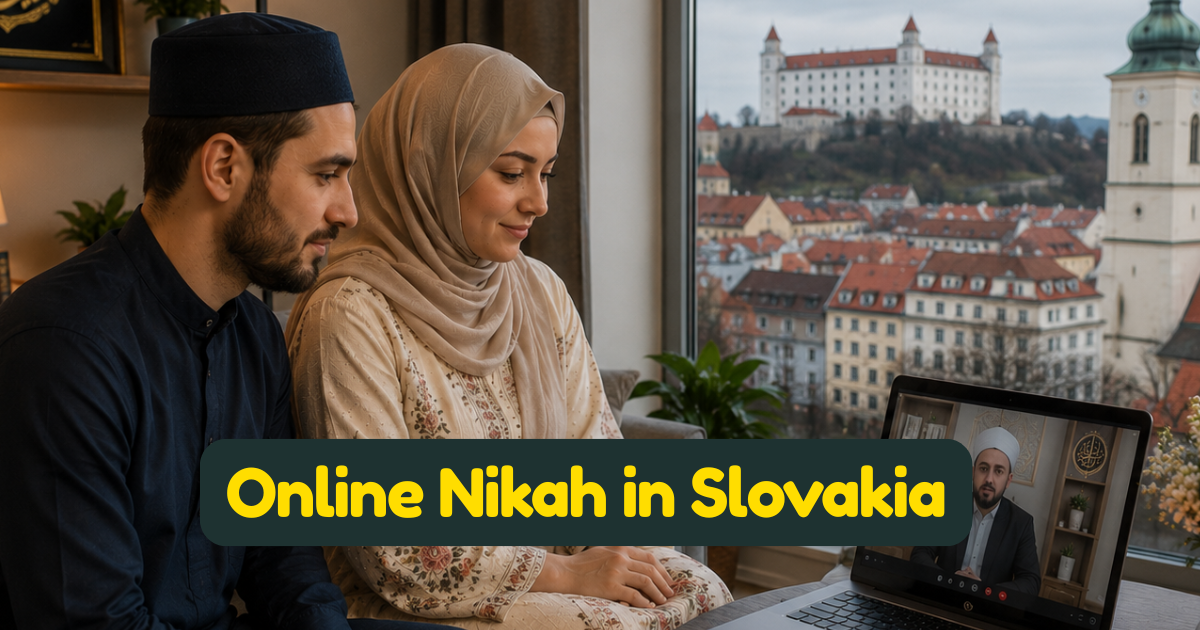
Online Nikah in Slovakia: The Only EU Country Without a Mosque, a Law Designed to Exclude Islam, and How 6,000 Muslims Marry in a State That Does Not Recognise Their Faith
Every country in this series has a civil marriage system that does not conduct nikah ceremonies. That is standard. What makes Slovakia different — what makes it unlike any other country in this series — is that the gap between Islam and the state is not passive neglect. It is deliberate law. In 2016, Slovakia's parliament enacted legislation raising the threshold for official religious recognition from 20,000 to 50,000 adult permanent residents with documented membership. The bill was drafted by the ultra-nationalist Slovak National Party, whose members made no secret of its purpose. As reported by Associated Press coverage of the vote, Prime Minister Robert Fico had previously declared that Slovakia was "not a suitable place for Muslims to live." The 50,000 threshold was chosen precisely because it was roughly ten times the estimated size of Slovakia's Muslim population, making it structurally impossible for Islam to ever achieve legal recognition under current demographics.
The consequences, documented by the U.S. Department of State's International Religious Freedom Report on Slovakia, are significant: unregistered religious groups cannot access state subsidies, tax exemptions, military chaplaincy services, or — most visibly — construction permits for dedicated places of worship. As Grokipedia's comprehensive Islam in Slovakia entry confirms, Slovakia is the only EU member state without an officially recognised mosque. Muslims in Bratislava pray in the Islamic Center Cordoba — a rented facility that functions as a prayer room — not in a mosque with legal status. Applications to build a mosque in Bratislava have been rejected by the city's mayor. The Islamic Foundation in Slovakia operates as a civic association, not as a registered religious body.
For Muslims trying to marry in this environment, the practical consequences are direct: there is no authorised Islamic officiant in Slovakia who can conduct a marriage with legal standing. Every Muslim couple in Slovakia must use the civil Matrika registry for the civil marriage, and must arrange the nikah entirely independently — through a community imam who has no state recognition, or through a properly conducted online ceremony with a qualified qazi.
Who Slovakia's Muslims Actually Are
Slovakia's Muslim community numbers approximately 6,000 by Islamic Foundation estimates, against a 2021 census figure of 3,862 self-identified Muslims — a gap that reflects the community's reasonable reluctance to identify publicly in a hostile political environment. The community is primarily composed of immigrants from Albania, Turkey, Iran, and Arab countries, alongside students at Slovak universities and fewer than 150 Slovak converts since 1989. As Wikipedia's Islam in Slovakia article confirms, most Muslims live in the capital Bratislava, with smaller communities in Košice and Martin.
Slovakia does carry a distant Islamic historical layer: the southern and central Slovak regions were under Ottoman control for portions of the 16th and 17th centuries following the Hungarian defeat at Mohács in 1526, and the University Library of Bratislava holds a collection of Islamic manuscripts on logic, astronomy, and literature acquired through scholarly exchanges. But the modern Muslim community has essentially no institutional continuity with that Ottoman presence — it is an immigrant and student community of the post-communist era, small, politically marginalised, and entirely dependent on informal community structures.
The Matrika: Slovakia's Civil Marriage Registry
Slovakia's civil marriage is administered through the Matrika — the civil registry office at the municipal or city district level. As confirmed by the U.S. Embassy in Slovakia's marriage guidance, foreigners wishing to marry in Slovakia must present the Matrika with an eligibility-to-marry document — a Marriage Affidavit or Certificate of No Impediment — from their home country, legalised for use in Slovakia through apostille or consular legalisation, plus an apostilled and Slovak-translated birth certificate and documentation of any prior marriages.
The registry office is chosen based on the permanent residence of one of the spouses. As Slovak immigration specialists IOM Migration Information Center Slovakia confirm, legalisation is not required for documents from countries with which Slovakia has bilateral legal assistance agreements — covering most EU neighbours but not most Muslim-majority countries. Slovakia joined the Hague Apostille Convention, so for countries in the Convention — Turkey, Egypt, Pakistan, Morocco — the apostille route applies.
Church marriages are also technically possible in Slovakia — a couple may marry in a registered church and submit the certificate to the Matrika within 3 days for civil recognition, as noted by Slovak legal specialists at Lawyers Slovakia. But since Islam is not a registered religion in Slovakia, an Islamic ceremony has no such pathway. An imam in Bratislava cannot submit a marriage declaration to the Matrika. The nikah must be arranged completely separately from the civil process.
The Islamic Historical Irony: Manuscripts but No Mosque
It is worth pausing on the historical paradox that Slovakia's own university library holds Islamic manuscripts — works of Islamic scholarship in logic, astronomy, and literature — while simultaneously being the only EU country to deny Islam the right to build a mosque. The manuscripts arrived through intellectual exchange; the denial of mosque construction arrived through a parliamentary vote. One reflects the medieval European encounter with Islamic scholarship; the other reflects the political anxieties of a 21st-century post-communist state responding to the 2015 refugee crisis. Both are equally real features of Slovakia's relationship with Islam.
What This Means for Muslim Marriage in Slovakia
For a Muslim couple in Bratislava, the situation is structurally clear: the Slovak state will register their marriage at the Matrika, and the Slovak state will never conduct their nikah. The nikah must be arranged through the community — through a willing imam who functions without legal status — or through a properly conducted online ceremony with a qualified qazi whose authority rests on Islamic scholarship rather than Slovak state recognition.
A valid nikah requires the same four conditions regardless of whether Slovakia recognises Islam:
- A wali — the bride's male Muslim guardian — whose consent gives the contract Islamic validity. For Muslim women in Slovakia whose family is in Turkey, Albania, Egypt, or Pakistan, the wali is almost certainly abroad.
- Two Muslim witnesses who genuinely hear the offer (ijab) and acceptance (qabul) as spoken.
- Agreed mahr, documented as the bride's exclusive right.
- Free consent from both parties without coercion.
In a community of 6,000 people scattered across a country of 5.46 million, finding a qualified qazi who can properly meet all these conditions — particularly when the wali is abroad — is genuinely difficult. An online nikah conducted through InstantNikah.com resolves this: the qazi officiates remotely, the wali joins from Turkey or Albania or Egypt, two witnesses are confirmed on the call, the mahr is agreed, and a nikah certificate is issued. For the scholarly basis of remote ceremonies, our guide on the video-call nikah ruling covers each major madhab. Where a wali appoints a proxy, our guide on appointing a wakeel in nikah explains the process. For Slovak converts with no Muslim family, our guide on how a convert finds a wali for nikah addresses the appointment.
After the Nikah: Civil Registration at the Matrika
The civil Matrika ceremony completes the legal side. Both parties attend the registry office in the district of one spouse's residence, with apostilled birth certificates, an eligibility-to-marry document from the home country (apostilled and translated into Slovak by a certified translator), and documentation of any prior marriages. The Matrika registers the marriage and issues a Slovak marriage certificate. For marriages concluded abroad, Slovak citizens must register the foreign marriage in Slovakia's Special Registry through the relevant registry office or Slovak diplomatic mission, as confirmed by Slovak law firm AKMV Lawyers.
For a broader country-by-country civil registration guide, see our resource on registering a nikah civilly after the Islamic ceremony.
Quick Answers for Muslims in Slovakia
Is Islam a legally recognised religion in Slovakia? No. Slovakia's 2016 law set the recognition threshold at 50,000 adherents — approximately ten times Slovakia's Muslim population — effectively barring Islam from legal recognition. Muslims operate through civic associations, not registered religious bodies.
Is there a mosque in Slovakia? No. Slovakia is the only EU member state without an officially recognised mosque. Muslims in Bratislava use the rented Islamic Center Cordoba as a prayer space. Applications to build a mosque have been rejected by the city.
Is an online nikah Islamically valid from Slovakia? Yes — when the wali participates, two witnesses genuinely hear the contract, mahr is agreed, and consent is free. Slovakia's refusal to recognise Islam does not affect the Islamic validity of the nikah contract.
Can an imam in Bratislava legally marry a Muslim couple? No. Since Islam is not a registered religion in Slovakia, an imam cannot submit a marriage declaration to the Matrika. Only a civil Matrika ceremony creates a legally recognised marriage.
A Law Against a Mosque — and a Faith That Needs Neither State Permission Nor a Minaret to Contract a Nikah
Slovakia's parliament can raise a registration threshold to 50,000. It can reject mosque construction permits. It can strip a religious community of state subsidies, tax exemptions, and legal status. What it cannot do — what no parliament anywhere has ever been able to do — is change the conditions that make a nikah valid under Islam. Those conditions predate the Slovak state by fourteen centuries. They require a wali, two witnesses, an agreed mahr, and free consent. They do not require state recognition, a registered officiant, or a minaret. InstantNikah.com ensures those conditions are fulfilled correctly and completely, for every Muslim couple in Slovakia who needs a properly conducted nikah in a country that will never provide one. When you are ready, book your online nikah and speak with our team.
Admin User
Author