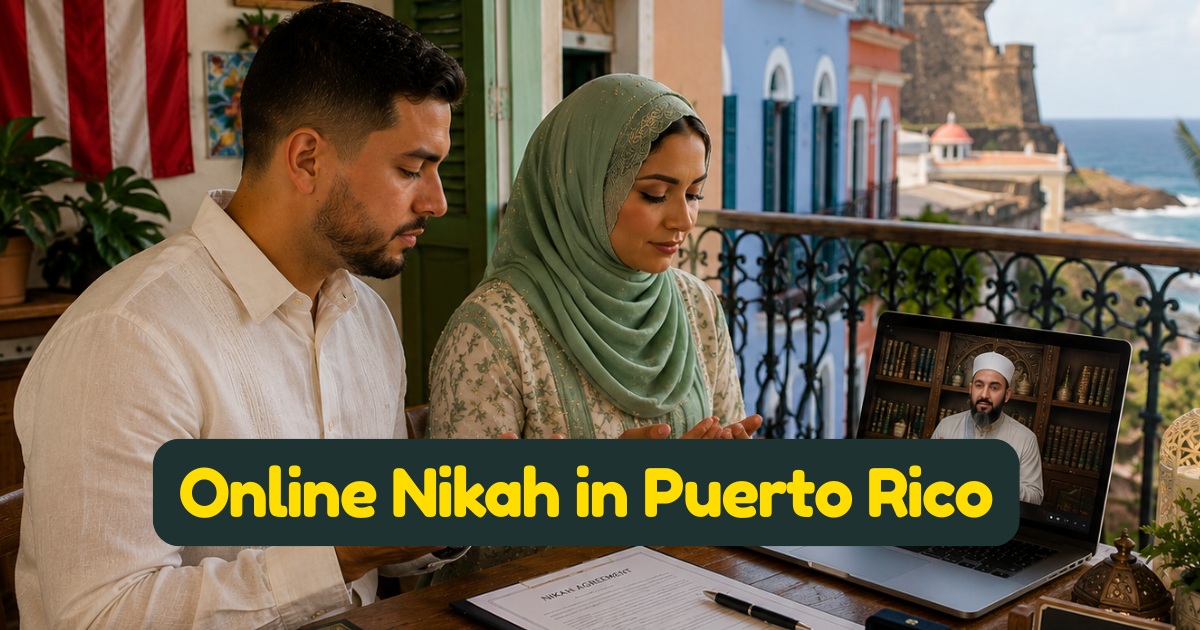
Online Nikah in Puerto Rico: Palestinian Founders, Nine Mosques, the Search for Boricua Islamidad, and a Registro Demográfico That Requires a Medical Exam Before Your Wedding
The first Muslims to arrive in Puerto Rico in significant numbers came from Palestine and Jordan — families displaced by the 1948 Arab-Israeli war, who found their way across the Atlantic to a Caribbean island that had itself been colonised, transferred between empires, and reshaped by successive waves of displacement and migration. They arrived between 1958 and 1962, settling primarily in Caguas in the island's central region south of San Juan, where they opened restaurants, jewelry stores, and clothing outlets. As documented by Arab News's historical documentation of Muslims in Puerto Rico, a 1973 visit by Dr. Ali Kettani found the Muslim population had reached approximately 2,000, 80 percent of them Palestinian, and described their religious situation as the most difficult he encountered during a 78-day, 28-country survey. There were no mosques. The community prayed wherever it could.
Half a century later, the picture is radically different. Puerto Rico now has nine mosques, including the Al-Faruq Mosque in Vega Alta — the largest, with a capacity of 1,200 men and 120 women — and the Masjid Montehiedra in the southern suburbs of San Juan, which holds the largest population of Muslim converts on the island. As documented by Wikipedia's Islam in Puerto Rico entry, the first mosque was established in Río Piedras in 1981, near the University of Puerto Rico, where Muslim student communities played a significant role in early Islamic education. The estimated Muslim population of approximately 5,000 (as of the most recent 2007 count) includes both the original Palestinian-descended families and a growing body of Puerto Rican converts — people who discovered Islam on their own terms and are forging what The Conversation's research on Puerto Rican Muslims calls "Boricua Islamidad" — a uniquely Puerto Rican Islamic identity.
Boricua Islamidad: The Convert Community's Search for Identity
The concept of "Boricua Islamidad" — Puerto Rican Islamic identity — captures something specific about the island's Muslim converts that distinguishes them from both the Arab diaspora community and from mainland US Latino Muslims. Puerto Rican converts are straddled, as The Conversation's research notes, "between a predominantly Arab Muslim population on the one hand and their avowedly Puerto Rican families, neighbors and co-workers who imagine Islam as a religion foreign to Puerto Rico." They resist complete assimilation into Arab cultural norms while simultaneously re-imagining what it means to be Puerto Rican and Muslim simultaneously.
One expression of this reclamation is the growing "halal tourism" movement, documented by Islamic Horizons through the story of Miriam Colón, a Puerto Rican convert who returned to the island after years in New Jersey and developed a tourism business exploring Puerto Rico's pre-colonial and Andalusian-connected Islamic heritage. Like the Latino Muslims of Houston described elsewhere in this series, Puerto Rican converts are framing Islam not as a foreign religion but as a recovery of an ancestral connection stripped away by Spanish colonisation — a narrative that gives their conversion personal and cultural depth alongside its spiritual dimension.
For this convert community, the nikah challenge is identical to that of Latina converts everywhere: a Puerto Rican woman who embraces Islam almost certainly has a Catholic or evangelical family. Her father is not a Muslim. Her brothers are not Muslim. She has no natural wali. The solution — a qualified imam appointed as her guardian — is the mainstream scholarly provision, and it is the provision InstantNikah.com arranges as standard for every convert bride whose family cannot supply the Islamic guardian role. Our guide on how a convert finds a wali for nikah covers the appointment process in detail, and our Muslim convert nikah checklist prepares converts for every step.
Puerto Rico's Unique Civil Marriage Framework
Puerto Rico operates under its own civil law system — a unique hybrid of Spanish civil law tradition and US federal jurisdiction. Marriage is governed by Puerto Rico's 2020 New Civil Code, administered by the Registro Demográfico (Demographic Registry), which falls under the Department of Health rather than a justice ministry as in most countries. As confirmed by American Marriage Ministries' Puerto Rico marriage law guide, Article 384 of the New Civil Code sets out several distinctive requirements:
- Medical examinations required by law — couples must undergo medical examinations before the marriage ceremony. The medical certification has a validity of only 10 calendar days from issuance, meaning the ceremony must take place within 10 days of receiving the medical certificate. This is one of the most distinctive civil marriage requirements in the entire Americas.
- A sworn affidavit of capacity to marry, contained within the Demographic Registry's marriage certificate form.
- A marriage licence issued by the Demographic Registry, required before the ceremony.
- An authorised officiant registered with the Demographic Registry — who can be a Puerto Rican judge, a lawyer-notary, or an authorised minister. Religious officiants can conduct legally recognised marriages if they are registered with the Demographic Registry.
For foreign nationals marrying in Puerto Rico, a sworn statement is required confirming the duration of the visit and that the foreign citizen will not stay beyond the permitted time for a US territory entry. Documents from countries outside the US must be apostilled — Puerto Rico benefits from the Hague Apostille Convention as a US territory — and if not in English or Spanish, officially translated.
The Nikah and Puerto Rico's Civil Marriage: Two Separate Necessities
Puerto Rico's marriage system creates an interesting possibility for Muslim couples: if a mosque imam or Islamic centre minister is registered as an authorised officiant with the Registro Demográfico, the nikah and the civil marriage can be conducted as a single ceremony — exactly as in Scotland and Quebec. Some of Puerto Rico's nine mosques may have imams or affiliated ministers who hold this authorisation. Couples should confirm directly with their mosque whether its imam is registered as an authorised civil officiant.
Where the imam is not a registered civil officiant, or where the wali is abroad, or where either party is a convert with no Muslim guardian, a two-step approach is necessary: an online nikah for the Islamic contract, followed by a civil ceremony at the Demographic Registry with a registered officiant. InstantNikah.com provides the Islamic side — the qualified qazi, the wali arrangement, the two witnesses, the documented mahr — wherever in Puerto Rico or the world the parties are located. For the scholarly basis of remote ceremonies, our guide on the video-call nikah ruling covers each major madhab. For the civil registration guide, our resource on registering a nikah civilly after the Islamic ceremony covers Puerto Rico's US-jurisdiction context.
Hurricane Maria and Puerto Rico's Muslim Community
Hurricane Maria struck Puerto Rico in September 2017 with catastrophic force — the deadliest Atlantic hurricane in nearly a century. Puerto Rico's Muslim community was not spared. The island's nine mosques, including those in coastal and flood-affected areas, faced damage and disruption alongside the broader Puerto Rican society. The Muslim community's response — organising food distribution, supporting relief efforts, and maintaining community prayer under difficult conditions — is documented in The Conversation's research on Puerto Rican Muslims and Ramadan post-Maria. For a community still building its identity and its institutions, the hurricane represented both a trauma and, for many converts, a moment of community solidarity that deepened their connection to Islam and to each other.
Quick Answers for Muslims in Puerto Rico
Does Puerto Rico require a medical exam before civil marriage? Yes. Under Article 384 of the 2020 New Civil Code, couples must undergo medical examinations before the ceremony. The medical certificate is valid for only 10 calendar days — the ceremony must occur within that window.
Can a mosque imam legally marry a Muslim couple in Puerto Rico? Potentially yes — if the imam is registered as an authorised officiant with the Registro Demográfico. Couples should confirm this directly with their mosque. If the imam is registered, the nikah and civil marriage can be one ceremony.
Is an online nikah Islamically valid from Puerto Rico? Yes — when the wali participates, two witnesses genuinely hear the contract, mahr is agreed, and consent is free. Puerto Rico's civil requirements do not affect Islamic validity.
What is "Boricua Islamidad"? A concept developed within Puerto Rico's convert Muslim community describing a distinctly Puerto Rican Islamic identity — one that integrates Islamic faith with Puerto Rican cultural heritage rather than assimilating into Arab or South Asian cultural norms.
From Palestinian Refugees to Nine Mosques to Halal Tourism — Puerto Rico's Islamic Story Is Still Being Written
The Palestinian families who arrived in Caguas in the late 1950s could not have imagined that half a century later their island would have nine mosques and a new generation of converts developing halal tour guides and building a uniquely Caribbean Islamic identity. Puerto Rico's Muslim community has come a long way from the 1973 visit that described its religious situation as the most difficult in 28 countries. The nikah that formalises a Muslim marriage in Puerto Rico today — whether between a Palestinian-Puerto Rican family and a bride from Jordan, or between two Puerto Rican converts navigating a family that doesn't understand Islam — needs the same things it has always needed: a qualified qazi, a wali, two witnesses, an agreed mahr, and free consent. InstantNikah.com provides all of these, wherever on the island or in the diaspora the family happens to be. When you are ready, book your online nikah and speak with our team.
Admin User
Author