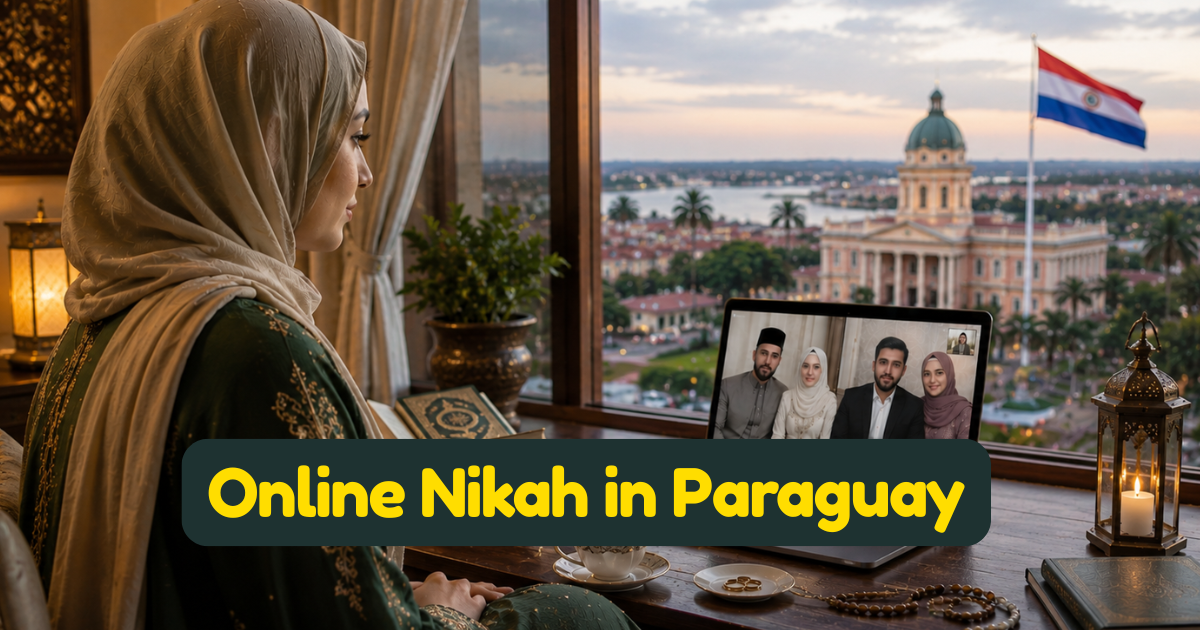
Online Nikah in Paraguay: The Arab Traders of Ciudad del Este, South America's Tri-Border Area, and How Muslims Marry in a Country That Recognises Both Civil and Religious Ceremonies
Ciudad del Este sits at the point where Paraguay, Brazil, and Argentina press against each other in what the security community calls the Tri-Border Area (TBA) — a commercial and demographic anomaly in the heart of South America. The Friendship Bridge connects it to Foz do Iguaçu in Brazil. The Puente Internacional San Roque González de Santa Cruz connects it to Puerto Iguazú in Argentina. And across both bridges, every day, flows one of the most remarkable cross-border commercial economies on the continent. What makes Ciudad del Este distinctive among South American cities is who built that economy: Arab traders, predominantly of Lebanese and Syrian descent, who arrived from the 1970s onward and established a commercial infrastructure that today makes the city one of the largest free-trade commerce centres in South America.
The Muslim presence within this Arab community is real but proportionally small — most Lebanese immigrants to Paraguay, as across Latin America, came as Maronite Christians, Eastern Orthodox Christians, or Melkite Catholics. The Muslim minority came later, with Sunni Arab traders arriving predominantly in the 1970s and Shia Lebanese following from the 1980s onward, according to Wikipedia's documentation of Lebanese Paraguayans. The total Muslim population ranges from under 1,000 by strict census measures to approximately 15,000 by community estimates as noted by Wikipedia's Islam in Paraguay entry — a gap that reflects both the difficulty of census measurement and the genuine uncertainty in the community's self-identification. What is clear is that Ciudad del Este hosts the most significant Muslim infrastructure in Paraguay, including mosques and Islamic centres that serve both Sunni and Shia communities across the Tri-Border Area.
Paraguay's Distinctive Legal Position: Religious Marriages Are Legally Recognised
Paraguay occupies a genuinely unusual legal position in this series. Unlike Brazil, Colombia, Mexico, Chile, Peru, Ecuador, Venezuela, Uruguay, and Argentina — all of which recognise only civil marriages — Paraguay's legal framework recognises both civil and religious marriages as legally binding. As documented by wedding legal resource Marry on Chain, Paraguay performs both civil and religious ceremonies, and both are generally accepted and legally binding in the country. Catholic religious marriages in particular play a significant role in Paraguayan life.
However, this recognition of religious marriages operates primarily through established and officially recognised religious institutions — predominantly the Catholic Church. For a Muslim nikah specifically, the position is more nuanced. Paraguay's civil registration law, as codified in Law No. 1266 on the Civil Registry, provides that marriages of Paraguayans or foreigners domiciled in Paraguay shall be registered in the Civil Registry offices, and that where contracting parties do not know the national languages (Spanish or Guaraní), an interpreter must assist. The most reliable path to full legal certainty for a Muslim couple in Paraguay is to ensure both the Islamic nikah and the civil Registro Civil registration are completed — giving the marriage both Islamic validity and unambiguous civil legal standing.
The Registro Civil Civil Marriage Process
Paraguay's civil marriage is administered by the Registro del Estado Civil under the Ministry of Justice. As confirmed by the 2024 Paraguayan civil marriage guide at Identificaciones Paraguay, the process involves submitting an official notice of marriage declaration, which is published for a stipulated notice period during which any impediments may be raised. The registration and celebration fee is Gs. 392,523 (approximately USD 50–55). Required documents for foreigners include a valid passport, proof of entry into the country, and where previously married, an authenticated divorce decree. At least one of the contracting parties must have domicile in Paraguay. Where the parties do not speak Spanish or Guaraní, an interpreter is legally required at the ceremony. After the civil ceremony before the Registro Civil official, the Acta de Matrimonio is issued — Paraguay's official civil marriage certificate, which carries the state's full legal authority.
What the Registro Civil Cannot Provide — and What the Nikah Requires
Whether a Muslim couple completes the civil Registro Civil ceremony alone or pursues the religious recognition route alongside it, one thing is certain: the Registro Civil official does not conduct a nikah. The conditions Islam requires for a valid marriage — the wali, the two Muslim witnesses who hear the offer and acceptance, the agreed mahr, and the free consent — must be arranged entirely independently of whatever the civil registry provides.
For a Muslim couple in Ciudad del Este where both parties are present and a local imam is available, a nikah can in principle be conducted at the mosque. But for the Lebanese Muslim businessman in Asunción whose fiancée is in Beirut, or the Shia Arab trader in Ciudad del Este whose future father-in-law is in South Lebanon, or the young Paraguayan convert whose family is Catholic — the wali problem and the distance problem are real and immediate. An online nikah conducted through InstantNikah.com resolves them: the qazi officiates remotely, the wali joins from Beirut or Sidon, two qualified Muslim witnesses confirm the contract on the call, the mahr is agreed, and a nikah certificate is issued. For the scholarly basis of remote ceremonies, our guide on the video-call nikah ruling covers each major madhab's position. Where the wali appoints a proxy, our guide on appointing a wakeel in nikah explains the process. For Paraguayan converts with no Muslim guardian, our guide on how a convert finds a wali for nikah covers the appointment.
Ciudad del Este: The Commercial Heart of Paraguayan Islam
Understanding the Tri-Border Area's significance is essential to understanding why Ciudad del Este matters for Paraguayan Muslim life. The city is home to Lebanese and Iranian Shia communities alongside Sunni Arabs from multiple countries, living alongside Taiwanese, Korean, and other Asian communities in a commercially dense environment that the World Team mission resource describes as "a multicultural and diverse city with mosques and pagodas evident in its streets." For a community whose core identity is mercantile — whose families came to Paraguay to trade and whose social networks extend across the Tri-Border Area into Brazil and Argentina — the wali is rarely in the same city as the groom. He is in Lebanon, in the Brazilian side of the border, or in Argentina. An online nikah is not a workaround for this community; it is a natural fit for a people whose entire commercial and social infrastructure already operates across borders.
After the Nikah: Civil Registration at the Registro Civil
Once the nikah has been conducted and the certificate issued, the civil Registro Civil ceremony completes the legal side with full certainty. For a foreign marriage registered abroad and brought to Paraguay, Gestoría en Paraguay confirms the process: submit a note to the Civil Registry director requesting registration, attach the marriage certificate legalised through the Paraguayan Foreign Ministry or consulate as applicable. Paraguay joined the Hague Apostille Convention, meaning certificates from countries in the Convention — including most Muslim-majority nations — can be apostilled rather than requiring full consular legalisation. For a broader sequencing guide, see our resource on registering a nikah civilly after the Islamic ceremony.
Quick Answers for Muslims in Paraguay
Does Paraguay legally recognise religious marriages? Yes — Paraguay recognises both civil and religious marriages as legally binding. Catholic marriages in particular are widely recognised. For a Muslim nikah to have the clearest legal standing, completing both the Islamic ceremony and the civil Registro Civil registration is the most reliable approach.
Is an online nikah Islamically valid from Paraguay? Yes — when the wali participates, two witnesses genuinely hear the contract, mahr is agreed, and consent is free. Paraguay's civil requirements do not affect the Islamic validity of the nikah.
Where is the main Muslim community in Paraguay? Ciudad del Este, near the convergence of the Paraguay, Brazil, and Argentina borders — the Tri-Border Area. The city hosts the country's main mosques and the largest Arab Muslim trading community.
What if my wali is in Lebanon or Brazil? He can join the online nikah ceremony remotely, or appoint a proxy (wakeel). The Tri-Border Area's cross-border commercial networks make remote family participation a familiar reality for this community.
From the Friendship Bridge to the Prayer Hall — A Community Built on Movement
The Arab Muslim community of Ciudad del Este was never defined by staying put. It came to Paraguay to trade across three countries, to bridge cultures, to operate across borders where most people see barriers. The Islamic contract has always been part of that life — performed in mosque halls in the city centre, maintained through the chain of wali, witnesses, and mahr that Islam has always required. InstantNikah.com ensures those requirements are met completely, for a community whose family networks already span continents. When you are ready, book your online nikah and speak with our team about your circumstances in Paraguay.
Admin User
Author