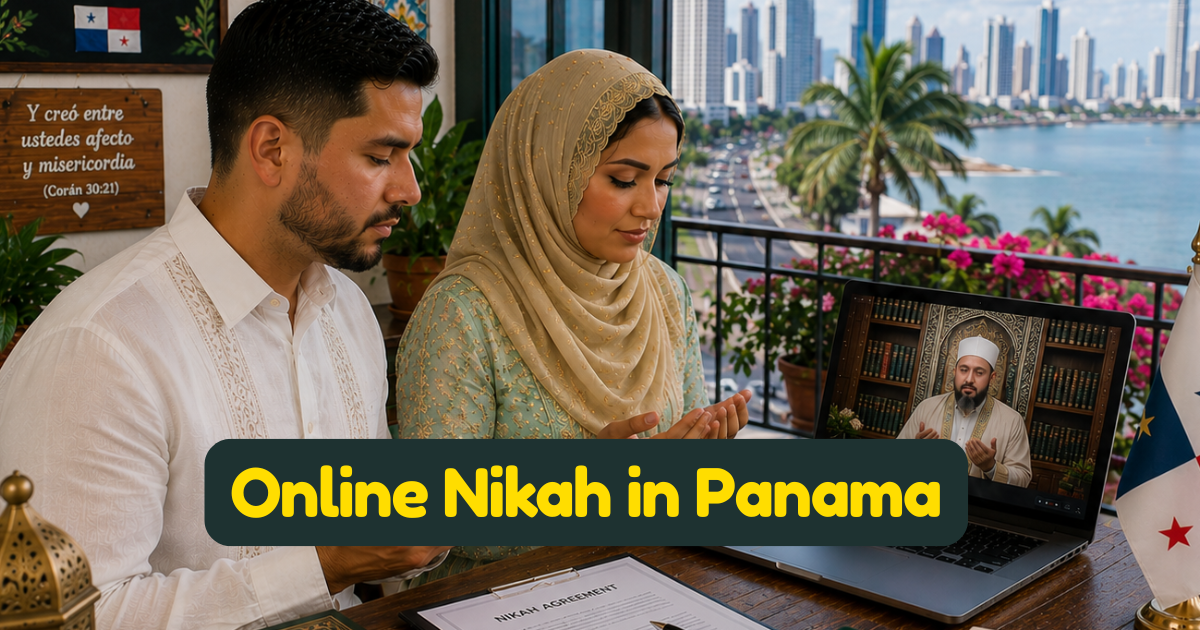
Online Nikah in Panama: Bayano's 16th-Century Mandinka Revolt, the Colón Free Zone's Three Muslim Communities, and a Civil Marriage Law That Requires an HIV Test
In 1552, a group of roughly 500 enslaved people from the Mandinka tribe of West Africa arrived on Panama's Atlantic coast aboard a ship that was sinking. They escaped. Among them was a man the Spanish called Bayano. As documented in Grokipedia's history of Islam in Panama, Bayano organised the escaped slaves — cimarrones — into an armed resistance movement against Spanish colonial rule that lasted from 1552 to 1557. They established an autonomous settlement called the palenque of Ronconcholón near a river later renamed the Bayano River in his honour, where they built mosques for prayer and communal meetings. According to the Wikipedia entry on Islam in Panama, the Mandinka were practising Muslims at the time of their capture, and the importation of Muslim slaves to the Americas had actually been prohibited by Spanish royal law — a prohibition the Portuguese slave traders simply ignored. Bayano was eventually captured by the colonial commander Pedro de Ursúa and exiled, first to Peru, then to Spain, where he lived out his life on a royal annuity. The river that bears his name still runs through Panama's Darién province today.
This is, in this entire series of country articles, the only documented case of an enslaved Muslim organising an armed anti-colonial revolt and founding mosques on his own authority — three and a half centuries before any of the immigration-driven Muslim communities that now define Panama's Islamic landscape arrived at all.
Three Communities, One Country: Indian Merchants, Lebanese Traders, Panamanian Converts
The Islam practised in Panama today traces to three almost entirely separate immigration and conversion histories, as documented by Maxine Wedderburn's account in Harvard's ReVista journal on Muslims and Jews in Panamá.
Indian and Pakistani Muslims arrived from the early 1900s onward, initially as single men who later married local women, with women from the Indian state of Gujarat beginning to immigrate in the 1950s. According to the Grokipedia entry on the Jama Mosque, this community built Panama City's Jama Mosque between 1929 and 1948 — making it, according to mosque leader Ahmad Bhattay, the oldest mosque in Central America. More than 500 people attend its Friday prayers, the majority of Indian descent.
Lebanese Shia Muslims settled in Colón from the second half of the 1960s, drawn by trading opportunities in the Colón Free Trade Zone — the second-largest free trade zone in the world after Hong Kong, as confirmed by Middle East Eye's reporting on Panama's Muslim and Jewish communities. Many of these traders had previously operated in Colombia before relocating their businesses to Colón's tax-advantaged commercial zone. They built a mosque, an Arab country club, a school, and ultimately the Islamic Cultural Center of Colón, inaugurated on 15 January 1982 with joint funding from the Libya-based Islamic Call Society and a local Indian merchant, Salomon Bhikhu.
Native Panamanian converts are the community's fastest-growing segment. As Religion Dispatches documents, two Panamanian women — Josefina Bell-Munajj and Khadijah Jackson — began holding small study circles for converts in 2011 with ten participants, growing to thirty within a year, and ultimately founded Al Haqq, Panama's first mosque built specifically for and by native Panamanians, in 2014. Jama Mosque's leadership reports two to three new Panamanian converts joining every week.
What This Means for Marriage: Three Communities, Different Practices
The diversity within Panama's Muslim community has a direct practical effect on how marriage is approached. The Jama Mosque, run by the Indian and Pakistani community, restricts women's prayer to the home rather than the mosque itself — a position that does not reflect every school of Islamic thought but is the practice at Panama's largest and oldest mosque. Bianca Chanis, the convert quoted by Religion Dispatches, travels an hour and a half to a mosque in Colón to attend prayer services that better match her preferred practice. For Panamanian Muslims navigating a community shaped by three distinct ethnic-religious traditions, finding a nikah officiant whose approach matches their specific circumstances — including converts whose family is non-Muslim, or interethnic couples bridging the Indian, Lebanese, and convert communities — is not always straightforward locally.
Panama's Civil Marriage Framework: Marriage Courts, Notaries, and an HIV Requirement
Panama's civil marriage is exclusively a secular legal act. As confirmed by Angloinfo's Panama marriage guidance, couples may marry either through the "Juzgado de Familia en Turno de Matrimonios" (the Family Court's marriage division) or before a notary public, as confirmed by Universal Services' guidance on notary marriages for foreigners. The notary drafts a public instrument, certifies the signatures, and registers the marriage with the Civil Registry Office under the Electoral Tribunal.
Required documents include valid passports, an apostilled certificate of single status (Certificado de Soltería or Certificate of No Impediment) issued within the previous two years, or alternatively a sworn statement of single status before a Panamanian notary with two non-relative witnesses also swearing to that status. Divorce or death certificates are required for previously married parties. Uniquely among most countries in this series — though shared with Honduras — both parties must undergo a premarital health certificate including HIV and STI testing, issued within fifteen days of the marriage date and authenticated by the Panamanian Consul if issued abroad, per Article 877 of Panama's Judicial Code, as detailed by the Consulate General of Panama's marriage registration guidance. All legal proceedings, including the ceremony itself, are conducted in Spanish, with a certified public translator required for any party not fluent in the language.
What Panama's Civil System Cannot Provide — and What the Nikah Requires
Panama's Marriage Court or notary creates a legally binding civil marriage. Neither conducts a nikah. The wali's consent, the mahr, and the two Muslim witnesses confirming the offer and acceptance are conditions the Panamanian state has no mechanism to assess or record. For a Lebanese Shia trader in Colón whose bride's family is still in Lebanon, for an Indian-Panamanian groom whose wali is in Gujarat, or for a Panamanian convert whose entire family is Catholic, these conditions must be met independently of whatever civil process follows.
An online nikah conducted through InstantNikah.com provides the complete Islamic contract regardless of where each party or the wali is located. A qualified qazi officiates, the wali joins remotely if travel is not possible, two witnesses confirm the contract live on the call, the mahr is agreed and documented, and a nikah certificate is issued. For the scholarly basis of remote ceremonies, our guide on the video-call nikah ruling covers the position of each major madhab, relevant to both the Sunni Indian-Pakistani and Shia Lebanese communities in Panama. For Panamanian converts whose family cannot supply a wali, our guide on finding a wali for nikah explains the standard scholarly provision for appointing one. Where a wali wants to appoint a representative, our guide on appointing a wakeel in nikah covers the process.
After the Nikah: Civil Registration in Panama
Once the nikah is complete, the civil process follows through either the Marriage Court or a notary, with the HIV/STI health certificate and apostilled single-status documentation prepared in advance. For couples marrying abroad and seeking to register the union in Panama for a Panamanian spouse, the process runs through the Civil Registry's Department of Foreign Vital Records, which takes approximately ten working days once a complete application is submitted, or can be completed at a Panamanian consulate where one exists. Our guide on registering a nikah civilly after the Islamic ceremony covers the broader sequencing for couples navigating both steps.
Quick Answers for Muslims in Panama
Is a nikah at the Jama Mosque or Colón's Islamic Cultural Center legally recognised in Panama? No. Only a marriage conducted through the Marriage Court or a notary public, and registered with the Civil Registry, is legally recognised in Panama. The nikah and the civil marriage are separate acts.
Does Panama require health testing before marriage? Yes. Both parties must present a premarital health certificate including HIV and STI testing, issued within 15 days of the wedding and properly authenticated.
Is an online nikah Islamically valid from Panama? Yes — when the wali participates or is properly represented, two witnesses genuinely hear the offer and acceptance, mahr is agreed, and consent is free. None of these conditions depend on Panama's civil law requirements.
Who was Bayano? A Mandinka Muslim brought to Panama as a slave in 1552 who led an armed revolt against Spanish colonial rule and founded an autonomous settlement where mosques were built — the earliest documented Islamic presence in Panama, predating all later immigration by more than three centuries.
From a River Named After a Rebel to a Mosque Built by Two Women
Panama's Muslim story spans from a 16th-century slave revolt to a 21st-century convert-led mosque, by way of Indian merchants, Lebanese traders, and a free trade zone that rivals Hong Kong. Few countries in this series carry an Islamic history with this much range, or a present-day community this divided by ethnicity, language, and even by which mosque permits women to pray inside it. What unites all of them is the same: a nikah that requires a wali, two genuine witnesses, an agreed mahr, and free consent, regardless of whether the family tracing back to Gujarat, Beirut, or a Panamanian Catholic household three generations removed from Islam. InstantNikah.com provides exactly that, wherever in Panama or the world the family is gathered. When you are ready, book your online nikah and speak with our team.
Admin User
Author