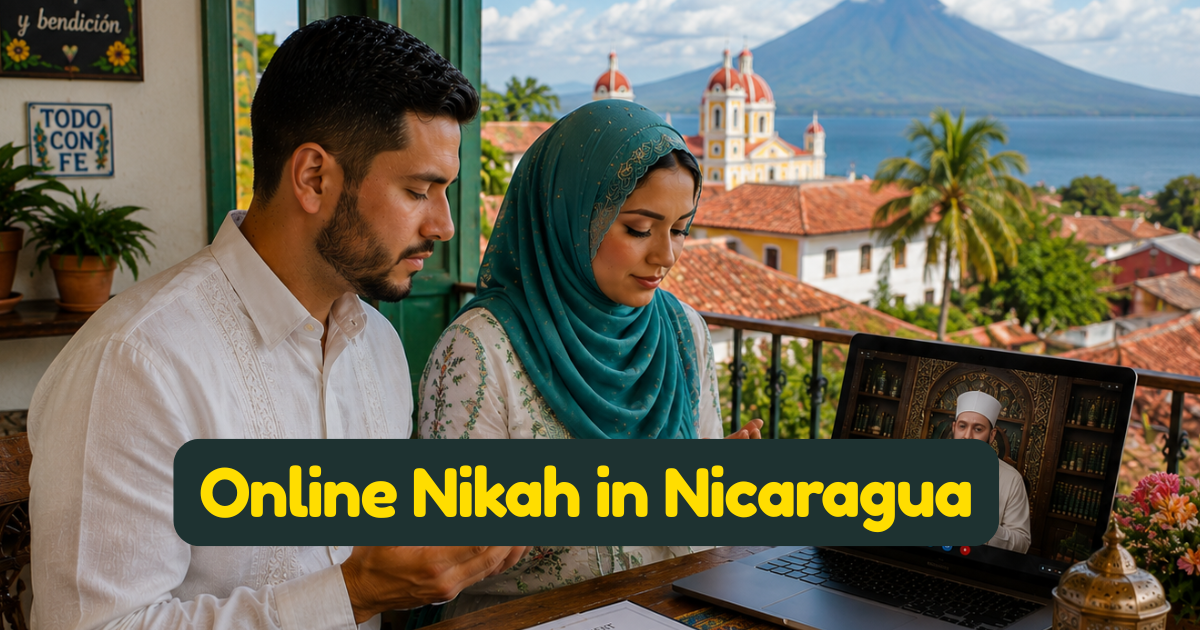
Online Nikah in Nicaragua: Palestinian Settlers, Iran's Political Influence, a First Mosque Built With Panamanian Help in 1999, and a Civil Marriage That Requires a Nicaraguan Lawyer
Nicaragua's Muslim community carries a political dimension unusual among the countries in this series. The community traces its origins to late-nineteenth century Arab immigration, predominantly Palestinian and Lebanese, arriving in three waves — the first in moderate numbers in the late 1800s, the second and third following the post-World War I disruptions and the early 1990s, when some emigrant Nicaraguan-Arabs returned to the country having deepened their Islamic practice abroad. As documented by the American Foreign Policy Council's World Almanac of Islamism on Nicaragua, the first mosque in the country was not constructed until 1999 — built on a 3,000-square-metre parcel of land in the San Juan district of Managua with the assistance of Panamanian Muslims, and with capacity for nearly one thousand people. A second mosque followed in 2009. For the previous century, Nicaragua's Muslim community had existed without a dedicated mosque, gathering in homes and informal prayer centres in Granada, Masaya, León, and Chinandega.
Then, in 2006, something changed. President Daniel Ortega returned to power and pursued a foreign policy that included close alliance with Iran — one of the most explicit Iran-Latin America alignments outside of Venezuela. As the American Foreign Policy Council documents, this represented "a stark, positive change in the relationship between Nicaragua's government and the country's Muslim community." An Iranian-linked Shia Muslim presence became more prominent alongside the predominantly Sunni Palestinian-descent community, to the point that in May 2007 the Sunni leader of the Managua prayer centre was reportedly dismissed, with a Shia leader expected to take over — a development that mirrors Iran's pattern of using cultural and religious infrastructure to build influence in allied states. The Islamic Cultural Center in Managua serves as the focal point of the Muslim community, with approximately 320 men attending Friday prayers according to Wikipedia's Islam in Nicaragua entry.
Nicaragua's Civil Marriage System: Notary or Judge, No Minister Pathway
Nicaragua's civil marriage is governed by the Nicaraguan Civil Code and administered through the Civil Registry (Registro del Estado Civil de las Personas) under the Consejo Supremo Electoral — Nicaragua's Supreme Electoral Council, which manages civil registration alongside its electoral functions. As the U.S. Embassy in Nicaragua's marriage guidance confirms, legal marriages in Nicaragua can be performed by either a Nicaraguan notary or a judge. Unlike Guatemala, which allows ministers of religion as authorised officiants, Nicaragua's framework limits the civil marriage officiant to secular legal professionals — notary or judge only.
For foreigners marrying in Nicaragua, the requirements as documented by Managua law firm Los Cisneros Law include: a valid passport with the most recent Nicaraguan entry stamp, original birth certificate, certificate of single status or divorce certificate, and personal details (full name, age, occupation, nationality, education level). Two witnesses are required — and uniquely among the Central American countries covered in this series, witnesses in Nicaragua may be relatives of the parties, unlike Guatemala's non-relative requirement and Honduras's strict non-relative rule. Both parties must be at least 18 years old.
As the Government of Canada's Nicaragua services guidance confirms, civil marriage "is a private legal matter and requires the presence of a practicing Nicaraguan lawyer to carry out the ceremony and to then register the marriage at the Nicaraguan Civil Registry Office." The notary is responsible for both officiating the ceremony and registering it at the Civil Registry — there is no separate civil registry office ceremony to attend. Nicaragua joined the Hague Apostille Convention, with the Directorate General for Consular Affairs of the Ministry of Foreign Affairs as the competent authority for apostilles. For U.S. immigration purposes, as the U.S. State Department's Nicaragua civil documents guide notes, marriage certificates for visa cases must be issued by Nicaragua's Central Registry in Managua — not just the local municipal office.
What the Notary Cannot Provide — and What the Nikah Requires
Nicaragua's notary or judge conducts the civil ceremony. They do not conduct a nikah. The Nicaraguan legal professional asks about identity, marital status, and witnesses — not about the wali's consent, the mahr, or whether two Muslim witnesses heard the Islamic offer and acceptance. For Nicaragua's Muslim community, where the bride's wali may be in Palestine, Lebanon, or Iran, and where finding a qualified qazi in Managua who can properly meet all Islamic conditions is genuinely difficult, an online nikah provides the complete Islamic contract.
InstantNikah.com conducts Shariah-compliant online nikah ceremonies over a secure live video connection. A qualified qazi officiates. The wali participates from wherever he is. Two witnesses confirm the contract. The mahr is agreed and documented. A nikah certificate is issued. For the scholarly basis of remote ceremonies, our guide on the video-call nikah ruling covers each major madhab. For Sunni couples the Hanafi and Shafi'i positions are covered; for the Shia community in Nicaragua, scholars familiar with Ja'fari jurisprudence are available. Where the wali appoints a proxy, our guide on appointing a wakeel in nikah explains the process. For converts with no Muslim guardian, our guide on finding a wali for nikah covers the appointment.
After the Nikah: Civil Registration Through a Nicaraguan Notary
Once the nikah has been conducted and the certificate issued, the Nicaraguan notary civil ceremony provides the legal recognition. The notary handles both the ceremony and the registration — the couple does not need to make a separate trip to a civil registry office. For foreign marriages conducted abroad that need to be registered in Nicaragua, the apostilled foreign marriage certificate must be submitted to the Nicaraguan Civil Registry. The marriage certificate, once registered, is obtainable from the Consejo Supremo Electoral's Central Registry in Managua or from the local civil registry where the marriage was registered. For a comprehensive civil registration guide, see our resource on registering a nikah civilly after the Islamic ceremony.
Quick Answers for Muslims in Nicaragua
Can a mosque imam legally marry a Muslim couple in Nicaragua? No — only a Nicaraguan notary or judge can officiate a legally recognised civil marriage in Nicaragua. Unlike Guatemala, there is no minister-of-religion pathway under Nicaraguan law.
Can witnesses at a Nicaraguan civil marriage be family members? Yes — Nicaragua's civil marriage permits family members to serve as witnesses, unlike Guatemala, Honduras, and most other Central American countries which require non-relative witnesses.
Is an online nikah Islamically valid from Nicaragua? Yes — when the wali participates, two witnesses genuinely hear the contract, mahr is agreed, and consent is free. Nicaragua's civil requirements do not affect Islamic validity.
What is the political relationship between Nicaragua's government and the Muslim community? President Daniel Ortega's return to power in 2006 brought significantly improved government-Muslim relations and close ties with Iran, which increased the Shia Muslim presence and influence within Nicaragua's small Muslim community.
One Hundred Years of Prayer in Borrowed Rooms — and a First Mosque Built With a Neighbour's Help
For nearly a century after Palestinian and Lebanese Muslims began arriving in Nicaragua, the community prayed in homes and borrowed spaces in cities across the country. The first mosque came in 1999 — built with the help of Panamanian Muslims, on a plot of land in Managua that had never before held a minaret. A decade later came the second. The community today navigates a political environment shaped by Ortega's alliances with Tehran and a Sunni-Shia dynamic that reflects geopolitics as much as theology. For the Muslim couples within this community — Palestinian families, Lebanese traders, Iranian professionals — the nikah remains the Islamic act that neither the notary nor the judge can perform. InstantNikah.com performs it properly, wherever in Nicaragua or in the world the parties and their families happen to be. When you are ready, book your online nikah and speak with our team.
Admin User
Author