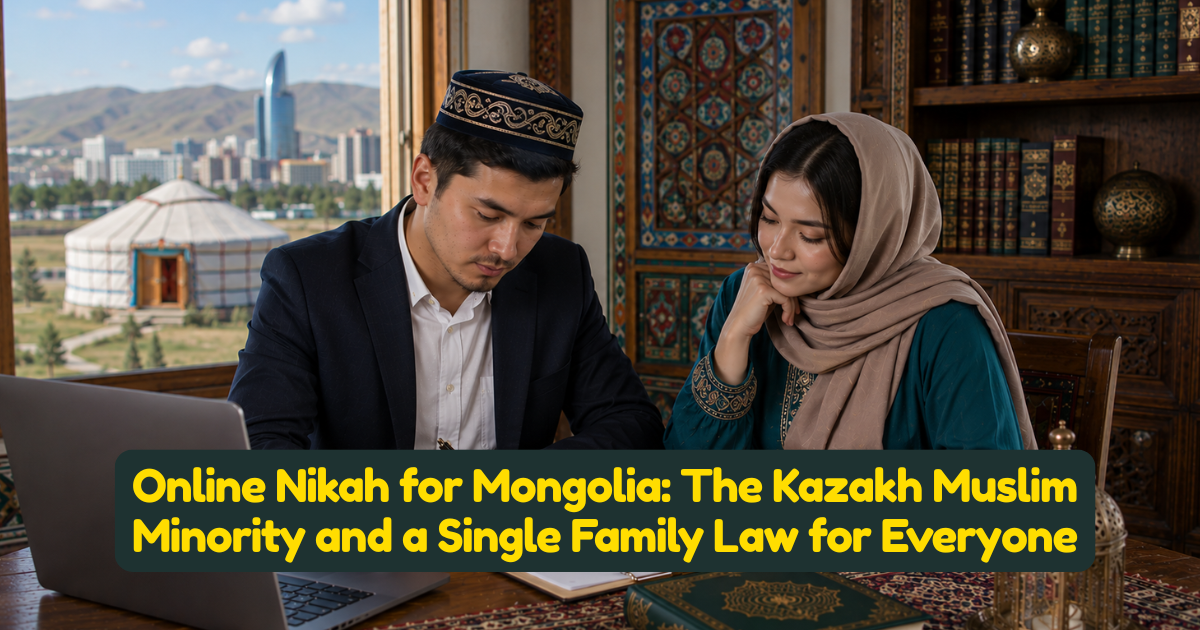
Online Nikah for Mongolia: The Kazakh Muslim Minority and a Single Family Law for Everyone
Mongolia's Muslim population is small and geographically concentrated, almost entirely ethnic Kazakh, and living predominantly in the western province of Bayan-Ölgii. Unlike almost every other country this series has documented, Mongolia has no separate Islamic marriage law, no Sharia court system, and no dedicated religious registration framework — Muslim couples marry under exactly the same general Family Law that applies to every other Mongolian citizen.
A Real, Documented Community With Its Own Marriage Customs
Official research prepared by the U.S. Department of Justice's Executive Office for Immigration Review specifically documented Mongolia's Kazakh Muslim community and its marriage-related customs. The research confirms the community, concentrated in Bayan-Ölgii, maintains distinct cultural practices while operating within Mongolia's general legal framework, with the same research noting that Islam is interpreted quite moderately among the Kazakh population in the region, with Kazakh women in Mongolia appearing to enjoy comparatively more freedom than in some other predominantly Muslim communities elsewhere.
No Separate Islamic Legal Framework — A Genuinely Distinctive Structure
This is the single most important structural fact about Mongolia's system. Unlike Ethiopia's federal Sharia courts, Sri Lanka's Quazi system, or the dedicated Islamic marriage acts this series has documented across South Asia and much of Africa, Mongolia's Kazakh Muslim minority marries under the country's general, secular Family Law — first enacted in 1999 — with no parallel religious court system or dedicated Islamic marriage registration act operating alongside it. A Nikah conducted within Mongolia's Kazakh community carries religious and cultural significance for the couple and community, but the marriage's actual civil legal standing depends entirely on registration under this single, general national framework.
A Genuinely Current, Real Legal Development Worth Knowing
Mongolia's Family Law is currently undergoing real, active revision, which is worth understanding for anyone researching current requirements. Detailed current reporting confirms that the Family Law, first enacted in 1999, has been under discussion for revision since 2022, with Mongolia's Minister of Justice and Home Affairs formally submitting an updated draft law to the State Great Khural (Parliament), aligned with a broader government plan to modernise national legislation by 2028. Since this general law governs Mongolia's entire population, including its Muslim minority, this ongoing reform process is directly relevant to how marriage registration requirements may evolve for Kazakh Muslim couples going forward — worth monitoring rather than assuming static, unchanging requirements.
Why a Single Framework Actually Simplifies Registration Questions
For couples with a Mongolian Kazakh Muslim connection, this structural simplicity is genuinely useful in one specific respect: there is no separate religious court jurisdiction question to navigate, unlike the dual-system complexity this series has documented in Ethiopia or the sect-declaration choice required in Iraq. The relevant civil registration process is simply Mongolia's standard national marriage registration system, applied uniformly, with the religious Nikah ceremony itself conducted according to the community's own Islamic customs alongside — but structurally separate from — that civil process.
What This Means Practically for the Religious Ceremony Itself
Given the absence of a dedicated Islamic marriage registration framework, the Nikah ceremony within Mongolia's Kazakh Muslim community functions as a religious and cultural rite conducted according to community custom and Islamic requirements — proper consent, witnesses, wali involvement, and mahr — without a parallel civil registration pathway specific to it. Couples seeking full civil recognition of their marriage in Mongolia pursue this through the same general Family Law registration process available to any Mongolian citizen, regardless of religion.
A Practical Sequence for Couples With a Mongolian Kazakh Connection
Given this structure, couples completing an online Nikah with a Mongolian Kazakh Muslim connection should treat the religious ceremony and Mongolia's general civil marriage registration as two genuinely separate processes — properly conducted according to Islamic requirements for the former, and Mongolia's standard national registration procedure for the latter — while staying attentive to the country's current Family Law reform process, given its potential to affect registration requirements going forward.
Frequently Asked Questions
Does Mongolia have a separate Islamic marriage law for its Muslim minority? No — Mongolia's small Kazakh Muslim population, concentrated in Bayan-Ölgii province, marries under the same general Family Law that applies to the entire country, with no dedicated Sharia court or Islamic marriage registration framework.
Is Mongolia's Family Law currently changing? Yes — a draft revision has been under discussion since 2022 and was formally submitted to Parliament, part of a broader government plan to modernise national legislation by 2028.
How does the Nikah ceremony relate to Mongolia's civil registration process? They are structurally separate — the religious ceremony follows Islamic requirements and community custom, while civil legal recognition depends on registration through Mongolia's standard, religion-neutral national marriage registration system.
Suggested Internal Links
Zainab Butt
Author