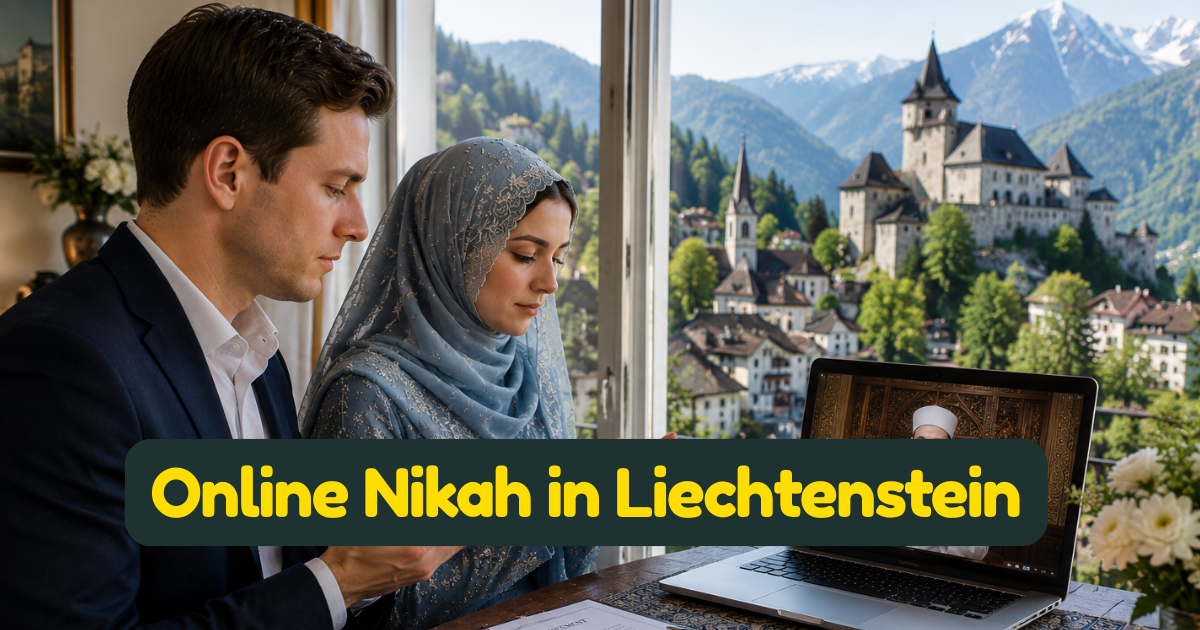
Online Nikah in Liechtenstein: Europe's Smallest Constitutional Monarchy, a Muslim Community Without a Mosque, and the One Civil Registry Office in Vaduz
Liechtenstein is a principality of 40,000 people tucked between Switzerland and Austria in the Rhine Valley — one of the most unusual states in Europe by almost every measure. It is one of only two doubly landlocked countries in the world (the other being Uzbekistan), meaning every country that borders it is itself landlocked. It is the smallest German-speaking country. Its head of state, Prince Hans-Adam II, holds one of the most active roles of any European monarch in national governance, having successfully led a referendum in 2003 that gave him the right to dismiss governments and veto legislation. Its economy, based on financial services and precision manufacturing, gives it one of the highest GDP per capita figures in the world.
And Islam is its second-largest religion. According to the 2020 census, 6 percent of Liechtenstein's population — approximately 2,400 people — identify as Muslim, as confirmed by Wikipedia's religion in Liechtenstein entry. The community is predominantly Sunni, with the great majority originating from Turkey, Kosovo, Bosnia and Herzegovina, and North Macedonia — countries that supplied a significant share of Liechtenstein's post-war industrial workforce, as they did across the broader German-speaking Alpine region. According to the Grokipedia entry on Islam in Liechtenstein, by 2024 the Islamic community has three Muslim organisations: the Turkish-Islamic Community, a Turkish-Islamic Cultural Association affiliated with Turkey's Diyanet, and the IGFL (Islamische Gemeinschaft im Fürstentum Liechtenstein), which has its own association house in Schaan. Despite this organisational presence, Liechtenstein has no official mosque — Muslims pray in rented facilities and prayer rooms, and regularly cross the border into Switzerland for major services including Eid prayers.
Liechtenstein's Civil Marriage System: The Only Registry Office in Vaduz
Liechtenstein's civil marriage is governed by the Liechtenstein Civil Registry Office (Zivilstandsamt) — and there is precisely one of them, located in Vaduz, the capital. As confirmed by the official Liechtenstein National Administration marriage guidance, all marriages in the principality pass through this single office. There are no branch registries, no municipal alternatives, no notary pathway as in El Salvador or Colombia. One building, one registry, one process for the entire country.
The procedure, as detailed on the official required documents page, requires documents to be submitted no earlier than 6 months and no later than 3 weeks before the planned marriage date. For foreigners, documents must not be older than 6 months — a validity window that requires careful timing. Documents not in German or English must be translated into German by a recognised translation agency. A marriage certificate is typically issued within less than two weeks of the ceremony.
One critical Liechtenstein-specific constraint distinguishes it from most countries in this series: as confirmed on the official prerequisites page, two foreigners residing abroad cannot marry in Liechtenstein. At least one of the two parties must either be a Liechtenstein citizen or a permanent resident of the principality. This means that an international Muslim couple with no connection to Liechtenstein cannot simply travel to Vaduz for a civil marriage in the way they might travel to Georgia or Armenia.
For third-country nationals (non-EU/EEA) who are permanent residents in Liechtenstein, the process is further structured through the Swiss diplomatic network: as the official Liechtenstein guidance confirms, third-country nationals must make their promise of marriage at the Swiss representation abroad, so that the Liechtenstein Civil Registry Office receives all documents via the corresponding Swiss consulate or embassy. This is because Liechtenstein uses the Swiss diplomatic network globally, having no embassies of its own in most countries.
Only civil marriages are legally recognised in Liechtenstein. As documented by Marry on Chain's marriage guide, religious ceremonies have no legal standing. A nikah conducted at the IGFL prayer rooms in Schaan or at the Turkish community's Grüne Moschee in Triesen is an Islamic religious act; it is not entered in the Vaduz civil registry and confers no legal rights.
The Government's Relationship With Liechtenstein's Muslim Community
Liechtenstein's government has maintained a formally supportive relationship with its Muslim community that is remarkable for a principality with a Catholic state church. As documented by the U.S. Department of State's 2022 International Religious Freedom Report on Liechtenstein, the Turkish-Islamic Community of Liechtenstein has continued to operate the one mosque-equivalent in the country, in leased space in Triesen. In 2006, the Liechtenstein government contributed $20,000 (25,000 Swiss francs) to the Muslim community — a notable gesture for a country whose constitution designates the Roman Catholic Church as the state church. Since 2001, the government has granted the Muslim community a residency permit for one imam year-round and one additional imam during Ramadan. Islamic religious instruction was introduced in eight primary schools in 2013 to accommodate demand among Muslim children.
What the Vaduz Civil Registry Cannot Provide — and What the Nikah Requires
The Vaduz Civil Registry Office registers the marriage with the full authority of the Liechtenstein state. It does not conduct a nikah. The civil registrar does not ask about the wali, the mahr, or whether two Muslim witnesses heard the Islamic offer and acceptance. For Liechtenstein's Muslim community — Turkish, Bosnian, Kosovar, and North Macedonian families whose relatives are overwhelmingly based in their home countries — the nikah conditions often cannot be met locally. The bride's wali may be in Ankara, Sarajevo, Pristina, or Skopje. Two qualified Muslim witnesses may not always be available at short notice in a community of 2,400 people.
An online nikah conducted through InstantNikah.com resolves the Islamic side: a qualified qazi officiates remotely, the wali participates from wherever he is, two witnesses confirm the contract, the mahr is documented, and a nikah certificate is issued. The Vaduz civil ceremony follows for legal recognition. For the scholarly basis of remote ceremonies, our guide on the video-call nikah ruling covers each major madhab. Where the wali appoints a proxy, our guide on appointing a wakeel in nikah explains the process. For converts with no Muslim guardian, our guide on finding a wali for nikah covers the appointment. For the full civil registration guide, see our resource on registering a nikah civilly after the Islamic ceremony.
Quick Answers for Muslims in Liechtenstein
Is a nikah at the IGFL prayer rooms legally recognised in Liechtenstein? No. Religious ceremonies have no legal standing in Liechtenstein. Only the Vaduz Civil Registry Office registration creates a legally recognised marriage.
Can two foreign Muslims who don't live in Liechtenstein marry here? No. At least one of the two parties must be a Liechtenstein citizen or permanent resident. Two foreigners residing abroad cannot marry in Liechtenstein.
Is an online nikah Islamically valid from Liechtenstein? Yes — when the wali participates, two witnesses genuinely hear the contract, mahr is agreed, and consent is free. Liechtenstein's civil requirements do not affect Islamic validity.
How does Liechtenstein handle foreign marriages for its citizens? Foreign marriages involving Liechtenstein citizens must be recognised by the Vaduz Civil Registry Office. Recognition requires submitting original or certified copies of the foreign marriage certificate, with third-country documents routed through Swiss diplomatic representations given Liechtenstein's use of the Swiss embassy network globally.
One Office in Vaduz, No Mosque in the Principality — and a Faith That Needs Neither to Contract a Nikah
Liechtenstein's Muslim community crosses the Rhine into Switzerland to attend Eid prayers because the principality has no mosque large enough to hold them all. It uses three prayer rooms and a small association house. It functions with one government-issued imam residency permit per year. Yet it maintains Islamic identity, Islamic education for children, and Islamic community life across a country the size of a small city. The nikah — the Islamic marriage contract — is part of that maintained identity. The Vaduz Civil Registry handles the legal side with efficiency and precision. What it cannot handle is the Islamic side. InstantNikah.com provides that — from whatever city or country the wali, the witnesses, and the couple happen to be in. When you are ready, book your online nikah and speak with our team.
Admin User
Author