Online Nikah in Serbia: Five Centuries of Ottoman Islam, Twenty-Five Mosques in Novi Pazar, One Surviving Mosque in Belgrade, and How Bosniak Couples Marry Across Borders
In 1868, Belgrade had between 270 and 300 mosques. In that year, 34 mosques were demolished in Užice alone and 24 in Smederevo, as the Ottoman Empire's long presence in the Balkans was being systematically erased from the Serbian capital's physical landscape. Only one mosque survived: the Bajrakli Mosque, built in the mid-sixteenth century, still standing in the Dorćol neighbourhood of Belgrade. As documented by the Muslim 500's contribution on Muslims in Serbia, the Ottoman period left a mark on Serbian culture that goes far beyond the single remaining mosque in Belgrade — including over 10,000 Turkish, Persian, and Arabic words absorbed into the Serbian language.
The contrast between what was lost in Belgrade and what was preserved in Sandžak is striking. Drive southwest from Belgrade toward the Montenegrin border and the landscape becomes increasingly Ottoman in character. Novi Pazar — the economic and cultural heart of the Sandžak region — has 25 mosques from the Ottoman era and a Muslim population of 82 percent of its 100,410 inhabitants, according to the 2022 Serbian census cited by Kharchoufa's Islam in Serbia documentation. The municipality of Tutin has the highest Muslim percentage in all of Serbia, at approximately 94 percent. This is not a recent migration story. These are communities whose Islamic faith was formed under the Ottoman Empire, maintained through Austro-Hungarian rule, suppressed under Yugoslav communism, reconstituted after 1991, and tested by the wars of the 1990s that displaced approximately 75,000 Bosniaks from Sandžak through intimidation and ethnic cleansing.
Serbia's Muslim Community: Who They Are
According to the 2022 Serbian census, as confirmed by Wikipedia's documentation of Bosniaks in Serbia, there are 153,801 ethnic Bosniaks in Serbia — 2.3 percent of the total population and the third-largest ethnic group in the country after Serbs and Hungarians. These Bosniaks constitute approximately 55 percent of all Muslims in Serbia; the remainder are Albanians concentrated in the Preševo Valley in southern Serbia, and Muslim Roma scattered across the country. The total Muslim population of 278,212 (4.2 percent of Serbia's total population) makes Serbia one of the larger Muslim communities in southeastern Europe.
The Bosniak community of Sandžak is distinct from the Bosniaks of Bosnia-Herzegovina in one important way: they are Serbian citizens, holding Serbian passports, navigating Serbian civil law, and living in a country where their community was an ethnic minority within Yugoslavia long before the 1990s wars made that status politically charged. They maintain strong cultural and religious connections to Bosnia-Herzegovina — many families have relatives on both sides of the Sandžak border, which straddles Serbia and Montenegro — and the Islamic Community of Bosnia and Herzegovina (Islamska Zajednica) has significant influence in the Serbian Sandžak community alongside Serbia's own Islamic Community.
Serbia's Civil Marriage System: The Matičar and the Municipal Registry
Serbia's civil marriage is administered at the municipal level by the matičar — the civil registry officer — at the local marriage registry (matičarska knjiga venčanih). As the Serbian Ministry of Foreign Affairs confirms, citizens of Serbia may also conclude marriages before authorised Serbian diplomatic-consular missions abroad. For foreigners marrying in Serbia, the requirements include valid passports, apostilled birth certificates translated into Serbian, single status certificates from the home country, and documentation of any previous marriages.
Serbia is a member of the Hague Apostille Convention, meaning documents from Pakistan, Turkey, Egypt, Morocco, and most Muslim-majority countries can be apostilled rather than going through full consular legalisation. The Australian Embassy in Serbia's marriage guidance confirms that a Certificate of No Impediment and an original birth certificate (not more than six months old) with apostille are standard requirements. A critical Serbia-specific requirement: the original foreign marriage certificate, if registering a foreign marriage in Serbia, must be apostilled and translated into Serbian in Cyrillic script by a Serbian court-certified translator — not just any translation into Serbian, but specifically the Cyrillic script, as confirmed by the Serbian Consulate in New York.
Religious ceremonies in Serbia — including a nikah at a mosque — have no independent legal standing. Only the matičar registration creates a legally recognised marriage. A nikah conducted at any of Novi Pazar's 25 Ottoman-era mosques or at the Bajrakli Mosque in Belgrade is an Islamic religious act; it is not entered into the civil registry and confers no civil legal rights without the separate matičar registration.
The Bosniak Long-Distance Marriage Challenge
For Bosniak families whose members are distributed across Serbia, Bosnia-Herzegovina, Montenegro, and the wider Bosniak diaspora in Western Europe (Germany, Austria, Switzerland), the marriage question is often a cross-border one. A young man in Novi Pazar may be engaged to a woman whose family is in Sarajevo or Tuzla. Her wali may be in Germany. The families may want the nikah conducted before the formal civil registration, in accordance with Islamic tradition, while the bureaucratic timelines of both Serbian and Bosnian civil registries are being navigated.
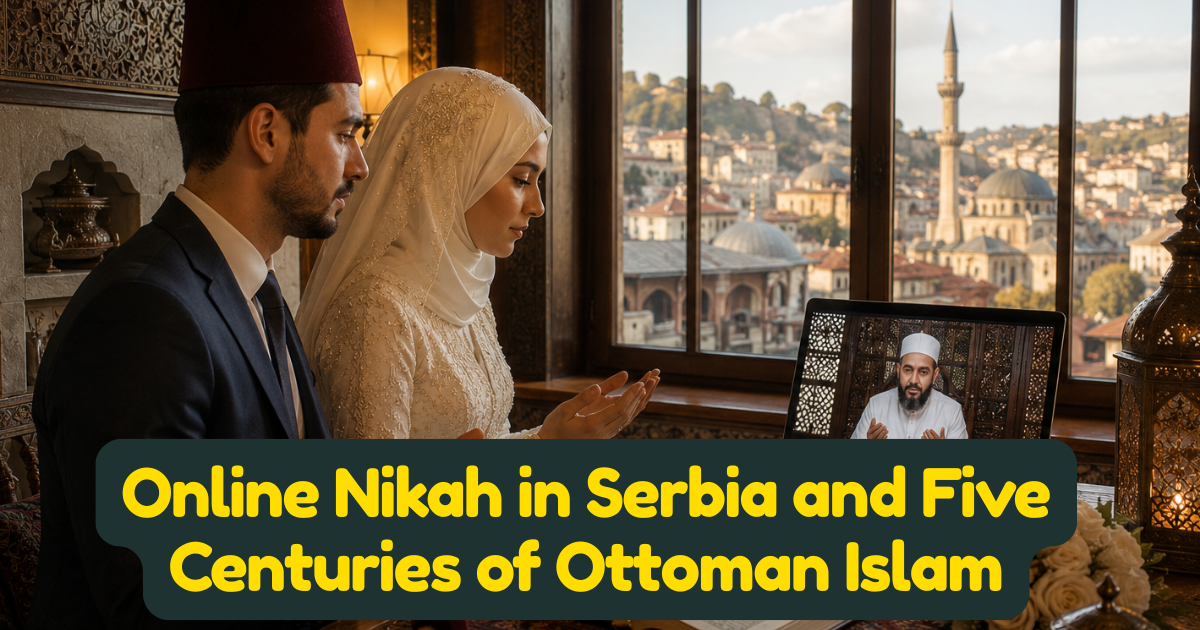
An online nikah conducted through InstantNikah.com resolves the geographic challenge cleanly. The qazi officiates remotely. The bride's wali joins from Sarajevo, Germany, or wherever he is located. Two Muslim witnesses confirm the contract on the call. The mahr is agreed and documented. A nikah certificate is issued that serves as the Islamic record of the marriage while the civil matičar registration follows. For the scholarly basis of remote ceremonies, our guide on the video-call nikah ruling addresses each major madhab. Where the wali appoints a proxy, our guide on appointing a wakeel in nikah explains the process. For Muslim converts or women with no Muslim guardian, our guide on finding a wali for nikah covers the appointment.
Registering a Foreign Nikah Certificate in Serbia
For Bosniak couples who marry outside Serbia and wish to have that marriage recognised in the Serbian civil registry, the foreign marriage certificate must be apostilled and translated into Serbian in Cyrillic by a court-certified translator. The application can be submitted at a Serbian consulate abroad or at the municipal matičar in Serbia. Foreign divorce judgments must first be recognised by a Serbian higher court before they can be used to register a new marriage — an important procedural point for previously divorced parties. For a comprehensive country-by-country civil registration guide, see our resource on registering a nikah civilly after the Islamic ceremony.
Quick Answers for Muslims in Serbia
Is a nikah at a mosque in Serbia legally recognised? No. Religious ceremonies have no legal standing in Serbia. Only registration at the municipal matičar creates a legally recognised civil marriage.
Is an online nikah Islamically valid from Serbia? Yes — when the wali participates, two witnesses genuinely hear the contract, mahr is agreed, and consent is free. Serbia's civil requirements do not affect Islamic validity.
Do I need my foreign documents in Cyrillic for Serbian civil registration? Yes. Foreign marriage certificates and their translations must be translated into Serbian in Cyrillic script by a Serbian court-certified translator — not just translated into Serbian in Latin script.
What if my wali is in Bosnia-Herzegovina or Germany? He can participate in the online nikah ceremony from wherever he is, or appoint a wakeel. The geographic separation that characterises many Bosniak families is precisely what the online nikah is designed to bridge.
One Mosque Left Standing in Belgrade — and a Community That Has Never Left
The demolition of 270 mosques in Belgrade in 1868 was a statement about whose heritage was to be acknowledged in the newly expanding Serbian state. The survival of the Bajrakli Mosque was an accident or oversight — the sole physical reminder in the capital of five centuries of Islamic presence. But in Sandžak, the Ottoman heritage survived not in architecture alone but in community, in language, in the 10,000 Turkish, Persian, and Arabic words now embedded in Serbian, in the 25 mosques of Novi Pazar that the demolishers never reached. For the Bosniak families of Sandžak and their relatives across the borders, the Islamic contract of marriage — the nikah — is part of that living heritage. InstantNikah.com ensures it is conducted with the care its centuries of tradition deserve, wherever in the world the family happens to be gathered. When you are ready, book your online nikah and speak with our team.
Admin User
Author