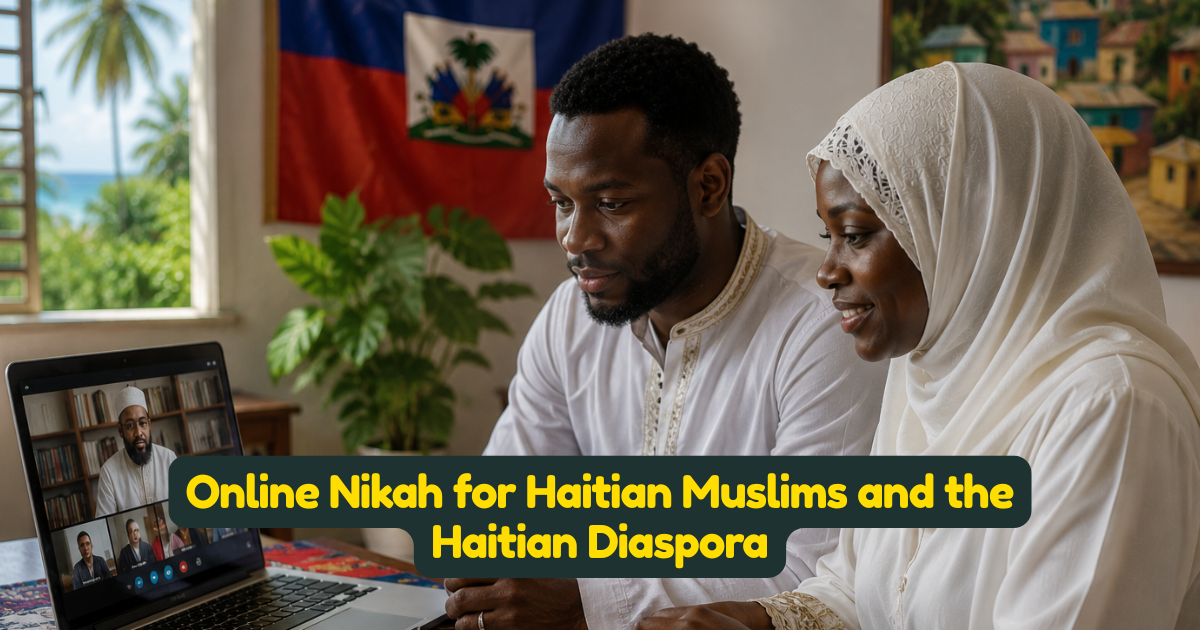
Online Nikah for Haitian Muslims and the Haitian Diaspora
Haiti's Muslim community is small, but it is real, established, and growing — concentrated in Port-au-Prince and connected to a much larger Haitian Muslim diaspora across Florida, New York, Montreal, and the wider Caribbean. For couples with any connection to Haiti planning a religious marriage, an online Nikah offers a practical way to bring together family split across these locations — but Haitian family law has one specific rule that makes planning the civil side just as important as the ceremony itself.
The One Rule That Shapes Everything: Civil Registration Is Mandatory
Haitian family law is unusually direct on this point compared to many countries. Official guidance on Haitian family law confirms plainly that religious ceremonies, including those held according to any faith tradition, "must be followed by civil registration to have legal status" and that a marriage which is not registered civilly simply "does not have legal recognition" in Haiti. This is a stricter and clearer rule than exists in many Western countries, where a religious-only marriage exists in a legal grey area rather than being explicitly unrecognised. For a Haitian Muslim couple, this means the online Nikah should always be planned as step one of a two-step process, with civil registration treated as non-negotiable rather than optional.
How Civil Marriage Actually Works in Haiti
The United States Embassy in Haiti, which regularly assists American citizens marrying Haitian nationals, publishes detailed practical guidance confirming that couples must first visit the Civil Registrar in the district where they intend to marry, present identification and a list of witnesses, and purchase an official "Acte de Marriage Civil." The embassy notes that the standard blood test and waiting period requirements are often waived for foreign nationals but may still be required depending on the specific Civil Registrar. This detail matters directly for online Nikah couples: because civil registration in Haiti requires an in-person appointment with a specific Civil Registrar, it cannot be completed remotely in the way the religious ceremony can — making it essential to plan a window of in-person time in Haiti (or wherever the couple intends to register) shortly after the online Nikah.
What Haitian Law Says About Marriage Age and Consent
A detailed legal research report on marriage under Haitian law, published by the Law Library of Congress — the research arm of the United States' own national library — confirms that the legal minimum age for marriage in Haiti is 18 for men, with parental consent required for sons under 25 and daughters under 21. The same report describes a formal notice period, known as banns, which must be publicly posted for at least eight days before a civil marriage can proceed, and notes that objections to a marriage can be formally lodged by specific categories of relatives during this window. This procedural detail is genuinely useful for planning purposes: couples aiming to register a Haiti-based civil marriage around their online Nikah should build this notice period into their timeline rather than assuming registration can happen immediately.
Why the Diaspora Dimension Matters So Much Here
Haiti's Muslim population is genuinely small relative to the country's overall population, which means a large share of Haitian Muslim marriages today actually involve at least one partner based in the diaspora — the United States, Canada, France, or the wider Caribbean — rather than two parties both physically present in Haiti. This is precisely the scenario online Nikah is built for: a couple with family, officiant access, and religious community spread across two or three countries can complete the religious ceremony together over video, with witnesses appropriately placed, rather than requiring the entire extended family to travel to a single physical location.
Monogamy Requirement and What It Means for Nikah Structure
Haitian civil law explicitly requires monogamous marriage, with polygamy prohibited under the Civil Code. For Muslim couples, this means the civil marriage layer will only ever recognise a single, monogamous union — a detail worth understanding clearly before assuming any additional religious marriage could carry equivalent civil status in Haiti.
Building the Right Post-Ceremony Documentation Trail
Given how firmly Haitian law ties legal recognition to civil registration, couples completing an online Nikah with any Haitian connection should prioritise, in order: a clearly documented religious certificate recording the date, officiant, and witnesses; confirmation of which Civil Registrar's district the couple intends to register in, since Haitian civil registration is handled at a local level; and an apostille or consular legalisation plan for any documents originating outside Haiti that will support the civil registration application, since foreign documents typically need to be authenticated before Haitian civil authorities will accept them.
What Diaspora Couples Should Know About U.S. and Canadian Recognition
For the many Haitian Muslim couples where one or both partners live in the United States or Canada, it is worth understanding that a properly registered Haitian civil marriage is generally recognised for immigration and sponsorship purposes in both countries, provided it was validly performed under Haitian law and properly documented. This is exactly why the civil registration step described above should never be skipped or indefinitely postponed — it is very often the document that a later spousal visa or sponsorship application will depend on entirely.
Frequently Asked Questions
Is a religious-only Nikah legally recognised in Haiti? No. Haitian family law is explicit that a marriage not registered with the civil authorities has no legal recognition, regardless of which faith tradition performed the religious ceremony.
Can the civil registration step be completed remotely? No — Haitian civil registration requires an in-person appointment with the relevant Civil Registrar, making it necessary to plan in-person time in Haiti specifically for this step.
Does polygamy have any legal standing in Haiti? No. Haitian civil law requires monogamous marriage, and polygamy carries no civil legal recognition.
Suggested Internal Links
Admin User
Author