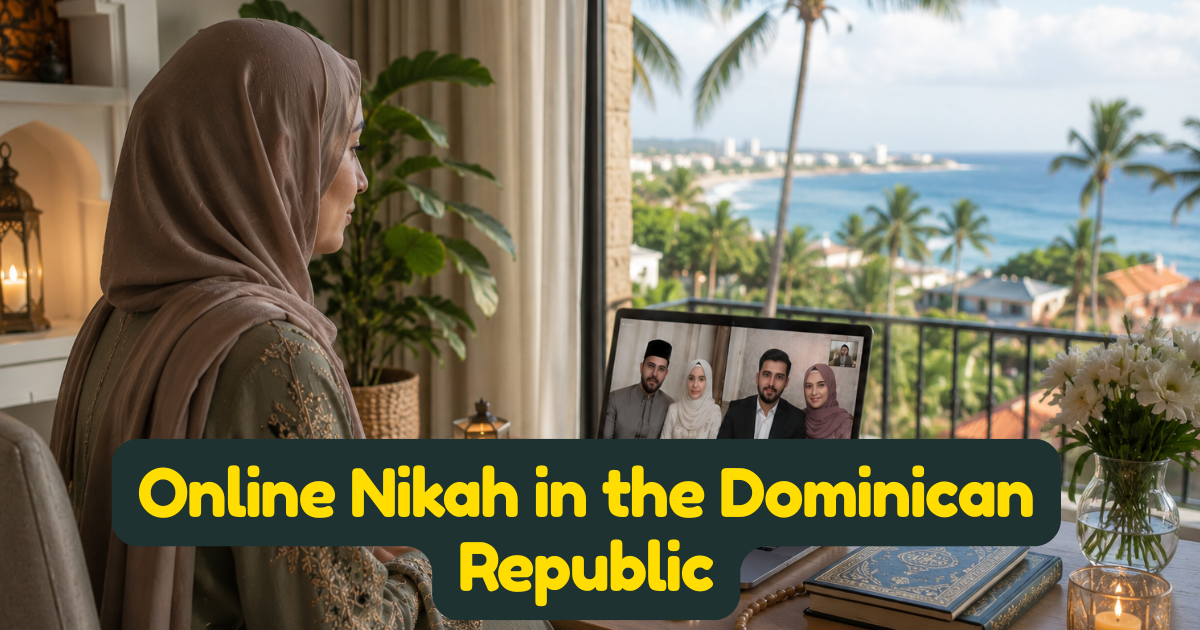
Online Nikah in the Dominican Republic: The Al-Noor Mosque, the Ibadi Community of the Cibao, and How Muslims Marry on an Island Where Civil Law and Church Law Share the Stage
In the heart of the Cibao Valley — the fertile agricultural heartland of the Dominican Republic, stretching between the northern and southern mountain ranges — something religiously unusual has been growing. A community of Dominican Muslims has been embracing Ibadi Islam: one of the oldest surviving branches of the faith, predating the Sunni-Shia split, practised today almost exclusively in Oman and in small diaspora communities scattered across East Africa and North Africa. The Comunidad Ibadi del Cibao has attracted an estimated 10,000 adherents according to figures cited by the Wikipedia entry on Islam in the Dominican Republic — Dominicans of no Arab descent who have embraced a theological tradition from the first century of Islamic history and are building it anew in a Caribbean valley. It is, by any measure, one of the most unexpected Islamic developments in the Western Hemisphere.
Beyond the Ibadi community, the Dominican Republic's Muslim population includes approximately 30,000 Sunni Muslims according to the Círculo Islámico de República Dominicana — though other estimates place the total Muslim population considerably lower, at 3,000 to 5,000, reflecting the absence of reliable census data on religion. The community's Sunni majority is served primarily by the Al-Noor Mosque in Santo Domingo, the country's principal mosque and Islamic centre. Arab immigrants from Lebanon, Syria, and Palestine — as well as Pakistani and African professionals — make up the immigrant Muslim layer, alongside a growing population of Dominican converts who discovered Islam through their own study and community contact. The U.S. Department of State's 2023 International Religious Freedom Report on the Dominican Republic confirms the constitutional framework of religious freedom within which all these communities operate.
The Dominican Republic's Marriage Framework: Civil and Religious, Both Legally Valid
Like Paraguay, the Dominican Republic occupies a distinctive legal position among the Latin American countries in this series. The country recognises both civil and religious marriages, with Catholic Church marriages in particular playing a central role in Dominican social life. As the U.S. Embassy in the Dominican Republic confirms, marriages in the Dominican Republic fall into two categories: civil marriages conducted directly at the Civil Registry office (Oficialía del Estado Civil) or at an authorised private location such as a resort, and religious marriages conducted by a recognised church — but with the critical requirement that all religious marriages must be recorded in the civil registry within three working days of the ceremony. Without that registration, the religious marriage has no legal standing.
For a Muslim nikah specifically, the same principle applies as in Paraguay: the degree to which an Islamic ceremony qualifies as a "religious marriage" with legal standing in Dominican law depends on whether the Islamic community has obtained official recognition and whether the imam conducting the ceremony is authorised to submit the record to the civil registry. The safest and most legally certain path for Muslim couples in the Dominican Republic is to conduct both an Islamic nikah and a civil ceremony at the Civil Status Office — ensuring Islamic validity and full civil legal recognition through the unambiguous civil route.
The Civil Marriage Process: Dominican Republic's Flexible Framework
The Dominican Republic has developed one of the most flexible civil marriage frameworks in the Caribbean for foreign nationals, partly because destination weddings are a major economic sector. As confirmed by wedding legal specialist resource Batu.do and confirmed by Destify's Dominican Republic marriage guide, the requirements are as follows:
- No residency requirement. Foreigners can marry in the Dominican Republic without being residents — arriving 3–5 business days before the ceremony is typically recommended for document processing.
- Valid original passports for both parties, plus copies.
- Apostilled birth certificates from the country of origin, translated into Spanish by an official translator. The Dominican Republic joined the Hague Apostille Convention.
- Affidavit of single status — a sworn declaration before a notary that both parties are unmarried and free to marry.
- Two adult witnesses with valid identity documents. Witnesses may be foreigners or Dominican nationals.
- Divorce decrees or death certificates if either party was previously married, apostilled and translated.
The ceremony is conducted in Spanish by a Dominican civil judge or authorised Civil Status Officer. Uniquely among destination wedding countries, the Dominican Republic allows the civil ceremony to be performed anywhere — including on the beach, at a resort in Punta Cana, or at a private home — as long as the authorised officer is present. The couple need not appear at a courthouse at all. The marriage certificate issued after the ceremony is apostilled at the Dominican Ministry of Foreign Affairs for international use.
What the Civil Status Office Cannot Provide — and What the Nikah Requires
Fast and flexible as it is, the Dominican civil marriage system does not conduct a nikah. The Civil Status Officer — whether at a courthouse in Santo Domingo or on a beach in Punta Cana — does not ask about the wali, does not recite the ijab and qabul, does not inquire about the mahr, and does not arrange for two Muslim witnesses to hear an Islamic offer and acceptance. These conditions must be met independently.
For the Ibadi Muslim community of the Cibao, the theological dimension adds specific considerations: Ibadi jurisprudence has its own nuanced positions on the conditions of a valid nikah, the role of the wali, and the witnessing of the contract that differ in certain respects from Sunni Hanafi or Shafi'i positions. InstantNikah.com works with scholars familiar with Ibadi jurisprudence as well as the Sunni madhabs to ensure the ceremony meets the specific theological tradition of the couple.
For Sunni Muslim couples — Arab diaspora families, Pakistani professionals, Dominican converts — the four conditions remain constant: a wali, two witnesses who hear the contract, agreed mahr, and free consent. InstantNikah.com conducts Shariah-compliant online nikah ceremonies over a secure live video connection, with a qualified qazi officiating, the wali participating from wherever he is in the world, and two witnesses confirming the contract on the call. A nikah certificate is issued after the ceremony. For the scholarly basis of remote ceremonies, our guide on the video-call nikah ruling covers each major madhab. Where the wali appoints a proxy, our guide on appointing a wakeel in nikah explains the process. For Dominican converts with no Muslim guardian, our guide on how a convert finds a wali for nikah addresses the appointment.
The Dominican Republic as a Muslim Wedding Destination
The Dominican Republic's flexible civil marriage system — no residency requirement, beach and resort ceremony options, quick processing — makes it a potential Muslim destination wedding location. A Muslim couple could conduct their nikah online before travelling, then celebrate the civil marriage at a resort in Punta Cana with family and friends present. The civil certificate is apostilled in Santo Domingo and recognised internationally. The online nikah certificate accompanies it as the Islamic record of the marriage. Both ceremonies can be separated by whatever distance and time is convenient for the family.
For Muslim couples who marry in the Dominican Republic and need to register that marriage in their home country, the apostilled Dominican civil marriage certificate is the document to work with. Our guide on registering a nikah civilly after the Islamic ceremony covers the registration sequences for major home-country nationalities.
Quick Answers for Muslims in the Dominican Republic
Is a nikah at the Al-Noor Mosque in Santo Domingo legally recognised? The legal standing depends on whether the mosque has civil marriage registration authorisation. To ensure unambiguous legal recognition, completing both the Islamic nikah and the civil ceremony at the Oficialía del Estado Civil is the recommended approach.
Is an online nikah Islamically valid from the Dominican Republic? Yes — when the wali participates, two witnesses genuinely hear the contract, mahr is agreed, and consent is free. The Dominican civil framework does not affect Islamic validity.
Can we have the civil marriage ceremony at a beach resort in Punta Cana? Yes. The Dominican Republic's civil marriage law allows authorised Civil Status Officers to perform the ceremony at any location, including resorts and beaches, making it one of the most flexible civil marriage destinations in the Caribbean.
What is the Ibadi Muslim community in the Cibao? The Comunidad Ibadi del Cibao is a Dominican Muslim community that has embraced Ibadi Islam — one of the oldest surviving sects of the faith, predating the Sunni-Shia split, practised mainly in Oman. It represents one of the most unusual Islamic developments in the Caribbean and the Americas.
A Caribbean Island With an Ancient Sect, a Flexible Civil Registry, and a Nikah That Needs Neither
The Dominican Republic's Islamic story is distinctly its own: a tiny Al-Noor Mosque in Santo Domingo, a Cibao valley growing an ancient Ibadi tradition, Arab traders and Pakistani professionals building quiet lives in a Catholic-majority Caribbean nation, and Dominican converts discovering Islam through their own journey. The civil marriage system is one of the most accommodating for foreigners anywhere in Latin America. What it cannot provide — and what the Al-Noor Mosque may or may not be legally positioned to provide — is a nikah that is unambiguously, verifiably valid under Islam. InstantNikah.com provides exactly that: a qualified qazi, proper witnesses, a participating wali, a documented mahr, and a nikah certificate for a community building its Islamic life in one of the world's most unexpected locations. When you are ready, book your online nikah and speak with our team about your circumstances in the Dominican Republic.
Admin User
Author