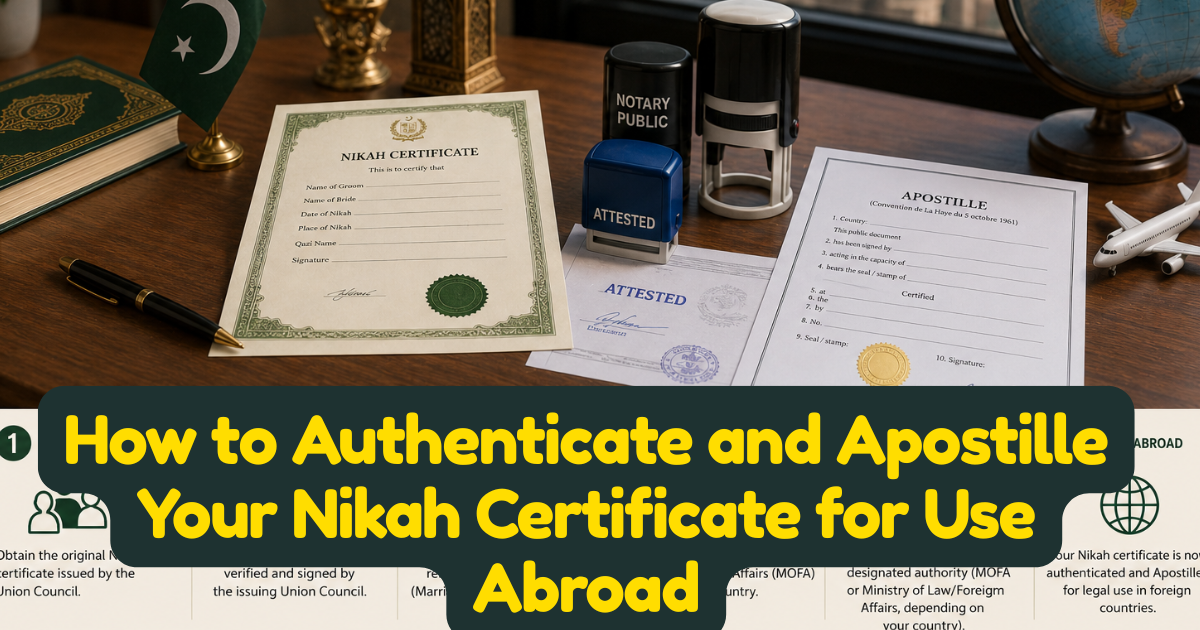
How to Authenticate and Apostille Your Nikah Certificate for Use Abroad — Step-by-Step Country Guide
Most couples who receive their nikah certificate assume the hard part is over. They have the document; it confirms the marriage; it is signed, stamped, and genuine. What they do not always realise is that this document — as it stands — may not be accepted in another country without an additional layer of official authentication. This is not a flaw in the certificate. It is simply the reality of how international document recognition works under a system that has been in place since 1961.
Whether you need to use your nikah certificate for a visa application in Germany, a spousal immigration petition in the USA, a civil registration in France, or an inheritance claim in the UAE, understanding the authentication and apostille process will save you weeks of delay and the frustration of having a valid document rejected on a procedural basis. This guide explains everything — from what an apostille actually is, to the specific steps required depending on where your nikah was performed.
What Is an Apostille and Why Does It Matter for a Nikah Certificate?
An apostille is an official certification that authenticates the origin and genuineness of a public document for use in a foreign country. It does not validate the content of the document itself — it confirms that the signature, seal, or stamp on the document is genuine and that the issuing authority is recognised.
The apostille system was created by the Hague Convention of 5 October 1961 — formally called the Convention Abolishing the Requirement of Legalisation for Foreign Public Documents. As the US State Department's official apostille guidance confirms: apostille certificates are for documents used in countries that signed the 1961 Hague Convention. For countries that did not sign — of which there are still a significant number — a different process called authentication or embassy legalisation applies instead.
Currently, over 129 countries are party to the Hague Convention, including all EU member states, the UK, the USA, Australia, and most of South America. This means an apostilled nikah certificate from the UK, for example, will be accepted in Germany, France, Spain, Australia, and dozens of other countries without any further steps. As the Hague Apostille UK resource confirms: once the FCDO apostille is attached to a UK document, it is legally recognised by all competent authorities in every member country.
For countries not in the Hague Convention — such as the UAE, Saudi Arabia, and some countries in Asia and Africa — a more extensive process involving both apostille and embassy legalisation (attestation) is required. The UAE is a particularly important example for Muslim couples because of its significance in Muslim diaspora immigration routes.
The Critical Distinction: UK-Issued vs Foreign-Issued Nikah Certificates
Before understanding the authentication process, it is essential to grasp the most important distinction in this area: the country that issued the nikah certificate determines where and how it can be apostilled. An apostille can only be issued by the country that issued the document. A Pakistani nikah nama cannot be apostilled by the UK FCDO. A UK nikah certificate cannot be apostilled by Pakistan's MOFA. Each country's apostille authority can only authenticate documents issued by its own government agencies.
This principle is stated clearly in the FCDO Apostille Legalisation Office guidance: the FCDO authenticates UK public documents. If your document was issued in another country, you need to contact the competent authority in that country. The practical implication for Muslim couples is that the process depends entirely on where their nikah was performed and which country issued the certificate.
Part One: Authenticating and Apostilling a UK-Issued Nikah Certificate
For Muslim couples in the UK who had their nikah conducted in the UK and received a certificate from a UK-based service — including through InstantNikah.com — the process for making that certificate usable abroad involves the following steps.
Step 1: Understand What Type of Certificate You Have
There are two types of marriage certificates in the UK context. The first is an official civil marriage certificate issued by the General Register Office (GRO) — this is a government-issued public document that can be directly apostilled by the FCDO. The second is an Islamic nikah certificate issued by the religious official or online nikah service — this is not a government document and therefore requires additional steps before it can be apostilled.
As the guidance from Notary.co.uk on marriage certificate legalisation explains directly: "Nikkah marriage certificates aren't issued by the UK government. They will need to be notarised before they can be apostilled. You will need to provide us with the original nikkah certificate, and our team will carry out checks to make sure it is authentic. We will then make a photocopy and one of our notaries will notarise the copy. Finally, we will submit the notarised copy to the FCDO on either our Premium or Standard Service to be apostilled."
This is a crucial distinction. If you have a UK civil marriage certificate from the GRO — the document issued after a civil registration — you can proceed directly to Step 3. If you have only a nikah certificate from a religious service, you must go through the notarisation step first.
Step 2: Notarise the Nikah Certificate (For Islamic Certificates Not Issued by Government)
Take your original nikah certificate to a qualified UK notary public. The notary will verify the authenticity of the certificate, examine the original, and then notarise a certified copy. This notarised copy now has a legally recognised signature and stamp — the notary's — which the FCDO is authorised to authenticate. The notarisation process typically takes one to five working days and costs between £50 and £150 depending on the notary.
It is worth noting that some embassies — for example, the Egyptian Embassy and the Chinese Embassy as mentioned in the Notary.co.uk guidance — will not legalise nikah certificates at all, even after apostille. If you need your nikah certificate legalised specifically for use in countries with such embassy restrictions, consulting an immigration solicitor before beginning the process is advisable.
Step 3: Apply for an FCDO Apostille
Once the document is either a GRO civil marriage certificate (Step 3 directly) or a notarised nikah certificate (after Step 2), it can be submitted to the UK Foreign Commonwealth and Development Office (FCDO) for an apostille. The FCDO's Legalisation Office in Milton Keynes handles all apostille applications. As confirmed by the Legalisation Services FAQ on FCDO apostille: the FCDO apostille is recognised in 170+ countries that are signatories to the Hague Apostille Convention, including all EU countries, USA, Canada, and Australia.
Applications can be submitted by post or through an authorised apostille service. The FCDO apostille service offers standard processing (up to ten working days) and a premium service (five working days). Several private apostille services — including Hague Apostille UK — offer one to two day turnaround by handling the FCDO submission on your behalf for a service fee.
Step 4: Embassy Legalisation (For Non-Hague Convention Countries)
If the country where you need to use the certificate is not a Hague Convention signatory — the UAE, Saudi Arabia, Qatar, and several other countries fall into this category — an additional step of embassy legalisation is required after the FCDO apostille. As the Fast Track Apostille guide on legalising UK marriage certificates for spouse visas explains: "For non-Hague countries, the process doesn't stop at the apostille. Countries such as the United Arab Emirates typically require both apostille and embassy attestation. Failing to complete the full legalisation chain is one of the most common causes of spouse visa delays."
Embassy legalisation requires submitting the apostilled document to the embassy or consulate of the destination country in the UK. The embassy then places its own stamp or seal, confirming that the FCDO apostille is genuine. This step typically adds five to fifteen working days to the process, plus the embassy's attestation fee.
Part Two: Authenticating and Apostilling a Pakistani Nikah Nama
For couples whose nikah was performed in Pakistan and who need to use the nikah nama abroad — for UK, EU, or US immigration purposes, or for civil registration in another country — the Pakistani authentication chain is distinct from the UK process and has more stages.
Step 1: Ensure the Nikah Nama Is Properly Registered
The foundation of any Pakistani marriage document authentication is proper civil registration. As established in the previous article in this series, a nikah nama that was never submitted to the Union Council for registration cannot be properly attested or apostilled. The Union Council registration is the baseline from which all further authentication proceeds. If your nikah nama is not Union Council registered, this must be resolved first — ideally with the assistance of a family lawyer in Pakistan.
Step 2: Union Council Attestation and NADRA Certificate
Visit the Union Council in the district where the nikah was registered. Present the original nikah nama along with CNICs (Computerised National Identity Cards) of both parties. The Union Council will verify the registration record and attest the document. As confirmed by the Attestation Services Pakistan guide on nikah nama attestation: the Union Council attestation is the essential first step before any further processing.
Simultaneously — or after the Union Council attestation — obtain the NADRA computerised Marriage Registration Certificate (MRC). As documented in the Vital Attestation Pakistan guide on marriage certificate attestation: foreign embassies typically require the MRC rather than the handwritten nikah nama because the MRC contains Union Council authentication, a QR code, and official stamps and signatures that verify the marriage is officially recorded.
Step 3: Notary Public Attestation
After Union Council attestation, take the documents to a Notary Public in Pakistan. The notary authenticates the Union Council attestation and adds their own legal verification stamp and signature. This step bridges the local administrative authentication and the national government authentication that follows.
Step 4: Ministry of Foreign Affairs (MOFA) Attestation — Apostille for Hague Countries
Pakistan joined the Hague Apostille Convention in 2022, meaning it can now issue apostille certificates directly for documents destined for Hague member countries. This represented a significant simplification of the process. For Schengen/EU countries, UK, Australia, and other Hague members, the MOFA apostille is now the final step — replacing the need for individual embassy attestations. As the Pakistani Ministry of Foreign Affairs confirms at apostille.mofa.gov.pk: the apostille process covers nikah namas and Marriage Registration Certificates with specific documentary requirements including the original nikah nama with registrar's signature and stamp, the MRC, and CNIC of the bride with husband's name.
For online nikah ceremonies specifically, the MOFA confirms: "In case a Marriage took place 'online', the requirements would be the same and the original Nikkah Nama must be duly signed by the bride and groom as well as witnesses with their thumb impressions affixed on it." This is important guidance for couples who conducted their nikah through an online service — the document requirements are identical to an in-person ceremony, and a properly documented online nikah nama is eligible for the full apostille process.
Step 5: Embassy Attestation (For Non-Hague Countries)
For countries not in the Hague Convention — UAE, Saudi Arabia, Kuwait, Qatar, and others — the MOFA apostille alone is insufficient. These countries require embassy attestation from their embassy in Pakistan in addition to the MOFA attestation. As documented in the Vital Attestation Pakistan guide: for UAE, MOFA Pakistan and the UAE Embassy must both verify the document; for Saudi Arabia, Pakistani authorities and the Saudi Embassy in Pakistan must both attest the marriage certificate.
For couples living in the UK who need to authenticate a Pakistani nikah nama from abroad, the Pakistan High Commission London's attestation requirements specify that UK-issued documents require prior FCDO attestation before the Pakistan High Commission will process them — and conversely, that NADRA cards and other Pakistan-issued documents can be attested at the High Commission in London for use in the UK.
Part Three: Authenticating a Bangladeshi Nikah Certificate (Kabinnama)
For Bangladeshi Muslims, the kabinnama (Muslim marriage deed) registered with a licensed Kazi is the primary marriage document. Authentication for international use follows a similar chain to Pakistan's process.
The standard authentication chain for Bangladeshi kabinnamas for international use is:
- Kazi registration — confirmation that the kabinnama was properly registered under the Muslim Family Laws Ordinance 1961 with a licensed Kazi
- Notarisation — by a Bangladeshi notary public
- Ministry of Foreign Affairs (MOFA) Bangladesh attestation — Bangladesh acceded to the Hague Convention in 2025, meaning apostille is now available for Hague member country destinations
- Embassy attestation — for non-Hague destination countries
The US Embassy Bangladesh's official marriage certificate instructions — updated July 2025 and referenced in our previous article — require both Bengali and English versions of the kabinnama. For international use requiring apostille, a certified English translation should accompany the authenticated Bengali original.
Summary: Apostille or Authentication — A Quick Reference
For couples navigating this process, the following quick reference summarises the key decisions:
- Destination country in Hague Convention (EU, UK, USA, Australia, etc.) — apostille from the issuing country's MOFA or FCDO is sufficient
- Destination country NOT in Hague Convention (UAE, Saudi Arabia, Kuwait, etc.) — apostille PLUS embassy legalisation from the destination country's embassy required
- UK civil marriage certificate — can be apostilled directly by FCDO without notarisation
- UK Islamic nikah certificate — must be notarised by a UK notary first, then apostilled by FCDO
- Pakistani nikah nama — Union Council → NADRA MRC → Notary → MOFA apostille (Hague) or MOFA + Embassy (non-Hague)
- Bangladeshi kabinnama — Kazi registration → Notary → MOFA Bangladesh apostille (Hague) or MOFA + Embassy (non-Hague)
- All foreign-language documents — must include a certified English translation for UK and USA immigration purposes
Common Mistakes That Cause Delays
Understanding the process also means knowing where couples most commonly go wrong. The following errors consistently cause documentation delays in visa and immigration applications:
- Submitting a nikah nama without Union Council registration — the document has no civil standing and will be rejected by immigration authorities regardless of any other authentication
- Attempting to apostille a UK nikah certificate without prior notarisation — the FCDO will not apostille a document that does not carry a recognised official signature; the notarisation step cannot be skipped
- Using only the MOFA apostille for UAE or Saudi visa applications — these countries require additional embassy attestation; the MOFA apostille alone will not suffice
- Failing to obtain certified English translations — all foreign-language documents submitted to UK and US immigration must be accompanied by certified translations; photocopies of untranslated documents are not accepted
- Sending photocopies rather than certified originals — apostille can only be applied to original certified documents or notarised copies of originals; standard photocopies are not eligible
How InstantNikah.com Certificates Are Structured for International Use
Every nikah certificate issued by InstantNikah.com is prepared to the standard required for the authentication and apostille process. The certificate includes the full names of both parties, the names of the witnesses and wali, the agreed mahr, the officiant's details, and the date and nature of the ceremony — all the information required by notaries and apostille authorities to verify the document's authenticity.
For couples who received their InstantNikah.com certificate and now need to use it abroad — for a visa application, embassy submission, civil registration, or property matter — the team can advise on the specific notarisation and apostille steps required for your destination country. The contact page is the best starting point for country-specific guidance.
For the broader picture of civil recognition of nikah certificates in different countries, the article at Can a Non-Muslim Country Recognise a Pakistani or Bangladeshi Nikah Certificate provides the full legal context. For understanding what makes a nikah certificate valid under Islamic and civil law, see What Makes a Nikah Certificate Islamically and Legally Valid.
To arrange your nikah through a service that issues properly structured, internationally usable certificates, visit the process page. Booking options include Instant Nikah, Same Day Nikah, Express Nikah, and Essential Nikah.
Admin User
Author