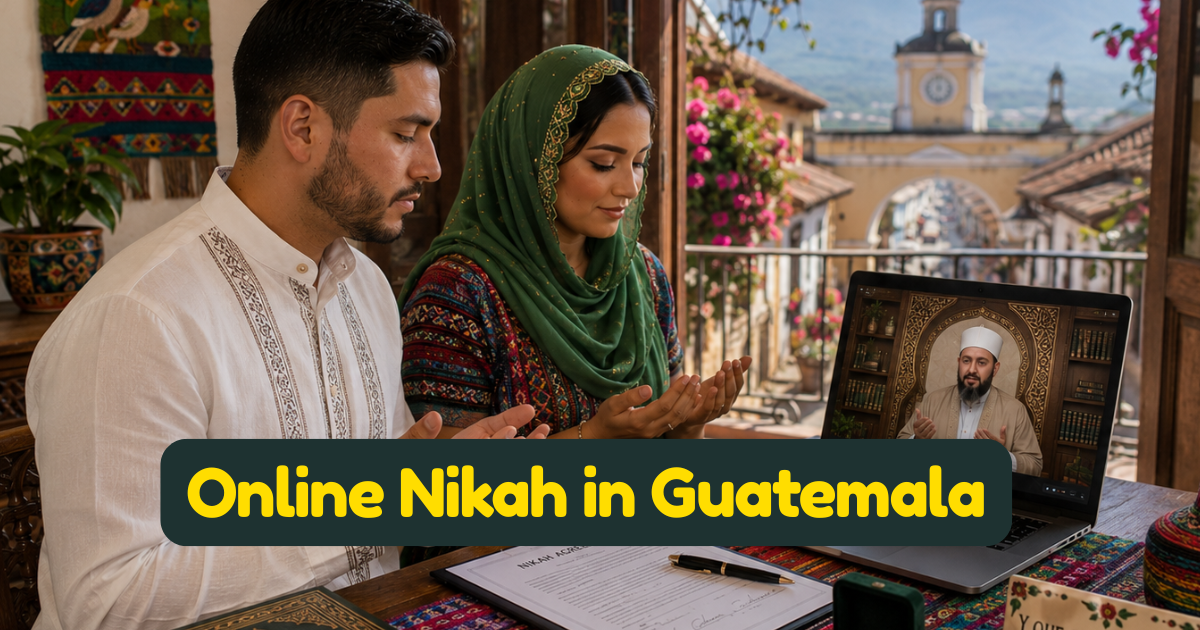
Online Nikah in Guatemala: Palestinian Muslims Under a 1936 Discrimination Decree, Central America's First Ahmadiyya Mosque, and How 2,000 Muslims Marry Through RENAP
In 1936, Guatemalan President Jorge Ubico issued a decree restricting Arab-owned businesses — a measure targeting the Palestinian, Lebanese, and Syrian immigrant community that had been arriving since the late nineteenth century. The effect, as documented by Grokipedia's comprehensive entry on Islam in Guatemala, was to push Arab immigrants toward assimilation through naturalisation, intermarriage, and conversion to Catholicism, which "limited the establishment of lasting Muslim communities due to the absence of mosques." This is a detail unique in this entire series — the direct causal link between a government discrimination decree and the stunting of an Islamic community's institutional development. The Muslim minority that exists in Guatemala today is the remnant of what survived that assimilatory pressure: a small, primarily Palestinian-descended community that maintained its Islamic faith through private practice for decades before the infrastructure of a mosque and organised community could be established.
Today Guatemala has approximately 2,000 Muslims, according to the U.S. Department of State's 2023 International Religious Freedom Report on Guatemala, the vast majority of Palestinian origin and residing primarily in Guatemala City. The community is served by the Da'wah Mosque of Guatemala (Mezquita de Aldawaa Islámica), located near the emblematic Reforma Avenue in Zone 9 of Guatemala City, which is available for the five daily prayers and offers classes in Islamic studies. Alongside the Sunni Palestinian-descent community, Guatemala has a notable Ahmadiyya presence of approximately 700 members, served by the Baitul Awwal Mosque — the first Ahmadiyya mosque ever built in Central America, inaugurated on July 3, 1989, by the fourth Caliph of the Ahmadiyya Muslim Community, Hazrat Mirza Tahir Ahmad. The Ahmadiyya community also has smaller mosques in Huehuetenango and Quetzaltenango, giving it three mosque locations across the country.
Guatemala's RENAP Civil Marriage System: A Pathway for Registered Imams
Guatemala's civil marriage is governed by the Civil Code (Decreto-Ley 106, Articles 78–91) and administered through RENAP — the National Registry of Persons (Registro Nacional de las Personas). As confirmed by the U.S. Department of State's Guatemala civil documents guide, RENAP issues all official marriage certificates, and it is from RENAP — not the municipality where the ceremony occurred — that official certified copies should be requested.
Guatemala's Civil Code specifies three categories of authorised marriage officiants, as confirmed by Guatemala legal specialist resource Living in Guatemala: a mayor, a notary public, or a minister of religion. This third category — minister of religion — creates a pathway that most other countries in this Central American sub-series do not offer. If an Islamic community leader or imam in Guatemala is recognised as a minister of religion for civil marriage purposes, the nikah ceremony could potentially serve simultaneously as the legally registered civil marriage, with registration at RENAP following within the required timeframe.
For foreigners marrying in Guatemala, the additional requirements include a single status certificate (acta de solteía) from the country of origin, apostilled and translated into Spanish by a Guatemala-registered sworn translator, valid passport, birth certificates no more than 6 months old, and — for previously married parties — a divorce decree or death certificate. Foreigners must also publish a marriage announcement in the Official Gazette (Diario de Centro América) for two weeks before the ceremony can proceed. Guatemala joined the Hague Apostille Convention, meaning apostilled documents from Pakistan, Egypt, Turkey, Morocco, and most Muslim-majority countries are accepted. After the ceremony, the notary or officiant registers the marriage with RENAP within 5 to 15 days, and the official certificate is issued.
The Ubico Decree's Long Shadow — and What the Nikah Requires Today
The 1936 Ubico decree did not destroy Guatemala's Palestinian Muslim community. It pushed it underground. The families that maintained their Islamic faith through private practice, through prayer in homes and gardens rather than mosques, through Arabic kept alive within family life rather than in public schools — those families are the ancestors of today's 2,000 Guatemalan Muslims. For them, the nikah has always been something conducted within the family and community, not something the Guatemalan state provided.
A valid nikah requires a wali, two witnesses who hear the offer and acceptance, agreed mahr, and free consent. For a Palestinian Muslim family in Guatemala City whose bride's wali is in Ramallah or in the West Bank, an online ceremony through InstantNikah.com provides the Islamic contract wherever the family is located. The qazi officiates remotely, the wali participates from wherever he is, two witnesses confirm the contract, the mahr is documented, and a nikah certificate is issued. For the scholarly basis of remote ceremonies, our guide on the video-call nikah ruling covers each major madhab. Where the wali appoints a proxy, our guide on appointing a wakeel in nikah explains the process. For converts with no Muslim guardian, our guide on finding a wali for nikah covers the appointment.
After the Nikah: RENAP Civil Registration
Once the nikah has been conducted and the certificate issued, the civil marriage provides the legal recognition through RENAP. Whether conducted before a notary, a mayor, or a registered minister of religion, the ceremony must be followed by RENAP registration within 5 to 15 business days. The official RENAP marriage certificate can then be apostilled for international use — including for home-country registration, immigration purposes, or legal transactions. For a comprehensive civil registration sequencing guide, see our resource on registering a nikah civilly after the Islamic ceremony.
Quick Answers for Muslims in Guatemala
Can a mosque imam legally marry a Muslim couple in Guatemala? Potentially yes — Guatemala's Civil Code allows ministers of religion as authorised marriage officiants alongside mayors and notaries. Muslim community leaders should confirm whether their status qualifies under this provision with RENAP.
How long is the public notice period for civil marriage in Guatemala? Foreigners must publish a marriage announcement in the Official Gazette (Diario de Centro América) for two weeks before the ceremony can proceed.
Is an online nikah Islamically valid from Guatemala? Yes — when the wali participates, two witnesses genuinely hear the contract, mahr is agreed, and consent is free. Guatemala's civil requirements do not affect Islamic validity.
What was the 1936 Ubico decree? President Jorge Ubico's 1936 decree restricted Arab-owned businesses in Guatemala, directly causing many Arab Muslim immigrants to assimilate into Catholicism and limiting the development of Islamic institutional infrastructure for decades.
From Ubico's Decree to the Da'wah Mosque — A Community That Survived Its Own Suppression
The Palestinian Muslim community of Guatemala is one of the most historically tested in this entire series — a community that survived a government decree specifically designed to push it toward assimilation, and that maintained its Islamic identity through private practice for decades before it could build a mosque. The Da'wah Mosque near Reforma Avenue is both a place of worship and a statement of survival. The nikah that formalises a Muslim marriage in Guatemala today carries the weight of that history. InstantNikah.com ensures it is conducted with all the care and rigour its conditions require — wherever in Guatemala or in the world the wali and family happen to be. When you are ready, book your online nikah and speak with our team.
Admin User
Author