Online Nikah in El Salvador: Central America's Yemeni Arab Muslim Community, a Mosque School Teaching Robotics and Arabic, and How Civil Marriage Works Through Notaries and Mayors
El Salvador is the smallest country in Central America by land area, and it holds what is probably the most under-documented Muslim community in all of Latin America. The range of estimates alone tells the story: the Wikipedia entry places the Muslim population at 1,000 to 1,500, while community leaders cite figures as high as 18,000 — a gap that reflects both the difficulty of measuring a community in a country where no census asks about religion in detail, and the genuine uncertainty about how to count a population that includes formally observant immigrant families, their second-generation children, and a growing number of Salvadoran converts whose practice varies widely. What is clear is that a Muslim community exists, has existed since the early 20th century when Arab immigrants arrived from what is now Yemen, Syria, Lebanon, and Palestine, and is growing.
In March 2024, a school called the Escuela Dar Ibrahim opened in Nahuizalco, led by Imam Emerson Bukele. As documented by Grokipedia's comprehensive entry on Islam in El Salvador, the school offers classes in Quran recitation, Islamic religion, ethics, and apologetics alongside secular subjects including robotics, programming, and financial education — all taught in four languages: Arabic, French, English, and Spanish. It targets children from low-income families, including indigenous and local Muslim households, regardless of faith. For a community that has operated largely without formal institutional infrastructure for most of its history, a school that teaches both Quran and coding is a remarkable development.
El Salvador's Muslim History: Yemeni Traders and the First Mosque
Most of El Salvador's Arab Muslim immigrants came from Yemen — distinguishing the country's Muslim community from the Lebanese and Palestinian Christian-majority Arab communities found across the rest of Latin America. The first Islamic cultural centre was established in 1994, and the first mosque in San Salvador followed in the years after. As the Wikipedia entry on Islam in El Salvador documents, El Salvador also has a Shia community — the Islamic Cultural Association Fatimah Az-Zahra, which published the first Islamic magazine in Central America and operates the only Islamic library dedicated to spreading Islamic culture in the country. An Ahmadiyya community exists alongside the Sunni and Shia communities. The community is thus theologically diverse despite its small size, reflecting the different waves of Arab Muslim immigration that have reached Central America over the decades.
El Salvador's constitution guarantees religious freedom and allows non-Catholic groups to register officially with the government for tax-exempt status and legal recognition. The Muslim community has integrated into El Salvador's commercial and civic fabric without significant discrimination, though the challenges of practising a minority faith in a predominantly Catholic evangelical Christian society remain.
El Salvador's Unique Civil Marriage System: Notaries, Mayors, and Governors
El Salvador's civil marriage framework is genuinely distinctive and different from every other country in this series. As confirmed by the U.S. Embassy in El Salvador's marriage guidance, a legal marriage in El Salvador must be conducted by one of three types of officials:
- A public notary (most lawyers in El Salvador hold notary status under El Salvador's civil law system).
- A mayor (alcalde), in one of El Salvador's 262 municipalities.
- A governor (gobernador), in one of El Salvador's 14 provinces.
The couple signs the Escritura Pública de Matrimonio (Public Deed of Marriage) in the presence of two witnesses. The chosen official is responsible for entering the marriage in a Protocol Book and sending a photocopy of the entry to the city hall of the Salvadoran spouse's known place of birth. The notary must then register the Escritura at the appropriate City Hall, which then issues the official Partida de Matrimonio (Marriage Certificate) based on the deed. There is no civil registry office ceremony as in most other countries — the notary or mayor is the officiant.
For foreigners, birth and divorce certificates must be apostilled and issued within 60 days before the proposed civil ceremony date — a tight validity window. El Salvador joined the Hague Apostille Convention, meaning apostilled documents from Pakistan, Morocco, Turkey, and most Muslim-majority countries are accepted. As confirmed by the Library of Congress's report on El Salvador's December 2024 Family Registry Modernisation Law, El Salvador has enacted new legislation to modernise its family registry system, improving efficiency, security, and accessibility of civil status records — reforms that will affect how marriages are registered and documents are issued going forward.
What the Notary or Mayor Cannot Provide — and What the Nikah Requires
The notary or mayor who signs El Salvador's Escritura Pública de Matrimonio creates a legal marriage under Salvadoran civil law. They do not conduct a nikah. The two witnesses who sign the Escritura are civil witnesses, not Islamic witnesses hearing an offer and acceptance. The wali's consent, the mahr, and the recitation of the ijab and qabul are conditions that must be arranged entirely independently of the civil process.
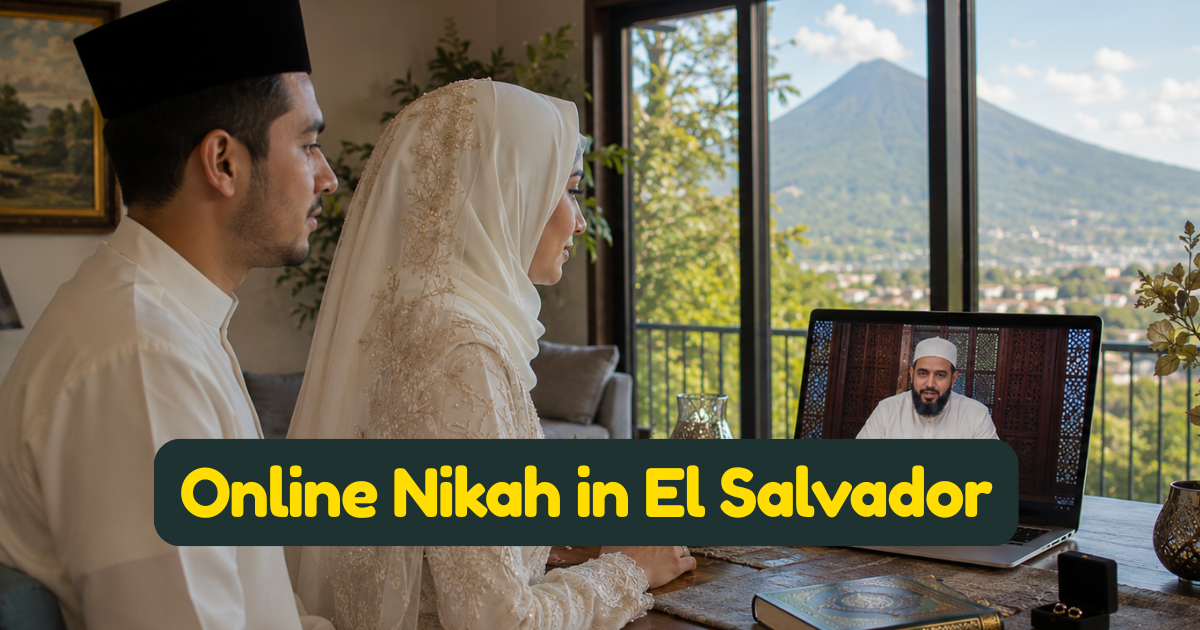
For El Salvador's small Muslim community, where a bride's wali may be in Yemen, Syria, or Lebanon, an online nikah conducted through InstantNikah.com provides the Islamic contract properly and completely. The qazi officiates remotely, the wali participates from wherever he is located, two Muslim witnesses confirm the contract on the call, the mahr is documented, and a nikah certificate is issued. For the scholarly basis of remote ceremonies, our guide on the video-call nikah ruling covers each major madhab. Where the wali appoints a proxy, our guide on appointing a wakeel in nikah explains the process. For Salvadoran converts with no Muslim guardian, our guide on how a convert finds a wali for nikah covers the appointment.
After the Nikah: The Civil Escritura Registration
Once the nikah has been conducted and the certificate issued, the civil marriage at a notary or before a mayor provides full Salvadoran legal recognition. The 60-day validity window for apostilled documents must be planned carefully — couples should ensure their home-country certificates are apostilled close to the planned civil ceremony date. For foreign marriages conducted abroad that need to be registered in El Salvador, the original marriage certificate with apostille must be submitted to the Salvadoran consulate, as confirmed by the U.S. Department of State's El Salvador civil documents guide. For a broader country sequencing guide, see our resource on registering a nikah civilly after the Islamic ceremony.
Quick Answers for Muslims in El Salvador
Who conducts a legal civil marriage in El Salvador? A public notary, a mayor, or a governor. There is no separate civil registry office ceremony — the Escritura Pública de Matrimonio is signed before one of these three types of authorised officials.
Is a nikah legally recognised in El Salvador? No. Religious ceremonies have no independent legal standing in El Salvador. Only the Escritura Pública de Matrimonio signed before an authorised civil official creates a legally recognised marriage.
Is an online nikah Islamically valid from El Salvador? Yes — when the wali participates, two witnesses genuinely hear the contract, mahr is agreed, and consent is free. El Salvador's civil requirements do not affect Islamic validity.
How early must foreign documents be apostilled before the civil ceremony? Apostilled birth and divorce certificates must be issued within 60 days before the proposed civil ceremony date. Documents older than this validity window must be renewed before the ceremony can proceed.
From Yemeni Traders to Robotics and Arabic — A Community Still Building
El Salvador's Muslim community is perhaps the most quietly determined in Central America — a community of Yemeni traders who established themselves in one of the region's most volatile countries during decades of civil conflict, who built a mosque and a magazine and a library, and who are now building a school that teaches Quran and coding side by side. The civil marriage notary who signs the Escritura Pública does not know or care about the nikah that preceded it. The nikah is the community's own responsibility — conducted through its own scholars, its own witnesses, its own wali arrangements. InstantNikah.com ensures that responsibility is met correctly, for Muslim couples in El Salvador regardless of where their family happens to be. When you are ready, book your online nikah and speak with our team.
Admin User
Author