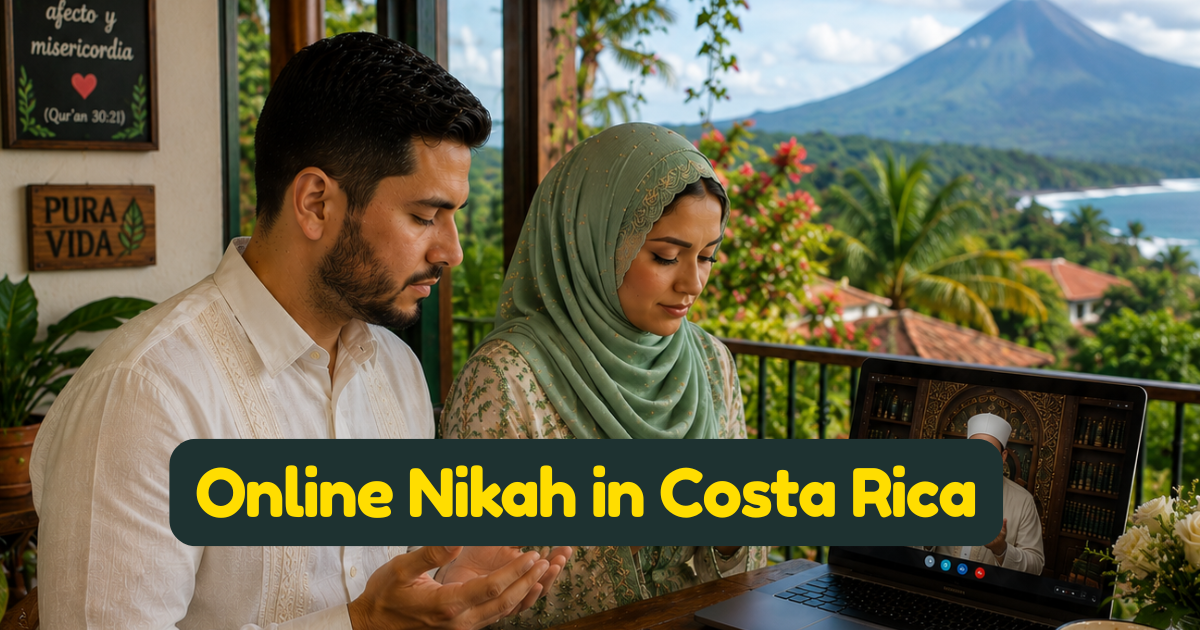
Online Nikah in Costa Rica: A Palestinian Doctor's Mosque, Central America's Only Khoja Shia Community, a Woman Presiding Over the Omar Mosque, and How Muslims Marry Through a Notary
In 1973, a Palestinian doctor named Abdulfatah Sasa arrived in Costa Rica. He had come to practise medicine, but over the years he found himself doing something else as well: building an Islamic community from scratch in a country that had almost none. In the early 1990s, Sasa gathered 14 Muslims at his home in San José to discuss the possibility of a dedicated mosque. That meeting — fourteen people in a doctor's living room — was, as documented by Grokipedia's Omar Mosque documentation, the formal beginning of what would become the Omar Mosque and Islamic Center of Costa Rica. Completed and opened in the early 1990s, the Omar Mosque in downtown San José is the country's principal Islamic institution — a small building in a chaotic capital, serving a community whose size nobody quite agrees on.
How many Muslims are there in Costa Rica? The answer depends enormously on who you ask. As documented by The New Arab's feature on Costa Rica's Muslim community, Professor Sergio Moya of Costa Rica's National University Centre for Middle East and North Africa Studies (CEMOAN) estimates 400 to 1,200 Muslims. Wikipedia's Islam in Costa Rica entry puts the figure at 1,000 to 1,500. The Grokipedia entry on the Omar Mosque cites approximately 7,500 members as of 2023. The U.S. Department of State's 2023 International Religious Freedom Report on Costa Rica confirms "a small Muslim community" without specifying numbers. This wide variance — between 400 and 7,500 — reflects not just measurement difficulties but the genuine diversity of who counts as a practising member of the community versus a background-identified Muslim.
What is clear is that Costa Rica's Muslim community is geographically concentrated in the Central Valley (San José and surrounding areas), theologically diverse (Sunni majority, with a notable Shia minority), and institutionally anchored by the Omar Mosque and a second mosque — the Belén Mosque in La Ribera, Belén, Heredia, managed by a Panama-born sheikh. And it carries one feature unique in all of Central America.
The Khoja Shia: Central America's Only Such Community
Professor Moya's research identified something that makes Costa Rica's Muslim community singular in the region: "Costa Rica is the only country in Central America with a Khoja community." The Khojas are a Shia Muslim trading community originating from South Asia — primarily Gujarat, India and Sindh, Pakistan — who follow the Ismaili or Ithna Ashari (Twelver) traditions and who established global trading diasporas across East Africa, Europe, North America, and parts of Latin America. Their presence in Costa Rica, as a distinctive Shia sub-community within an otherwise Sunni-majority Muslim context, adds a theological and cultural layer absent from neighbouring Guatemala, Nicaragua, El Salvador, and Honduras. Professor Moya also noted that "Sunnis and Shias often go to the same mosque" in Costa Rica — a degree of intra-Muslim unity facilitated by the community's small size and geographic concentration.
Jennifer Rashida Torres: A Woman at the Head of the Omar Mosque
According to Wikipedia's Islam in Costa Rica article, the Omar Mosque and Cultural Muslim Centre of Costa Rica in downtown San José is presided over by Jennifer Rashida Torres. A woman serving as the presiding figure of a mosque is an extraordinary institutional fact — one that is rarely highlighted in coverage of Central American Islam but that reflects something important about Costa Rica's Muslim community: its small size and the nature of local community building means that institutional roles are filled by whoever has the commitment and capability to fill them, not necessarily along gender lines that larger established communities might follow. This detail gives Costa Rica's Muslim community a genuinely distinctive character.
Costa Rica's Civil Marriage System: Notary, Catholic Priest, or Judge
Costa Rica's civil marriage is administered by the Registro Civil under the Tribunal Supremo de Elecciones (Supreme Electoral Tribunal — the same structure as Nicaragua). As confirmed by Costa Rica legal specialist AristaLegal and BGACorp legal specialists, a legal civil marriage in Costa Rica must be conducted before one of three types of authorised officiants: a notary public (attorney), a Catholic priest, or a civil judge. The notary is responsible for registering the marriage with the Registro Civil within eight days of the ceremony; the certificate is processed and issued within eight to twelve weeks.
For foreigners marrying in Costa Rica, the requirements include valid passports (with at least 6 months' validity remaining), a certificate of singleness from the country of origin, birth certificates, and for previously married parties, divorce decrees or death certificates. Two witnesses who know the couple and can attest to their legal capacity must be present — Costa Rica does not allow witnesses who have no personal knowledge of the parties. Costa Rica joined the Hague Apostille Convention. The marriage certificate, once issued, can be apostilled for international use.
Costa Rica made international headlines in May 2020 by becoming the first Central American country to legalise same-sex marriage — a significant legal development that reflects the country's social progressive trajectory but does not change the Islamic marriage requirements for Muslim couples.
What the Notary Cannot Provide — and What the Nikah Requires
Costa Rica's notary public conducts the civil ceremony with the full authority of the Registro Civil. They do not conduct a nikah. The notary asks about identity, marital status, and witness attestation — not about the wali's consent, the mahr, or whether two Muslim witnesses heard the Islamic offer and acceptance. For a Muslim couple in San José whose bride's wali is in Palestine or Lebanon, or for a Costa Rican convert whose entire family is Catholic, the Islamic conditions must be met independently through a properly conducted online nikah.
InstantNikah.com conducts Shariah-compliant online nikah ceremonies over a secure live video connection. A qualified qazi officiates. The wali participates from wherever he is. Two witnesses confirm the contract on the call. The mahr is agreed and documented. A nikah certificate is issued. For the scholarly basis of remote ceremonies, our guide on the video-call nikah ruling covers each major madhab — including the Ismaili and Twelver Shia jurisprudence relevant to the Khoja community. Where the wali appoints a proxy, our guide on appointing a wakeel in nikah explains the process. For Costa Rican converts with no Muslim guardian, our guide on finding a wali for nikah covers the appointment.
After the Nikah: Civil Registration Through a Costa Rican Notary
Once the nikah has been conducted and the certificate issued, the notary civil ceremony provides the legal recognition. Both parties and two witnesses attend the ceremony; the notary submits all documentation to the Registro Civil within eight days. The certificate is processed within eight to twelve weeks and can be apostilled for international use. As Expat.com's Costa Rica marriage guide notes, the Registro Civil also offers free civil marriages at its offices in San José for those who prefer a direct civil registry ceremony without a notary fee. For a comprehensive civil registration guide, see our resource on registering a nikah civilly after the Islamic ceremony.
Quick Answers for Muslims in Costa Rica
Is Costa Rica the only Central American country with a Khoja Shia Muslim community? Yes — academic research by Professor Sergio Moya of Costa Rica's National University confirms it is the only country in Central America with a Khoja community.
Who officiates civil marriages in Costa Rica? A notary public (attorney), a Catholic priest, or a civil judge — no other minister-of-religion pathway exists. The notary is responsible for Registro Civil registration within eight days of the ceremony.
Is an online nikah Islamically valid from Costa Rica? Yes — when the wali participates, two witnesses genuinely hear the contract, mahr is agreed, and consent is free. Costa Rica's civil requirements do not affect Islamic validity.
Can Muslim witnesses at a Costa Rican civil ceremony be family members? Costa Rica requires two witnesses who "know" the couple personally — but does not specifically exclude relatives. Unlike Guatemala and Honduras, there is no explicit non-relative rule.
From Fourteen Muslims in a Doctor's Home to the Land of the Gallo Pinto's Mosque
La Nación, Costa Rica's newspaper of record, once published a feature on Islam titled "El Islam en la tierra del gallo pinto" — Islam in the Land of the Gallo Pinto. The headline captured the improbability of the community's existence and the warmth with which Costa Rican society has largely received it. Dr. Abdulfatah Sasa's gathering of fourteen Muslims in his home three decades ago produced a mosque, a cultural centre, and a community small enough that a woman presides over the mosque and Sunni and Shia worshippers sit together at Friday prayers. The nikah that formalises a Muslim marriage in this community deserves the same careful attention that built the institution itself. InstantNikah.com provides a qualified qazi, a participating wali, proper witnesses, a documented mahr, and a nikah certificate — for the Khoja community, the Palestinian families, the Lebanese traders, and the Costa Rican converts navigating their faith in the land of the gallo pinto. When you are ready, book your online nikah and speak with our team.
Admin User
Author