Online Nikah in Colombia: Indigenous Muslim Converts, Lebanese Diaspora Communities, and How to Marry Islamically in a Country Where the Notaría Holds All the Power
In the coastal town of Maicao, just kilometres from the Venezuelan border in the La Guajira department, the mosque stands as one of the largest in South America — an architectural landmark in a town where Arab merchants have traded for over a century and where the Muslim community is openly, visibly present in ways unusual for Latin America. Further south, in the highland neighbourhoods of Bogotá, something different is happening: young Colombians with no Arab ancestry and no immigrant family connection are embracing Islam through personal study, through online contact with the global Muslim community, and through small, locally-embedded congregations that a 2024 peer-reviewed study in the journal Religions describes as an emerging "indigenous" Colombian Islam — locally rooted, Spanish-speaking, and distinctly non-immigrant in character.
These two faces of Colombian Islam — the established Arab diaspora community of the Caribbean coast and the Bogotá convert wave — share a country and a faith but face the same structural situation when it comes to marriage: Colombia is a secular state where only a Notaría-processed marriage creates full legal standing, and where a nikah conducted at a mosque, however properly witnessed, has no civil legal effect unless it is subsequently registered. For practising Muslims in Colombia, this means the same dual requirement that applies across Latin America: an Islamic marriage contract for the religious side, and a Notaría registration for the civil side.
Colombia's Notaría Marriage System: How It Works and Why It Is Faster Than Most
Colombia's civil marriage is conducted through the Notaría (Notary Public) system under Decree 2668 of 1988, rather than through courts or civil registry offices as in many other countries. The Notaría combines the functions of document verification, ceremony, and registration into a single institution. As confirmed by Colombian legal specialists at Nexo Legal and LegalClarity, the process involves the following steps for both Colombian nationals and foreigners:
- Document submission at a Notaría — both parties present valid passports or Colombian ID (cédula), birth certificates issued within the last 90 days (apostilled and certified in Spanish for foreign documents), a sworn declaration of no legal impediment to marry, and if previously married, a divorce decree or death certificate of the former spouse.
- The Edicto — a public notice posted at the Notaría for five business days announcing the intended marriage, during which any party may raise a legal objection. This is significantly shorter than Brazil's 30-day habilitação.
- The civil ceremony — a brief formal proceeding before the Notary, in the presence of two adult witnesses who cannot be family members of either party, during which the Notary reads relevant articles of the Civil Code.
- The Registro Civil de Matrimonio — the official marriage certificate, which is the legally binding document for all subsequent civil, immigration, and inheritance purposes.
Colombia joined the Hague Apostille Convention, meaning foreign birth certificates and other public documents from Hague member countries — including Pakistan, India, Bangladesh, and most Muslim-majority countries — require an apostille rather than full consular legalisation. As the Medellín-based legal resource Medellín Lawyer notes, the most common cause of delays for foreign couples is missing apostilles or uncertified Spanish translations — not the legal requirements themselves.
A Unique Feature: Colombia Allows Religious Marriages to Gain Civil Effect
Colombia has one feature that distinguishes it from Mexico, Brazil, and most other countries in this series: religious marriages can gain full civil legal effect when registered at the Notaría. The Colombian state formally recognises marriages celebrated by the Catholic Church and certain other Christian churches that have signed recognition agreements. When such a marriage certificate is registered at the Notaría or the National Civil Registry (Registraduría), it is legally equivalent to a civil marriage.
However — and this is the critical point for Muslim couples — Islam is not among the religions whose marriage certificates are automatically given civil effect under this framework. A nikah conducted at a mosque in Bogotá or Maicao is a recognised Islamic contract, but it does not automatically produce a Colombian marriage certificate. The couple must still proceed to the Notaría for a civil ceremony or register the nikah through the civil process to achieve full legal standing. The practical consequence is identical to Mexico and Brazil: both the nikah and the civil step are necessary. The religious act and the civil act are separate, and the state provides only the latter.
Islam in Colombia: Three Communities, One Marriage Challenge
Understanding who Colombia's Muslims are explains why the online nikah solution serves different people in different ways.
The Arab diaspora of the Caribbean coast. The Lebanese, Palestinian, and Syrian communities of Maicao, Barranquilla, and Cartagena have been established since the late nineteenth century. Colombia hosts the third-largest Lebanese diaspora population in the world after Argentina and Brazil, estimated at between 1.2 million and 2.5 million people of Lebanese descent according to Colombia's National Administrative Department of Statistics (DANE), as documented by BBC Mundo. Within this community, the Muslim minority — predominantly Sunni and Shia — maintains mosque communities and Islamic social networks. For couples where the future spouse or wali is still in Lebanon or Palestine, an online nikah is the practical path to the Islamic contract before the Notaría civil step.
The indigenous Colombian Muslim converts. The peer-reviewed study in Religions journal documents through fieldwork conducted between 2020 and 2024 that Colombian converts form the fastest-growing segment of the Muslim community, with urban Islamic centres in Bogotá, Medellín, and Cali serving predominantly Spanish-speaking Colombian converts rather than immigrant communities. Bogotá went from one mosque in 2007 to six by 2023. For these converts, the wali question is the most acute: a Colombian woman who has taken shahada typically has no Muslim male family member who can serve as her guardian. Without a qualified alternative being arranged, her nikah cannot proceed under the conditions the majority of scholars require.
The international Muslim professional and student community. Bogotá and Medellín attract growing numbers of international professionals and students from Muslim-majority countries, some of whom wish to marry while based in Colombia but whose partner and family are abroad.
How an Online Nikah Works for Muslims in Colombia
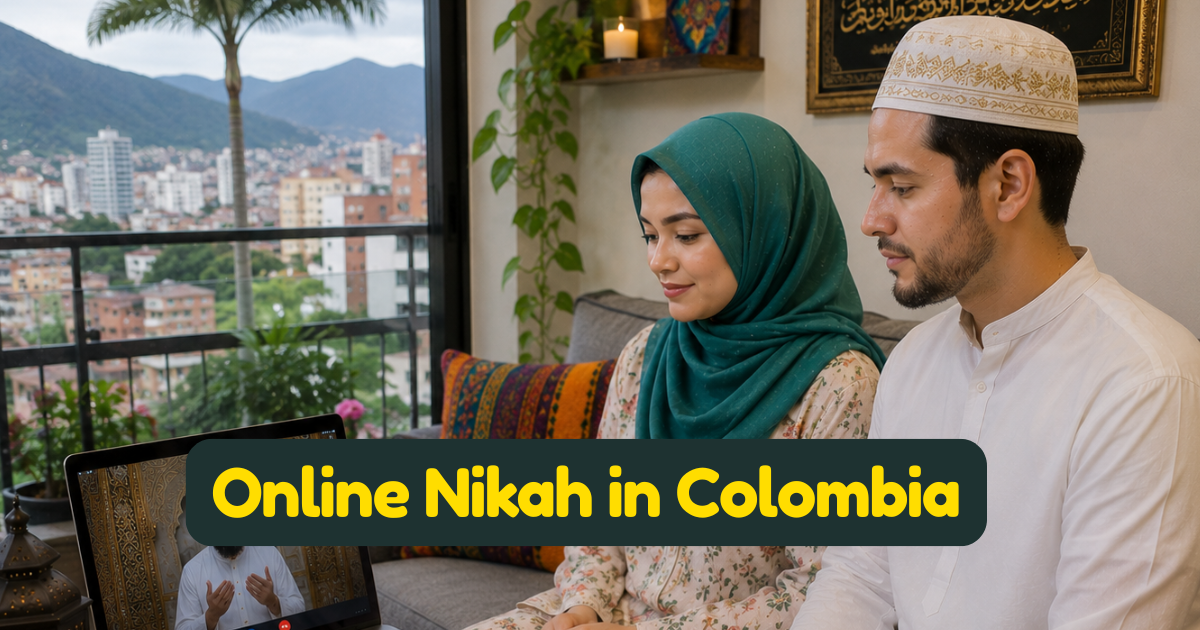
InstantNikah.com conducts Shariah-compliant online nikah ceremonies over a secure live video connection. A qualified qazi or recognised Islamic scholar officiates. The bride's wali participates from wherever he is — Beirut, Ramallah, Karachi, or another Colombian city. Two qualified Muslim witnesses confirm on the call that they have clearly heard the offer (ijab) and acceptance (qabul). The mahr is agreed and documented. A nikah certificate is issued following the ceremony.
For the Colombian convert bride whose family is non-Muslim, a qualified imam or Islamic scholar is appointed to serve as her wali — a mainstream scholarly provision detailed in our guide on how a convert finds a wali for nikah. For the Lebanese-Colombian Muslim whose future wife is in Beirut, the online ceremony completes the Islamic contract now, with the Notaría civil step following when both parties are physically in Colombia. For couples uncertain about the scholarly basis for a remote ceremony, our guide on the video-call nikah ruling covers each major madhab's position in detail.
After the Nikah: The Notaría Civil Registration
Once the nikah has been conducted and the certificate issued, couples in Colombia complete the civil side through the Notaría. Foreign nationals need their apostilled birth certificate with certified Spanish translation, a valid passport, a sworn declaration of single status, and two adult witnesses who are not family members. The five-business-day edicto waiting period is among the shortest in Latin America, meaning the civil process can be completed relatively quickly once documents are properly prepared.
For couples whose nikah was conducted outside Colombia and who wish to register that marriage in Colombia, the foreign marriage certificate must be apostilled and submitted with a certified Spanish translation to the Notaría or Registraduría for registration, as documented by expat legal specialists at Expat Group Colombia. For a broader country-by-country guide on this process, our resource on registering a nikah civilly after the Islamic ceremony covers the major nationality sequences.
Situations an Online Nikah Resolves in Colombia
- Colombian Muslim converts — particularly women — whose entire family is non-Muslim and who need a qualified wali appointed before the nikah can proceed validly. This is the single most common scenario among Colombia's growing convert community.
- Lebanese and Palestinian diaspora couples in Maicao or Barranquilla whose fiancé or wali is still in the Middle East, who want the Islamic contract completed before the civil Notaría step.
- International Muslim professionals in Bogotá or Medellín whose partner and family are abroad and who cannot wait for a physical ceremony to be arranged.
- Long-distance couples where one partner is in Colombia and the other is in a Muslim-majority country — the online ceremony creates the Islamic marriage contract across any distance.
Quick Answers for Muslims in Colombia
Is a nikah at a mosque in Colombia legally recognised? Not automatically. Unlike Catholic marriages, Islamic marriages are not among the religious ceremonies that gain civil legal effect in Colombia without separate registration. A nikah must be followed by a civil Notaría ceremony or registration to achieve full legal standing.
Is an online nikah Islamically valid from Colombia? Yes — when the wali participates, two witnesses genuinely hear the contract, mahr is agreed, and consent is free. Colombia's civil law requirements do not affect the Islamic validity of the nikah contract.
How long does the Colombian civil marriage process take? After documents are submitted, the Notaría posts a public notice (edicto) for five business days. The ceremony can then proceed immediately after the waiting period. With properly prepared documents, the total process is among the fastest in Latin America.
Can a Colombian convert with no Muslim family have a valid nikah? Yes. A qualified imam or Islamic scholar can be appointed as her wali — a well-established scholarly provision that InstantNikah.com arranges as standard for every ceremony where needed.
From Maicao to Bogotá — A Faith Finding Its Colombian Shape
Colombia's Muslim community is doing something remarkable: it is becoming Colombian. The Lebanese families of La Guajira have been here for generations, weaving Arab Islamic culture into the Caribbean coast's social fabric. The converts of Bogotá are writing a different chapter — a Spanish-speaking, locally embedded Islam that does not require an immigration narrative to explain its presence. For all of them, and for the international Muslims who have made Colombia their temporary or permanent home, the Islamic marriage contract and the Colombian civil marriage are two distinct necessities that both deserve to be done properly. InstantNikah.com handles the Islamic side — with a qualified qazi, valid witnesses, a wali for every bride regardless of her family's faith, and clear documentation for the Notaría step that follows. When you are ready, book your online nikah and speak with our team about your specific circumstances in Colombia.
Admin User
Author