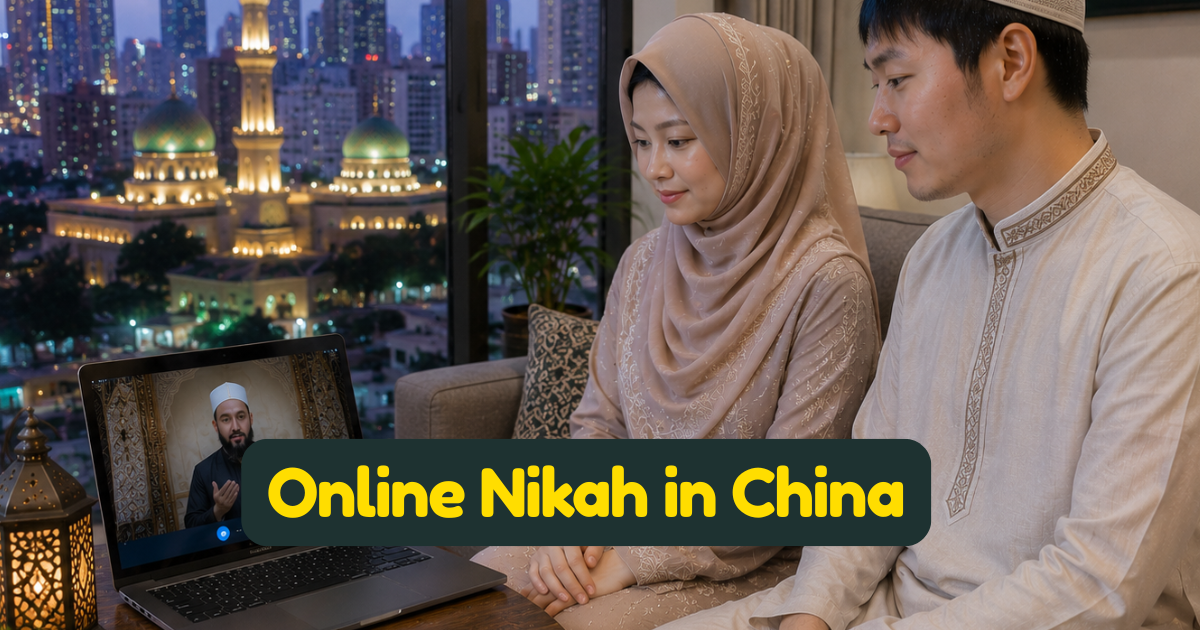
Online Nikah in China: The Hui Muslim Community, Civil Affairs Bureau Registration, and How Muslim Expats and Couples Marry Islamically in a Secular State
Islam arrived in China over thirteen hundred years ago — by some accounts, within decades of the Prophet's (peace be upon him) death — carried along the Silk Road by Arab and Persian merchants who settled in the cities of the Tang Dynasty. The communities they established, and the centuries of intermarriage and conversion that followed, produced the Hui people: a Mandarin-speaking, Han-appearing, ethnically Chinese Muslim community that today numbers approximately 11.3 million according to the 2020 census, distributed across every province of China, concentrated most heavily in Ningxia, Gansu, and Qinghai. They are joined by the Uyghurs of Xinjiang, the Kazakhs, Kyrgyz, Tajiks, Uzbeks, Tatars, Salar, Dongxiang, and Bonan peoples — ten officially recognised Muslim ethnic groups whose combined population, as analysed by the Pew Research Center, reaches an estimated 23 to 25 million, making China home to one of the largest Muslim populations in the world by absolute numbers.
And yet, for every one of these 23 million Muslims — and for the growing community of Muslim expatriates from Pakistan, Bangladesh, Indonesia, and the Middle East working in China's cities — the Chinese state offers no Islamic family law, no Shariah court, no religious marriage registration, and no recognition of a nikah as a legal act. Marriage in China is exclusively a civil administrative matter, processed at the Civil Affairs Bureau (民政局) with no ceremony whatsoever. A nikah conducted at a mosque in Yinchuan or Beijing carries the same legal weight in China as one conducted in a private home: none at all.
China's Civil Marriage System: The Civil Affairs Bureau and What It Requires
China's marriage registration is governed by the Marriage Registration Regulations, confirmed in translation by China Law Translate, which establishes the Civil Affairs Bureau at the county level or above as the sole competent authority for registering marriages. There is no court, no religious authority, no civil celebrant, and no ceremony. The process is entirely administrative.
For a Chinese national marrying a foreign national, registration must occur at the Civil Affairs Bureau in the jurisdiction of the Chinese partner's hukou — the household registration system that ties Chinese citizens to a specific administrative location. This means the registration cannot simply be done at whichever Civil Affairs Bureau is most convenient; it is tied to where the Chinese partner is officially registered as a resident, which may be a different city from where they currently live and work.
The document requirements for a foreigner marrying in China, as documented by the Beijing Municipal Government's official marriage registration guidance and Guangdong's Foreign Affairs Office, include:
- Valid passport and Chinese residence permit — at least one of the two parties must hold a Chinese residence permit for two foreigners to register together; for a Chinese-foreigner couple, the Chinese partner's hukou document is required.
- Single status certificate (marital status certification) issued by a notary office in the foreign national's home country, authenticated by that country's Ministry of Foreign Affairs, and then verified by the Chinese embassy or consulate in that country — or alternatively issued by the foreign country's embassy in China.
- Birth certificate for both parties, with Chinese translation by an accredited agency.
- Three official-style photos of the couple together, typically taken on-site at the Civil Affairs Bureau.
- Completed declaration form signed at the registration office, with an oath administered by the marriage registrar.
As established expat resource Travel China Guide notes, the entire process takes under one hour in most cases — sometimes as little as fifteen minutes — because there is no ceremony. The couple arrives, submits documents, signs forms, pays the fee, and leaves with a marriage certificate. No witnesses are required, no officiant is needed, and no religious element of any kind is involved.
The Nikah Gap: What the Civil Affairs Bureau Cannot Provide
The Civil Affairs Bureau makes you married in China. It does not make you married in Islam. It asks for a single status certificate, not a wali's consent. It records the registration, not the mahr. It photographs the couple, not the witnesses to an Islamic contract. For the Hui Muslim in Ningxia, the Uyghur professional in Shanghai, the Pakistani trader in Guangzhou, or the Indonesian student in Beijing, the Civil Affairs Bureau registration is a legal necessity — but it is also, from an Islamic perspective, entirely silent on the conditions that matter.
A valid nikah requires the same four elements regardless of which country the couple is in:
- A wali — the bride's male Muslim guardian — whose consent gives the contract Islamic validity. For Hui Chinese Muslim women, the wali is typically the father or a male Muslim family member. For foreign Muslim women in China without Muslim family present, a qualified imam can be appointed.
- Two Muslim witnesses who genuinely hear the offer (ijab) and acceptance (qabul) as they are spoken, and who are competent to testify to the contract.
- Agreed mahr, stated as the bride's exclusive right and documented as part of the contract.
- Free consent from both parties without coercion or duress.
None of these conditions depend on a Chinese administrative location. None require a hukou number or a residence permit. They require the right people, in defined Islamic roles, clearly performing the contract. A well-managed online ceremony fulfils every one of them — and for Muslim couples in China, this is often the most practical and reliable way to ensure the nikah is done properly alongside the Civil Affairs Bureau registration.
Muslim Expats in China: Pakistan, Bangladesh, and the Gulf Traders
Beyond China's indigenous Muslim communities, the country's cities host a significant and growing population of Muslim expat workers. Guangzhou's Xiaobei neighbourhood has earned the informal name "Little Africa" partly because of its large community of African Muslim traders; the city also has a substantial South Asian Muslim merchant population with deep historical roots in the city's centuries-old Arab trading heritage. Pakistani nationals form one of the largest South Asian communities in China, particularly in cities along the China-Pakistan Economic Corridor (CPEC) development zone and in commercial hubs like Yiwu, where wholesale trade draws Muslim buyers from across the Muslim world.
For a Pakistani trader in Yiwu or Guangzhou whose fiancée is in Lahore and whose father-in-law is also in Pakistan, the Civil Affairs Bureau can process the civil registration if the Pakistani partner holds a Chinese residence permit — but neither the wali, the witnesses, nor the Islamic contract itself can be supplied by that bureau. An online nikah, conducted before or alongside the civil registration, is the mechanism that supplies the Islamic contract reliably and with proper documentation.
How an Online Nikah Works for Couples in China
InstantNikah.com conducts Shariah-compliant online nikah ceremonies over a secure live video connection. A qualified qazi or Islamic scholar officiates. The bride's wali joins from wherever he is located — Lahore, Dhaka, Riyadh, or Yinchuan. Two Muslim witnesses confirm on the call that they have clearly heard the offer and acceptance. The mahr is agreed, stated, and documented. A nikah certificate is issued following the ceremony for use in subsequent civil and home-country registration.
For couples uncertain about the Islamic basis for a remote ceremony, our guide on the video-call nikah ruling covers the scholarly positions across each major madhab. The question of whether witnesses may attend a nikah remotely is addressed in our dedicated analysis of whether nikah witnesses can be appointed remotely. Where the wali wishes to appoint a proxy, our guide on appointing a wakeel in nikah explains the process.
The Hukou Challenge: Why Geography Complicates Civil Registration in China
The hukou system creates a practical challenge that does not exist in most other countries in this series. A Hui Muslim from Ningxia who has been working in Shenzhen for five years must still register his marriage at the Civil Affairs Bureau in Ningxia — where his hukou is registered — not at a conveniently local Shenzhen office. This means that for many Muslim couples, the Civil Affairs Bureau registration requires travel to the Chinese partner's home province, which may be hundreds or thousands of kilometres away.
An online nikah resolves the Islamic side of the marriage without any geographical constraint. The civil side — including the hukou-tied registration requirement — must be managed on its own timeline, but the couple can be Islamically married from the moment the online ceremony concludes, regardless of when the hukou province appointment can be arranged.
After the Online Nikah: Civil Recognition Routes
For couples registering inside China: Proceed to the Civil Affairs Bureau in the jurisdiction of the Chinese partner's hukou with the standard document set. The nikah certificate from InstantNikah.com serves as evidence of the Islamic marriage contract and can be included with documents as supporting material, though the civil registration is the legally binding step under Chinese law.
For foreign Muslim couples both resident in China: As confirmed by Guangdong's Foreign Affairs Office guidance, two foreigners can register a marriage in China provided both hold valid Chinese residence permits and one of them is based in the relevant jurisdiction. Both must attend in person at the Marriage Registration Office of the Civil Affairs Bureau.
For couples registering the marriage in the home country: A Muslim couple where one or both parties are foreign nationals may find it more practical to register the marriage in the foreign partner's home country and then have that certificate recognised in China through the standard authentication chain. Our guide on registering a nikah civilly after the Islamic ceremony covers the major nationality-by-nationality sequences.
Specific Situations This Serves in China
- Hui Chinese Muslims marrying partners whose wali is in another city or province, who want a properly conducted nikah before the hukou-province Civil Affairs Bureau appointment can be arranged.
- Pakistani and Bangladeshi traders and professionals in Guangzhou, Yiwu, and Beijing whose fiancée and wali are in South Asia and who need the Islamic contract completed while the residence permit and single status certificate documentation is being assembled.
- Muslim students from Southeast Asia, Central Asia, and the Middle East studying in Chinese universities who want to marry during their studies without travelling home for a ceremony.
- Muslim converts — including Han Chinese who have embraced Islam — whose family is non-Muslim and who need a qualified wali appointed. Our guide on how a convert finds a wali for nikah addresses this directly.
Quick Answers for Muslims in China
Is a nikah at a mosque in China legally recognised? No. China's civil law recognises only marriages registered at the Civil Affairs Bureau. A mosque nikah has no legal standing under Chinese law.
Is an online nikah Islamically valid from China? Yes — when the wali participates, two witnesses genuinely hear the contract, mahr is agreed, and consent is free. China's civil requirements do not affect the Islamic validity of the nikah contract.
Where do we register the civil marriage if my Chinese partner's hukou is in a different city? The civil registration must take place at the Civil Affairs Bureau in the jurisdiction of the Chinese partner's hukou — the administrative location where they are officially registered as a resident, regardless of where they currently live.
Can two foreign Muslims register their marriage at the Civil Affairs Bureau in China? Yes, provided both hold valid Chinese residence permits and at least one of them is based in the relevant jurisdiction. Both must attend in person.
Thirteen Centuries of Islam in China — and One Gap the State Cannot Fill
Islam has been part of China's cultural and demographic fabric since the seventh century. The Hui people have navigated imperial courts, republican governments, and the People's Republic — adapting, persisting, and maintaining their faith through arrangements that other Muslim communities around the world might find remarkable. The one thing the Chinese state has never provided, through any of those centuries and governments, is an Islamic marriage contract. That has always been the community's own responsibility — arranged between families, witnessed by fellow Muslims, conducted by a scholar, and recorded in the nikah itself. InstantNikah.com continues that tradition in its most accessible form, across any distance and in any city, for Muslim couples in China who want both their deen and their civil paperwork in order. When you are ready, book your online nikah and speak with our team about your specific circumstances.
Admin User
Author