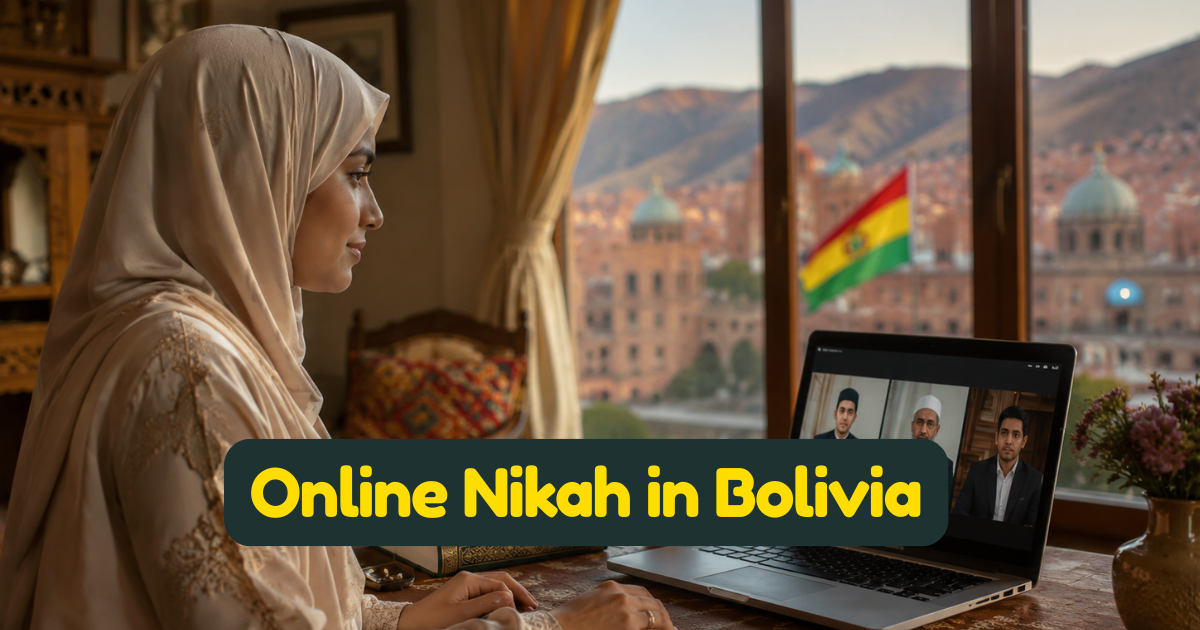
Online Nikah in Bolivia: A Palestinian Immigrant Built the First Mosque in 1994, the Andes Have Their Own Islamic Story, and Civil Law Requires a 5-Day Public Notice
In 1974, a Palestinian immigrant named Mahmud Amer Abusharar arrived in Santa Cruz de la Sierra — Bolivia's commercial capital, sprawling across the tropical lowlands east of the Andes. He came to trade, as Arab immigrants across Latin America came to trade, but he brought his faith with him. For twenty years he had no mosque, no formal community, no institutional infrastructure. He prayed as he could, maintained his Islamic practice privately, and watched the Arab community of Santa Cruz grow around him, predominantly Christian. Then, in September 1994, he completed the Centro Islámico Boliviano's first mosque — Bolivia's first — in the city of Santa Cruz. As documented by the American Foreign Policy Council's World Almanac of Islamism, he had done what Palestinians so often do across the diaspora: built something permanent in a place that had not thought to make room for it.
Bolivia's Muslim community, currently estimated at 2,000 to 3,000 people representing 0.02 percent of the 2024 census population of 11,312,620, is concentrated in La Paz and Santa Cruz, with smaller presences in Cochabamba and remote cities in the Beni and Santa Cruz departments. As documented by Wikipedia's Islam in Bolivia entry, the community includes descendants from Bangladesh, Pakistan, Egypt, Palestinian territories, Lebanon, Syria, and Iran, as well as a small number of Bolivian-born converts — including some indigenous Bolivians who have embraced Islam. Isa Amer Quevedo, the current Director of the Bolivian Islamic Centre, holds a degree in Islamic jurisprudence from the Islamic University of Madinah — giving Bolivia's community a scholarly depth disproportionate to its size.
Bolivia's Three Cities, Three Islamic Institutions
Bolivia's Islamic geography is spread across three distinct urban settings, each with its own institutional character.
Santa Cruz de la Sierra hosts the Centro Islámico Boliviano (CIB) — the oldest and most established Islamic institution, founded by Abusharar and built around the first mosque completed in 1994. The CIB is primarily Sunni and serves the Arab Muslim trading community of Bolivia's wealthiest and fastest-growing city. A second mosque has since been built in the Warnes district outside Santa Cruz, established in 2016 by an Indian Muslim couple following the Ahmadiyya tradition.
La Paz has the Yebel An Nur Mosque, founded in 2004, and the Association of the Islamic Community of Bolivia (Asociación Cultural Islamica Boliviana — ACIB), where the origins of La Paz's Islamic community trace to 1995 when Moumin Candia, a Bolivian trained in Islamic jurisprudence, began organising Muslim practice in the city. The As-Salam Mosque in La Paz receives both Sunni and Shia worshippers and has connections to both Saudi and Iranian funding sources, reflecting Bolivia's geopolitical position as one of the few Latin American countries that has cultivated close ties with both.
Cochabamba has a smaller Muslim cultural centre serving the community in Bolivia's third city.
Bolivia's SERECI Civil Marriage System
Bolivia's civil marriage is administered by the Servicio de Registro Cívico (SERECI) — the Civil Registry Service — which is part of the Tribunal Supremo Electoral (Supreme Electoral Tribunal) rather than the Ministry of Justice as in most other countries in this series. As confirmed by the official SERECI services page, the marriage between a Bolivian citizen and a foreigner, or between two foreigners, is a service explicitly offered and regulated through the electoral tribunal system. The procedure involves the following steps:
- Submission of the marriage application at the SERECI office, with valid identity documents and civil status certificates. For foreigners, the civil status certificate (certificación de libertad de estado civil) must be apostilled and translated into Spanish.
- Publication of edictos for five business days — a public notice posted at the civil registry for five working days, during which any legal impediment to the marriage may be raised. This is Bolivia's equivalent of the publication or notice period used in other countries.
- Marriage ceremony and registration within 15 calendar days following the last day of the edicto publication period. Both parties, their witnesses, and the Civil Registry Official must be present.
- Two adult witnesses who need not be Bolivian nationals — they can be foreigners with valid passports or identity documents.
- Issuance of the marriage certificate and libreta de familia (family booklet) following the ceremony.
Bolivia joined the Hague Apostille Convention, as confirmed by the Bolivian Embassy in Washington DC's marriage guidance, meaning documents from Pakistan, Turkey, Egypt, and most Muslim-majority countries can be authenticated through the apostille route. For a marriage contracted abroad, it must be registered at the Bolivian Consulate for recognition in Bolivia.
What SERECI Cannot Provide — and What the Nikah Requires
Bolivia's SERECI civil marriage creates a legal union under Bolivian law. It does not conduct a nikah. The Civil Registry Official does not ask about the wali, the mahr, or whether two Muslim witnesses heard the Islamic offer and acceptance. Religious ceremonies — including a nikah — have no legal standing under Bolivian law. Both the Islamic ceremony and the civil SERECI registration are necessary, and neither substitutes for the other.
For a Muslim couple in Bolivia, assembling all the Islamic conditions in person is genuinely difficult in a community of 2,000–3,000 people. A bride's wali in Palestine, Bangladesh, or Pakistan cannot easily travel to La Paz or Santa Cruz. An online nikah conducted through InstantNikah.com resolves this: the qazi officiates, the wali joins from wherever he is in the world, two witnesses confirm the contract on the call, the mahr is documented, and a nikah certificate is issued. For the scholarly basis, our guide on the video-call nikah ruling covers each major madhab. Where the wali appoints a proxy, our guide on appointing a wakeel in nikah explains the arrangement. For Bolivian converts with no Muslim guardian, our guide on how a convert finds a wali for nikah addresses the appointment.
Bolivia's Geopolitical Dimension: Iran, Saudi Arabia, and the Islamic Community
Bolivia's Muslim community is one of the most geopolitically interesting in South America. Since President Evo Morales opened Bolivia to Iran in 2008 — establishing diplomatic and economic relations and an Iranian embassy in La Paz — Iran has been an active funder of Shia Islamic infrastructure alongside Saudi Arabia's Sunni investments. This dual funding has created a community with institutions supported by two rival Islamic powers, creating theological diversity (Sunni, Shia, and Ahmadiyya) within a tiny population. For Muslim couples navigating this landscape, the online nikah's independence from any single national or geopolitical Islamic institution is actually an advantage — it brings a qualified scholar without institutional alignment.
After the Nikah: Civil Registration at SERECI
Once the nikah has been conducted and the certificate issued, the SERECI civil registration completes the legal side. The 5-day edicto period means at least one week of preparation is required between document submission and the ceremony date. For couples whose nikah was conducted outside Bolivia and who wish to register that marriage in Bolivia, the nikah certificate — apostilled in the country of issuance and translated into Spanish — can be submitted to a Bolivian consulate or SERECI office. For a full country sequencing guide, see our resource on registering a nikah civilly after the Islamic ceremony.
Quick Answers for Muslims in Bolivia
Is a nikah at the Santa Cruz or La Paz mosque legally recognised in Bolivia? No. Religious ceremonies have no legal standing under Bolivian law. Only a SERECI-registered civil marriage creates full legal recognition.
Is an online nikah Islamically valid from Bolivia? Yes — when the wali participates, two witnesses genuinely hear the contract, mahr is agreed, and consent is free. Bolivia's civil requirements do not affect Islamic validity.
How long does the Bolivian civil marriage process take? A minimum of 5 business days for the edicto publication, then the ceremony must take place within 15 calendar days after the edicto period ends. Total minimum elapsed time from document submission to ceremony is approximately 2–3 weeks.
Can two foreigners marry in Bolivia through SERECI? Yes. The SERECI process is explicitly available for marriages between two foreigners, not only for marriages involving a Bolivian citizen.
From a Palestinian's Prayer in 1974 to the First Mosque in 1994 — A Community Still Building
Mahmud Amer Abusharar prayed alone in Santa Cruz for twenty years before his mosque was built. That twenty-year gap between the faith arriving and the institution being established describes something essential about Bolivia's Muslim community: it has always been built from personal conviction and individual effort rather than institutional inheritance. The nikah — the Islamic contract that begins a marriage — is part of that same tradition of doing the religious work yourself, with the right people and the right conditions, regardless of whether the state provides a framework for it. InstantNikah.com ensures those conditions are met completely, from wherever in Bolivia or in the world you and your family happen to be. When you are ready, book your online nikah and speak with our team.
Admin User
Author