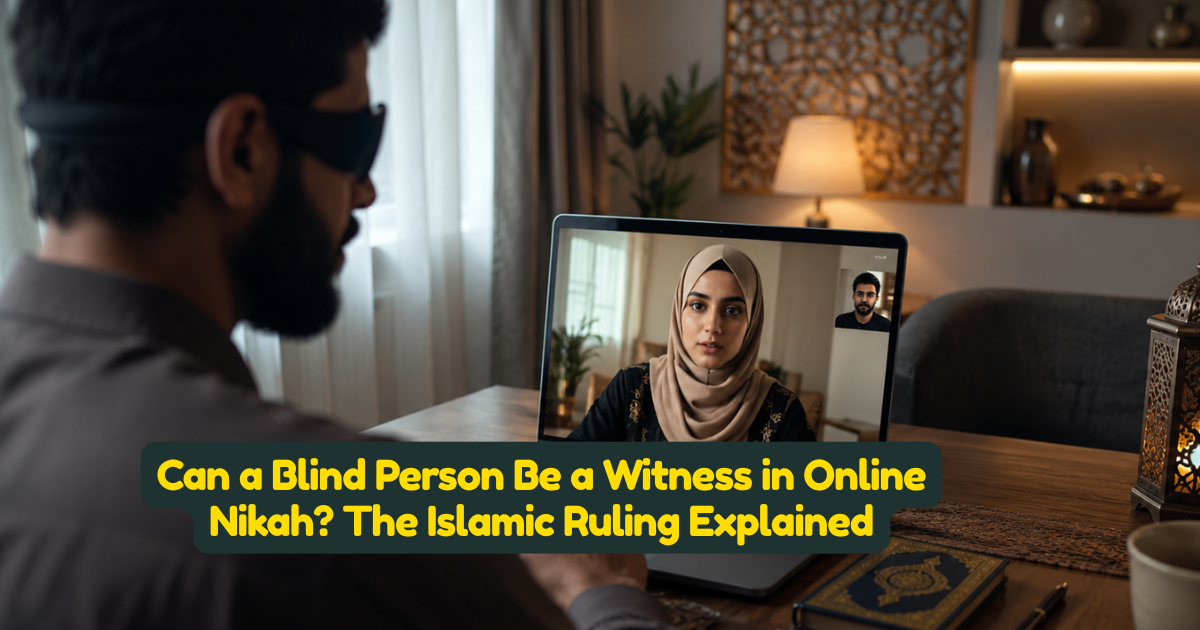
Can a Blind Person Be a Witness in Online Nikah?
A young man in Toronto, blind since birth, once asked an imam a question he'd clearly been carrying for a while: could he stand as a witness at his cousin's nikah, or would his blindness quietly disqualify him from a role every other male relative in the family had taken for granted? The imam's answer surprised him. Not only could he serve as a witness — the question itself revealed a common misunderstanding about what a nikah witness is actually required to do.
This question comes up more often than most people expect, and it has taken on new relevance with the rise of online nikah ceremonies, where every witness — sighted or not — is already relying heavily on sound rather than physical presence.
What Islamic Law Actually Requires From a Nikah Witness
The classical fiqh conditions for a valid marriage witness are narrower than most people assume. According to Sheikh Sayyed Sabiq's widely cited Fiqh As-Sunnah, a witness must be of sound mind, must have reached puberty, and must be of sound hearing so that they can hear and understand what the two parties are agreeing to. Sabiq's formulation notably does not list eyesight as a condition at all. Sound mind, adulthood, and sound hearing are the three pillars — not vision.
This is not a minor technicality. It means the entire legal function of a witness centers on comprehension of the ijab and qabul — the offer and the acceptance — not on visually observing the two people saying the words. A witness who is deaf but sighted, by contrast, would actually face a real problem under this same framework, since they could not confirm what was said.
The Majority Position on Blind Witnesses
Given that framework, the majority of jurists, including scholars within the Hanafi school, hold that a blind person may validly serve as a witness to a nikah contract, provided they can recognize the voices of the bride and groom (or their representatives) with enough certainty to remove any real doubt about who is speaking. The reasoning is straightforward once you separate the two functions a witness performs: identifying the parties, and confirming their words. A blind witness can do both through voice recognition — identifying a familiar relative by their voice, and hearing the offer and acceptance clearly.
Contemporary scholars have drawn a direct and useful comparison here to marriage contracts conducted by phone, where the witness likewise cannot see either party and must rely entirely on voice identification. If that arrangement is accepted by many jurists as sufficient — provided the voices are unmistakably recognized — the same logic extends naturally to a witness who happens to be permanently unable to see, not just temporarily unable to see over a phone line. In both cases, the missing sense is sight, and in both cases, hearing carries the full evidentiary weight.
Why This Matters More in an Online Nikah Setting
This is where the ruling becomes practically important rather than academic. In a traditional, in-person nikah, most witnesses default to relying on sight simply because it's available — they watch the bride's representative and the groom exchange words in the same room. In an online nikah ceremony, that default disappears for everyone. Every witness, blind or sighted, is already identifying the parties primarily through video and audio, often through a screen, sometimes with a translator relaying words between languages, and always with an internet connection standing between the witness and the couple.
In other words, an online nikah collapses the gap between a blind witness and a sighted witness far more than an in-person ceremony does. Both are working from voice, verified identity, and a clear audio record of the offer and acceptance. A properly conducted online nikah — one that verifies identity in advance, confirms audio quality before the ceremony begins, and records a clear ijab and qabul — is, if anything, a more documented and more accessible format for a blind witness than an unrecorded, in-person gathering where a witness might be standing at the back of a crowded room straining to hear.
Practical Conditions for a Blind Witness in an Online Ceremony
Scholars who accept blind witnesses do attach practical safeguards, and these translate cleanly into an online nikah setting:
- Certain voice recognition: the witness must know the bride, groom, or their representatives well enough to identify their voices without reasonable doubt — a family member, close friend, or someone introduced and confirmed before the ceremony begins.
- Clear audio throughout: the ijab and qabul must be audible and unambiguous; a dropped call or garbled connection during the exact moment of acceptance would undermine the witness's ability to testify to what was said.
- Sound mind and puberty: the same baseline conditions apply to every witness regardless of sight.
- No requirement to "see" the contract: unlike some civil notarization processes that expect a witness to visually confirm signatures, the Islamic requirement is testimonial — the witness affirms what they heard, not what they saw.
Officiants coordinating an online nikah with a blind witness should simply build these safeguards into the standard pre-ceremony verification steps most reputable platforms already use — confirming who is present, checking audio quality, and recording the ceremony for the couple's records.
A Note on Differing Views
As with most areas of fiqh, this is not a matter of complete unanimity. A minority of jurists have historically preferred sighted witnesses where they are reasonably available, out of an abundance of caution around identity verification — a concern more relevant in eras without audio recording, ID verification, or platforms where every participant's identity is confirmed in advance. The dominant, well-evidenced position across the major schools, however, remains that blindness alone does not disqualify a witness, and this is the position reflected in contemporary family law codes issued by Western fatwa bodies, including the Assembly of Muslim Jurists of America's Family Code for Muslim communities in North America, which centers witness validity on comprehension of the contract rather than physical observation of it.
Beyond Fiqh: A Question of Dignity, Too
There's a broader current running underneath this fiqh question, and it's worth naming directly: Islamic law was affirming the full legal capacity of blind Muslims to participate in binding religious and civil acts centuries before "accessibility" became a modern policy term. That same principle — that a person's testimony and participation shouldn't be diminished because of a physical condition unrelated to their judgment — echoes in contemporary disability rights frameworks. In the UK, for example, the Equality Act 2010's reasonable adjustments provisions establish a comparable civil principle: that disability alone should never be the barrier to full participation where a reasonable accommodation exists. In the United States, groups like the National Federation of the Blind's Muslim members' group specifically work to expand access to religious life and accurate religious information for blind Muslims — a reminder that this isn't a hypothetical fiqh puzzle but a lived question for real community members.
What This Means If You're Planning an Online Nikah
If a family member or close friend who is blind wants to serve as one of your two required witnesses, there is no need to look for a workaround or a substitute witness on their behalf. The requirement is simple: they know your voices, they can hear the ceremony clearly, and they are of sound mind and adult age. A well-run online nikah service should be able to accommodate this without hesitation, treating it as a standard identity-and-audio verification step rather than an exception to be negotiated.
Frequently Asked Questions
Does a blind witness need to "see" the couple on video during an online nikah?
No. The legal requirement is recognizing their voices and hearing the ijab and qabul clearly — not visual confirmation.
Can a blind person be one of the two required witnesses, or only a supplementary one?
Under the majority position, a blind person can be one of the two primary, legally required witnesses — not merely an additional or symbolic participant.
Does the same reasoning apply to a witness attending in person versus by video call?
Yes. The underlying condition — sound hearing and reliable voice recognition — applies the same way whether the witness is in the room or joining remotely.
Authority References Used (Live & Clickable)
- Fiqh As-Sunnah conditions of marriage witnesses, via IslamOnline Fiqh — classical Sunni jurisprudence reference on witness conditions
- Assembly of Muslim Jurists of America (AMJA) — established North American fatwa body, Family Code for Muslim Communities
- UK Equality Act 2010, Section 21 (legislation.gov.uk) — official UK government legislation on disability and reasonable adjustments
- National Federation of the Blind — U.S. disability advocacy organization, Muslim members' affinity group
Suggested Internal Links
- Can a Non-Muslim Be a Witness at a Nikah?
- How to Choose the Right Witnesses for Online Nikah
- Can a Nikah Witness Be Appointed Remotely?
- Our Online Nikah Process
- Book Your Online Nikah
Why This Article Is Different
Most existing content on nikah witness conditions repeats the standard checklist — sane, adult, Muslim — without addressing sensory conditions at all. This article isolates a specific, under-covered fiqh question (blindness and witnessing), grounds it in the actual classical condition list (sound hearing, not sight), and draws the direct parallel to phone-nikah reasoning that most competing content misses entirely. It also connects the fiqh position to real disability-advocacy and legal-rights sources rather than treating it as a purely abstract jurisprudential point, which strengthens both EEAT and AI-search extractability around a genuinely novel long-tail query.
Zainab Butt
Author