Online Nikah in Belize: Enslaved African Muslims Who Never Stopped Praying, a Lebanese Family's Mosque on a Tourist Island, and English Common Law Marriage on the Reef
In 1838, a British colonial official named John Burton, writing in what was then called the Honduras Almanac, made an observation about a group of enslaved people he encountered that he clearly did not fully understand. He noted that it was "not rare to meet with black persons who possess an utter aversion to spirituous liquors, and can by no means be prevailed upon to taste a beverage" — behaviour he attributed vaguely to "national usage" or "original intercourse with Mahometan connexions." As the Belizean newspaper Amandala's feature on the evolution of Muslim presence in Belize documents, this is direct, dated evidence that enslaved Muslims in colonial Belize were maintaining Islamic dietary practice in plain sight of a colonial administrator who had no framework to recognise what he was seeing. Five years earlier, in 1833, a British official named Robert Madden made a similar discovery among enslaved people in Jamaica: despite being forced to take Christian names, large numbers had remained faithful to Islam and were still communicating in Arabic.
"So, Islam was in Belize from the beginning, long before Christianity," the Amandala article states. "When our ancestors made Salah, it was that same Salah that Muhammad had established 1400 years ago." This is not a romanticised claim — it is supported by the documented testimony of the colonial officials who recorded it, often with bewilderment, in their own administrative writing. Whether or not unbroken Islamic practice survived continuously into the present-day Belizean Muslim community is a separate historical question from whether enslaved Africans in colonial Belize were practising Muslims who maintained Salah and Arabic literacy under conditions designed to erase exactly that. The documentary record on the latter point is clear.
A Small, Modern Community With Several Distinct Layers
Today's Belizean Muslim community is small by any measure — officially 577 according to the 2010 census as confirmed by the U.S. Department of State's 2023 International Religious Freedom Report on Belize, with the separately-counted Ahmadiyya Muslim Jama'at adding approximately 200 more members across three mosques in Belize City, Belmopan, and Orange Walk, established since 2013. The community traces, per Wikipedia's Islam in Belize entry, through 1960s activism that brought converts to Islam, Middle Eastern immigration, and a following among some members of the Kriol community. The Islamic Mission of Belize, headquartered in Belize City, operates the Muslim Community Primary School, recognised by the Belizean government in 1978, offering both Islamic and standard academic curricula to Muslim and non-Muslim children alike.
The Harmouche Mosque: One Family, One Island, One Congregation
The most vivid and well-documented case study of Belizean Muslim life comes not from the capital but from Ambergris Caye — specifically the town of San Pedro, a tourist destination known for its elite beach resorts. As Religion Unplugged's reporting documents, the island's roughly 200 Muslims out of a population of 13,000 are almost entirely connected to a single Lebanese family — the Harmouches. The community's mosque was built in 2000, and its imam, Malak Harmouche, runs a hardware store full-time and leads Friday jumah prayers for around sixty attendees part-time, refusing payment for his religious role: "I do this work for Allah's blessing alone. I was an imam in Lebanon, and now I am one here."
The community's origin traces to the 1980s Lebanese Civil War, when a relative of Malak's, Simon Harmouche, went to study at Loyola University in New Orleans and met a Belizean woman of partial Lebanese descent. The romance that followed produced the small Muslim community that exists in San Pedro today — a community Religion Unplugged notes includes only three or four converts, mostly the wives of Lebanese-Belizean businessmen who married into the family network. It is, in microcosm, a portrait of how an entire local Islamic community can be built from a single extended family's commercial and marital ties — a structure that matters directly for marriage practice, because the wali, the witnesses, and the wider Muslim community a bride or groom might draw on are often the same handful of related families.
Belize's Marriage Act: English Common Law, No Nikah-Specific Provision
Belize's civil marriage law, governed by the Marriage Act, Chapter 174 of the Substantive Laws of Belize (Revised Edition 2020), follows the English common law tradition inherited from British Honduras. As confirmed by the Attorney General's Ministry of Belize, marriages may be conducted as either civil ceremonies — performed by a registrar or a Senior Justice of the Peace — or religious ceremonies, performed by an authorised minister of a registered church, as confirmed by the Law Office of Wendy Auxillou's overview of Belizean matrimonial law. Unlike Guyana's Marriage Act, which explicitly names Hindu and Islamic marriage officers as a distinct statutory category, Belize's Act uses generic "registered church" and "minister" language without any nikah-specific provision. This means an imam's authority to conduct a legally binding marriage in Belize depends on whether his mosque is formally registered as a religious body under the Act — the same generic pathway available to any denomination, rather than a category created specifically for Islamic marriage as in Guyana.
For foreigners, the requirements as confirmed by the U.S. Embassy in Belize's marriage guidance include a minimum three-day (72-hour) residency in Belize before the licence application can be submitted, valid passports, divorce or death certificates for previously married parties, and two witnesses at the ceremony — traditionally one man and one woman, though hotel staff or wedding planners commonly stand in where the couple has no witnesses of their own. The licence costs USD $100 plus a USD $5 administrative fee and can typically be issued within two days of a complete application. No blood test is required. The marriage must then be formally registered with the Registry Department, with the official certificate typically taking up to ten weeks to be processed and mailed.
What Belize's Marriage Act Does Not Provide — and What the Nikah Requires
Whether the ceremony is performed by a civil registrar or by an authorised minister of a registered church, Belize's Marriage Act addresses none of the specific Islamic conditions for a valid nikah: the wali's consent, two witnesses who genuinely hear the offer and acceptance, an agreed mahr, and free consent unburdened by coercion. In a community as small and tightly interconnected as San Pedro's Harmouche-centred congregation, or the wider but still modest Belize City and Ahmadiyya communities, finding all of these elements properly assembled in one place is a real practical constraint — particularly for a bride whose wali is in Lebanon, or for the small number of converts whose family cannot supply one at all.
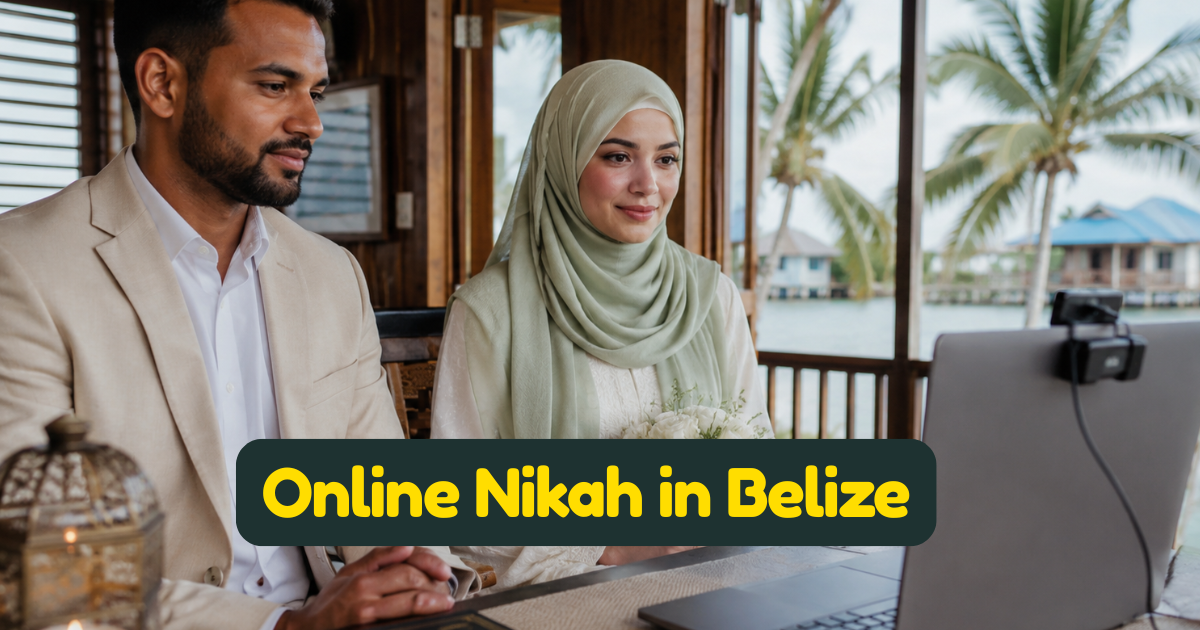
An online nikah conducted through InstantNikah.com resolves this directly. A qualified qazi officiates remotely, the wali participates from wherever he is located, two witnesses confirm the contract live on the call, the mahr is agreed and documented, and a nikah certificate is issued — independent of whether Belize's civil marriage process that follows is conducted by a Justice of the Peace or by a minister whose church happens to be registered under the Act. For the scholarly basis of remote ceremonies, our guide on the video-call nikah ruling covers each major madhab's position. Where the wali appoints a representative, our guide on appointing a wakeel in nikah explains the process. For converts whose family cannot supply a wali, our guide on finding a wali for nikah covers the standard scholarly provision.
After the Nikah: Civil Registration in Belize
Once the nikah has been conducted, couples can proceed to the civil licensing process through the Registrar General's Office or the Attorney General's Ministry, observing the three-day residency requirement for foreign nationals before applying. The marriage, once registered, is internationally recognised without further paperwork required in most home countries. Our guide on registering a nikah civilly after the Islamic ceremony covers the broader sequencing for couples managing both steps.
Quick Answers for Muslims in Belize
Does Belize have a specific Islamic marriage law like Guyana? No. Belize's Marriage Act uses generic "registered church" and "minister" language without a provision naming Islamic marriage officers as a distinct category. An imam's authority to conduct a civilly binding ceremony depends on his mosque's general religious registration status.
Is an online nikah Islamically valid from Belize? Yes — when the wali participates or is properly represented, two witnesses genuinely hear the offer and acceptance, mahr is agreed, and consent is free. None of these conditions depend on Belize's civil registration framework.
How long must foreigners reside in Belize before applying for a marriage licence? A minimum of three days (72 hours), after which the licence application can typically be processed within one to two days.
Where is Belize's most documented Muslim community? San Pedro on Ambergris Caye, centred almost entirely on the Lebanese Harmouche family, alongside the Islamic Mission of Belize in Belize City and the Ahmadiyya Muslim Jama'at across three mosques nationally.
From a Colonial Official's Confused Footnote to a Hardware Store Owner Leading Friday Prayers
Belize's Islamic story runs from John Burton's bewildered 1838 observation about enslaved people who would not drink alcohol, through a century and a half of near-invisibility, to Malak Harmouche closing his hardware store every Friday to lead jumah prayers for sixty people on a Caribbean tourist island, refusing to take a stipend for it. Between those two points lies a community that has never been large, has rarely been documented, and has had to build its own institutions — a school, three mosques, a mission — almost entirely from scratch. The nikah that joins two Belizean Muslims, or a Lebanese-Belizean family member to a partner from abroad, asks the same of this community as it does everywhere else: a wali, two genuine witnesses, an agreed mahr, free consent. InstantNikah.com provides exactly that, wherever in Belize or the world the family is gathered. When you are ready, book your online nikah and speak with our team.
Admin User
Author