Online Nikah in Belarus: Seven Centuries of Lipka Tatar Islam, Belarusian Written in Arabic Script, and a ZAGS Civil Registry That Gives Religious Ceremonies No Legal Force
In the 14th century, the Grand Duchy of Lithuania — which at its height covered not only modern Lithuania but much of what is now Belarus, Ukraine, and western Russia — invited Muslim Tatar warriors to settle in its territories as military auxiliaries. These Lipka Tatars, as they came to be known, did something remarkable over the centuries that followed: they adopted the local language. The Tatar communities of what is now Belarus gradually stopped speaking their ancestral Turkic tongue and began speaking Old Belarusian instead. But they maintained their Islamic faith. And when they wrote their prayer books, their Quranic commentaries, and their records of Islamic knowledge — they wrote Belarusian in Arabic script. These manuscripts, known as Kitabs, represent one of the most extraordinary linguistic-religious phenomena in European history: the Islamic faith of a Tatar community expressed through a Slavic language written in the script of the Quran.
As Grokipedia's comprehensive entry on Islam in Belarus documents, this community primarily follows the Hanafi school of Sunni Islam and constitutes the historical core of Belarusian Islam today. The official website of the President of Belarus confirms that as of January 2024, Belarus has 24 registered Muslim communities including 6 mosques and 2 places of worship — a relatively generous acknowledgment of Islam within what is otherwise a politically closed authoritarian state. The Muslim population is estimated at between 20,000 and 100,000 depending on the source, with the lower figures reflecting census self-identification and the higher figures reflecting community estimates that include Azerbaijani, Arab, Turkish, and Central Asian immigrants alongside the Lipka Tatar heritage community.
The Minsk Mosque: Reopened by Lukashenko and Erdoğan
In 2016, an unusual diplomatic ceremony took place in Minsk. Alexander Lukashenko, Belarus's authoritarian president, and Recep Tayyip Erdoğan, Turkey's president, jointly opened the reconstructed Minsk mosque — a replacement for the mosque destroyed during the Soviet era. As Belarus Feed documented at the time, the mosque's main prayer hall accommodates 347 men and 165 women, with a balcony for 380 additional worshippers. It incorporates a Sunday school, classrooms, a Mufti's study, and a small museum. Its architecture drew some theological criticism — the entrance faces the side rather than being directly opposite the mihrab, which some Muslim scholars noted was irregular — but the fact of its existence and its joint presidential opening reflects an interesting dimension of Belarusian foreign policy: Islam, managed carefully and officially, is acknowledged as part of Belarus's social fabric in ways that serve diplomatic purposes with Turkey and Muslim-majority states.
Beyond Minsk, the oldest surviving mosque in Belarus is in the town of Ivie in the Grodno region — built in 1884, maintaining an interior divided between male and female sections with separate entrances, and representing the Lipka Tatar heritage at its most tangible. The village of Tatarka, named for its Tatar settlers, still exists in the Mogilev region. These are not tourist reconstructions — they are living communities with centuries of continuous Islamic presence.
Belarus's ZAGS Civil Marriage System
Belarus's civil marriage is administered through the ZAGS (Отдел загс) — the Bureau of Acts of Civil Status — which falls under the Ministry of Justice. As confirmed by Belarus-based family law specialists Familylawyer.by, only civil marriages registered through the ZAGS are legally recognised in Belarus. Religious ceremonies — including a nikah — have no legal force under Belarusian law. The civil marriage certificate issued by the ZAGS is the sole legal proof of marriage.
The ZAGS process requires both parties to submit a joint application at the registry office of the area where either spouse or either spouse's parents resides. The application creates a minimum 15-day waiting period before the marriage ceremony can take place, which can be extended up to three months or reduced under exceptional circumstances. As confirmed by the U.S. Department of State's civil documents guide for Belarus, the ZAGS marriage certificate is issued in both Russian and Belarusian on a single folded document. Both parties must physically attend the marriage ceremony at the ZAGS. If either party does not speak Russian or Belarusian, a certified interpreter must be present.
The Non-Apostille Problem: Why Belarus Is Harder for Foreign Muslim Couples
This is the feature that sets Belarus apart from most other countries in this series and creates a specific practical burden for Muslim couples from abroad. Belarus has not joined the Hague Apostille Convention. This means that foreign public documents — including birth certificates, single status certificates, and divorce decrees from Pakistan, Bangladesh, Egypt, Turkey, or any other Muslim-majority country — cannot be authenticated through the relatively fast and accessible apostille route. They must instead go through the slower, more expensive process of full consular legalisation: authenticated by the foreign affairs ministry of the issuing country, then legalised at the Belarusian embassy in that country, then translated into Russian or Belarusian by a certified translator in Belarus.
As Human Constanta Belarus explains, for countries that are Hague Convention members the apostille route is technically available — but since Belarus itself is not a member, the receiving Belarusian authority's acceptance of apostilled documents depends on bilateral agreements. In practice, this means foreign Muslim couples marrying in Belarus should expect a significantly longer document preparation timeline than in the apostille-friendly countries covered elsewhere in this series.
What the ZAGS Cannot Provide — and What the Nikah Requires
The ZAGS registers your marriage with the full authority of the Belarusian state. It does not conduct a nikah. The civil registrar does not ask about the wali's consent, does not recite the ijab and qabul, and does not arrange for Muslim witnesses to hear an Islamic offer and acceptance. For a practising Muslim in Minsk, Grodno, or Brest, these conditions must be fulfilled independently — through the Lipka Tatar community imam, through the Minsk mosque's religious leadership, or through a properly conducted online ceremony with a qualified qazi.
A valid nikah requires:
- A wali — the bride's male Muslim guardian — whose participation gives the contract Islamic validity. For a Lipka Tatar bride whose family is local this is straightforward; for an immigrant Muslim woman from Turkey or Egypt whose family is abroad, the wali must join remotely or appoint a proxy.
- Two Muslim witnesses who genuinely hear the offer (ijab) and acceptance (qabul) as spoken.
- Agreed mahr, documented as the bride's exclusive right.
- Free consent from both parties without coercion.
How an Online Nikah Works for Muslims in Belarus
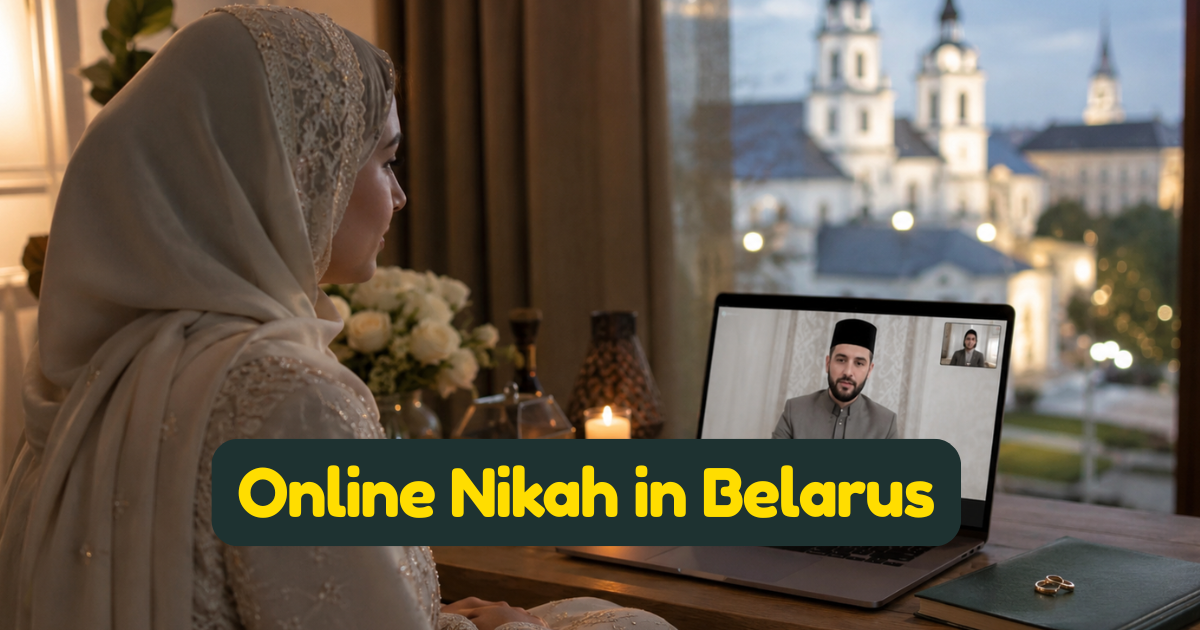
InstantNikah.com conducts Shariah-compliant online nikah ceremonies over a secure live video connection. A qualified qazi officiates under the Hanafi school, which is the tradition followed by both the Lipka Tatar community and the majority of Muslim immigrants in Belarus. The bride's wali participates from wherever he is located. Two Muslim witnesses confirm on the call that they have heard the offer and acceptance. The mahr is agreed and documented. A nikah certificate is issued following the ceremony.
For Belarusian Muslims in the diaspora — a growing community given the significant emigration from Belarus since 2020 — an online nikah is especially relevant. Lipka Tatar families now scattered across Poland, Lithuania, Ukraine, and Western Europe can contract a valid nikah without returning to Belarus, with the civil registration following in whatever country they now reside. For the scholarly basis of remote ceremonies, our guide on the video-call nikah ruling covers each major madhab. Where the wali appoints a proxy, our guide on appointing a wakeel in nikah explains the process. For converts with no Muslim guardian, our guide on how a convert finds a wali for nikah addresses the appointment.
After the Nikah: Civil Registration at the ZAGS
Once the nikah is conducted, the civil registration at the ZAGS follows. Both parties must attend in person with valid passports (plus notarised translations into Russian or Belarusian), proof of single status from the home country (fully legalised through the consular chain rather than apostille for most Muslim-majority countries), and documentation of any prior marriages. The minimum 15-day waiting period applies from the date of application. The marriage fee is 32 Belarusian rubles — one of the lowest civil marriage fees in any country in this series. For marriages conducted abroad, the foreign marriage certificate must be legalised and translated into Russian or Belarusian for recognition in Belarus.
For a country-by-country guide to the civil registration sequence, see our resource on registering a nikah civilly after the Islamic ceremony.
Quick Answers for Muslims in Belarus
Is a nikah at the Minsk mosque legally recognised in Belarus? No. Religious ceremonies have no legal force under Belarusian law. Only a ZAGS-registered civil marriage creates legal standing.
Is an online nikah Islamically valid from Belarus? Yes — when the wali participates, two witnesses genuinely hear the contract, mahr is agreed, and consent is free. Belarus's civil law does not affect the Islamic validity of the nikah.
Does Belarus accept apostilled documents? Belarus is not a Hague Apostille Convention member. Foreign documents generally require full consular legalisation rather than apostille, which adds time and cost to the ZAGS civil marriage process for foreign nationals.
How long does the ZAGS civil marriage process take? A minimum of 15 days from the joint application must elapse before the ceremony can take place. The period can be extended up to three months or shortened under exceptional circumstances.
From the Kitab Manuscripts to the Minsk Mosque — A Continuous Thread of Seven Hundred Years
The Lipka Tatars of Belarus wrote Belarusian in Arabic letters. They prayed in mosques that predated the Belarusian state. Their imams led prayers in a language with no Arabic roots, drawn from the same Slavic family as Russian and Polish, while reciting a faith rooted in the Arabian Peninsula. That continuous thread — seven hundred years of Islamic presence in a landscape that most of the world does not associate with Islam at all — is one of the hidden histories of European Islam, and it runs through the villages and small cities of western Belarus with quiet persistence. The ZAGS office that registers marriages in those same towns has no interest in the thread's religious dimension. It will register the civil marriage and issue the certificate. The nikah — the Islamic act that makes the union real in the sight of Allah — belongs to the couple and their community. InstantNikah.com ensures it is conducted with the full rigour those seven centuries of Tatar Islamic tradition deserve. When you are ready, book your online nikah and speak with our team.
Admin User
Author