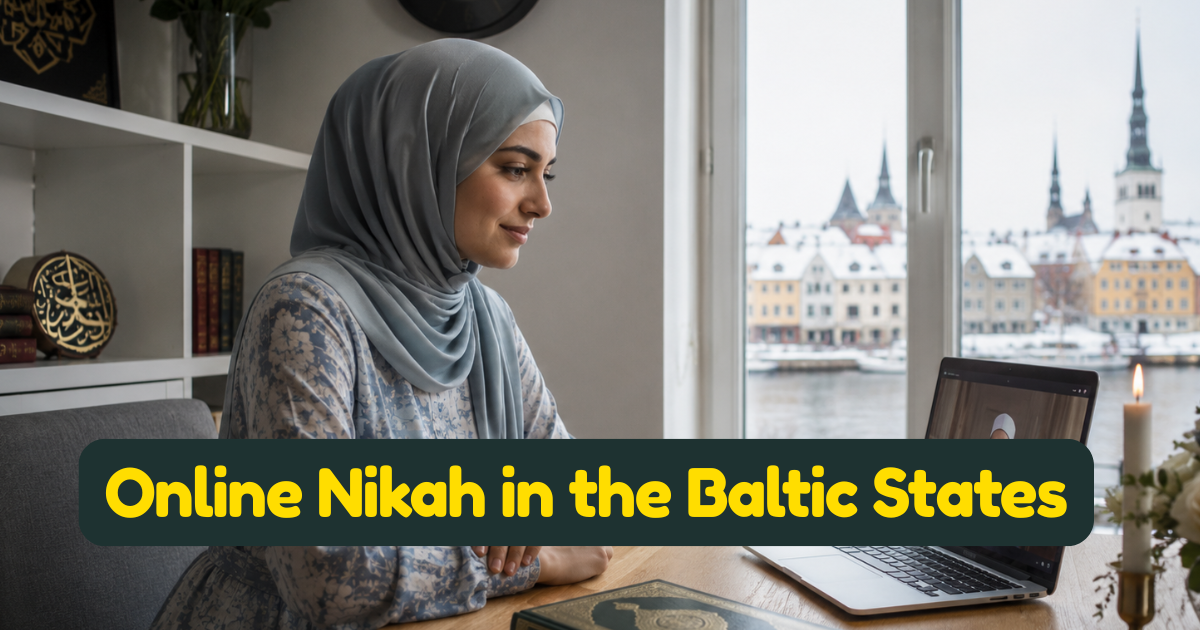
Online Nikah in the Baltic States: Six Hundred Years of Islam in Lithuania, Estonia, and Latvia — and How Modern Muslim Expats Marry Across Civil Registries
In a small village in rural Lithuania, just outside Vilnius, a wooden mosque stands on a site where Muslims have prayed since the sixteenth century. The village is called Keturiasdešimt Totorių — Forty Tatars — and its very name tells the story. In the fourteenth century, Grand Duke Vytautas the Great of the Grand Duchy of Lithuania invited Muslim Crimean Tatar soldiers to settle in his lands, granting them titles, villages, and religious freedom in exchange for military service against the Teutonic Knights. These soldiers stayed. Their descendants are still here. And as Deep Baltic documents, the oldest dateable Muslim grave in northern or western Europe — marked "Allahberdi," buried between 1621 and 1626 — sits in this village's ground.
"After 600 years, we are still Muslim" — that phrase, quoted in a Baltic Times feature on Lithuania's Tatar communities, captures something that most accounts of European Islam entirely miss: the Baltic States have had a continuous Muslim presence since the medieval period, predating the modern immigration wave by five centuries. Lithuania's Lithuanian Tatars — also called Lipka Tatars — number approximately 3,200 today. Latvia's Muslim community is estimated at around 2,000. Estonia, with 10,000 Muslims as of 2024 estimates, has seen the fastest growth driven by more recent Middle Eastern and South Asian immigration.
For all three of these communities — ancient Tatar heritage, newer immigrant arrivals, and the small but growing number of local converts — the Baltic civil marriage systems offer the same answer to the question of a nikah: nothing. Each Baltic state operates a secular civil registry that neither conducts nor recognises religious marriage ceremonies. A nikah must be arranged independently of whatever the civil system provides.
Three Countries, Three Civil Systems — With Important Differences
Estonia
Estonia's marriage law allows a ceremony to be conducted by a local government vital statistics official, a minister of religion, or a notary. As confirmed by the Estonian Ministry of the Interior, a marriage can be contracted between one and six months after submitting the joint application. Foreign nationals wishing to marry in Estonia must be in the country on a legal basis under the Aliens Act, and foreign documents must be legalised or apostilled unless a bilateral treaty exempts them. Estonia signed the Hague Apostille Convention, making authentication of documents from most Muslim-majority countries — Pakistan, Bangladesh, Turkey, Indonesia — straightforward through the apostille route.
Importantly, while a minister of religion can conduct a marriage ceremony in Estonia, Islamic imams are not automatically recognised as registered marriage officiants under Estonian law in the same way that Lutheran or Catholic clergy are. In practice, Muslim couples in Estonia use the civil route through the vital statistics office.
Latvia
Latvia's civil marriage process, documented by the Integration and Inclusion Agency of Latvia, requires both parties to submit a joint application in person at the registry office. Third-country nationals — which includes most Muslim expats from outside the EU — must present a document on their marital status issued by their home country, in addition to valid identity documents. The application must be submitted in person by both parties simultaneously, creating an immediate barrier for long-distance couples. Latvia joined the Hague Apostille Convention, and notably, documents from Estonia, Lithuania, Ukraine, Moldova, and Russia do not require apostille for use in Latvia — a useful simplification for inter-Baltic marriages.
Lithuania
Lithuania's civil marriage framework, as explained on the official Renkuosi Lietuva integration portal, requires registration at least one month after submitting the application — a mandatory waiting period longer than Colombia's five days but standard for EU member states. Foreign nationals must provide a Certificate of No Impediment from their home country confirming they are free to marry, plus birth certificates, identity documents, and proof of any prior marital status. Documents from Latvia, Estonia, Ukraine, and Moldova are exempt from apostille requirements; all others must be apostilled. Notably, Lithuania does recognise church marriages contracted according to the requirements of the Civil Code, if registered with the Civil Registry Office within ten days of the ceremony — but this specifically covers registered Christian churches, not Islamic ceremonies.
What All Three Systems Have in Common — and What None Provides
Despite their differences in timing and documentation, Estonia, Latvia, and Lithuania share the same fundamental position on religious marriage: it has no independent civil legal effect for Muslim couples. A nikah conducted in Tallinn, Riga, or Vilnius is an Islamic contract — meaningful and binding under Shariah — but it creates no entry in any Baltic civil registry, confers no spousal rights under Baltic law, and cannot be used for residence permit or immigration applications without a separate civil marriage registration.
And the Baltic civil registries, for their part, provide no Islamic contract. They record the union, ask for identity documents and marital status certificates, and issue a marriage certificate. They do not ask about the wali, the mahr, the witnesses to an Islamic contract, or the offer and acceptance. For the Lithuanian Tatar family in Nemėžis whose son is marrying a Turkish woman, for the Azerbaijani professional in Tallinn whose fiancée is in Baku, or for the Pakistani student in Riga whose intended is still in Lahore — both steps are necessary and neither substitutes for the other.
The Islamic Conditions That Apply in the Baltics as Everywhere
A valid nikah requires the same conditions regardless of whether the ceremony takes place in a Lithuanian Tatar wooden mosque or in a video call:
- A wali — the bride's male Muslim guardian — whose consent gives the contract its Islamic validity. For Lithuanian Tatar brides whose wali may be in another city or for newer immigrant brides whose guardian is in Turkey, Egypt, or Pakistan, remote participation is the practical solution.
- Two Muslim witnesses who genuinely hear the offer (ijab) and acceptance (qabul) as spoken. In small Baltic Muslim communities where finding two qualified witnesses on short notice is genuinely difficult, an online ceremony's remote witnesses solve a real logistical problem.
- Agreed mahr, stated and documented as the bride's exclusive right.
- Free consent from both parties without coercion.
For the scholarly basis of remote ceremonies across the Hanafi and Shafi'i schools — both represented within the Baltic Muslim communities — our guide on the video-call nikah ruling provides the detailed madhab analysis. The witness question for remote ceremonies is addressed in our article on whether nikah witnesses can be appointed remotely.
How an Online Nikah Serves Baltic Muslim Communities
InstantNikah.com conducts Shariah-compliant online nikah ceremonies over a secure live video connection. A qualified qazi officiates. The bride's wali participates from wherever he is — Istanbul, Cairo, Lahore, or another Baltic city. Two Muslim witnesses confirm their hearing of the contract. The mahr is agreed, stated, and documented. A nikah certificate is issued following the ceremony.
For the small but historically rich Lithuanian Tatar community, whose mullahs conduct prayers but may not always be positioned to conduct a full nikah with all required elements, an online ceremony with a qualified qazi ensures every Islamic condition is properly met. For newer Muslim immigrant communities in Tallinn, Riga, and Vilnius — Azerbaijanis, Turks, Arabs, and South Asians — the online nikah resolves the distance problem when the bride's family and guardian are outside the Baltic States. For Muslim converts among Baltic nationals whose family is non-Muslim, a qualified wali is arranged through our standard provision, detailed in our guide on how a convert finds a wali for nikah.
After the Nikah: Civil Registration in Estonia, Latvia, or Lithuania
Once the nikah is conducted, the civil registration follows the relevant Baltic state's procedure. For Estonia, the application is submitted to the local government vital statistics office with both parties present, apostilled foreign documents, and a waiting period of one to six months. For Latvia, both parties attend the registry office together with a home-country marital status document. For Lithuania, the application is submitted at least one month before the planned civil ceremony, with apostilled foreign documents and a Certificate of No Impediment from the home country.
The nikah certificate from InstantNikah.com supports the civil process by providing documented evidence of the Islamic marriage contract, which may also be required for home-country registration or embassy notifications. For a full country-by-country civil registration guide, see our resource on registering a nikah civilly after the Islamic ceremony.
Quick Answers for Muslims in the Baltic States
Is a nikah in a Lithuanian mosque legally recognised? No. Religious ceremonies of any kind — including a nikah — do not create civil legal marriage in Estonia, Latvia, or Lithuania. A civil registry ceremony or registration is required for legal standing.
Is an online nikah Islamically valid from the Baltic States? Yes — when the wali participates, two witnesses genuinely hear the contract, mahr is agreed, and consent is free. The Baltic civil systems do not affect Islamic validity.
How long is the waiting period for civil marriage in each Baltic state? Estonia: one to six months after submitting the joint application. Lithuania: at least one month. Latvia: no fixed waiting period specified, but the joint in-person application is the starting point.
Do I need an apostille on my home-country documents? For Estonia and Lithuania, yes — unless your home country has a bilateral exemption. Documents from Latvia, Estonia, Lithuania, Ukraine, and Moldova are mutually exempt from apostille requirements in Lithuania. All three Baltic states are Hague Convention members.
Six Centuries of Baltic Islam — and a Civil Gap That Has Always Required the Community's Own Solutions
The Lithuanian Tatars did not wait for the Grand Duchy of Lithuania to conduct their nikahs. They brought their own mullahs, built their own wooden mosques, and maintained their own marriage traditions for six centuries in the heart of northern Europe — through the Grand Duchy, through Russian imperial rule, through Soviet suppression, and through Baltic independence. The civil system of Estonia, Latvia, and Lithuania today is modern, efficient, and secular. It handles births, deaths, and marriages with administrative precision. What it has never handled — and what the Lithuanian Tatars never expected it to handle — is the Islamic contract. That remains the community's own responsibility, as it always has been. InstantNikah.com provides the qualified scholar, the proper witnesses, the wali arrangement, and the documentation to fulfil that responsibility correctly — wherever in the Baltic States or in the world you and your family happen to be. When you are ready, book your online nikah and speak with our team.
Admin User
Author