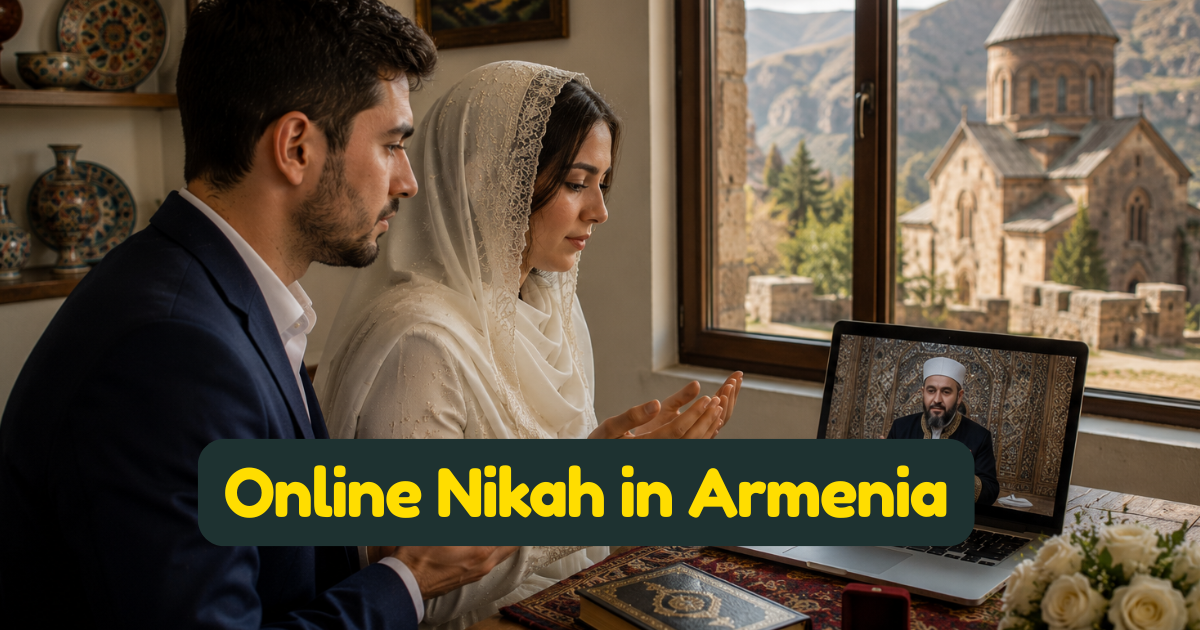
Online Nikah in Armenia: The Blue Mosque in Yerevan, One of the Smallest Muslim Communities in Eurasia, and a Civil Registry That Operates With Surprising Speed
The Blue Mosque stands in the centre of Yerevan — an 18th-century Persian-style mosque with a tiled dome and a courtyard of flowering plants, surrounded by the modern capital of a predominantly Christian nation. Built between 1764 and 1768 during the period of Persian rule over what is now Armenia, it is the only active mosque in the country. It survived centuries of political change, the Soviet closure of religious institutions, and the Nagorno-Karabakh conflicts that reshaped the ethnic composition of the South Caucasus. Today it is managed by Iran, which has maintained a cultural and religious presence through the mosque as part of a broader diplomacy of soft power in a country that, despite being Christian and closely aligned with Russia, maintains working relationships with Iran based on geographic proximity and economic interest.
Who worships at the Blue Mosque? According to demographic analysis by Al Sada Travels, Armenia has between 1,000 and 3,000 Muslim residents — foreign nationals from Muslim-majority countries, a handful of Kurds (some Yazidi, some Muslim), and a very small number of Hamsheni Armenians — Muslim Armenians whose communities have maintained Islamic practice for centuries, primarily in what is now northeastern Turkey and the wider Armenian diaspora. The 2022 Armenian census recorded approximately 515 formally self-identified Muslims, though the true number including foreign residents is considerably higher. This makes Armenia, in terms of its formally counted Muslim population, one of the smallest Muslim presences of any independent state in Eurasia.
Armenia's Muslim community is almost entirely urban, concentrated in Yerevan, serving a population of foreign professionals, students from Muslim-majority countries, and diplomatic personnel. It has no significant indigenous roots beyond the Hamsheni and Kurdish communities. For the Muslim expatriates who make up most of this small community, Islamic marriage in Armenia requires navigating a civil registry system designed for Armenian citizens and a Muslim community too small to have developed its own established nikah officiant infrastructure.
The Hamsheni: Armenia's Indigenous Muslim Layer
The Hamshenis are a historically Armenian Muslim community — people of Armenian ethnic origin whose ancestors converted to Islam, primarily in what is now northeastern Turkey, during the Ottoman period. Their relationship to both Armenian Christianity and to mainstream Sunni Islam is theologically and culturally complex: they are Armenian in language and some cultural practices, Muslim in faith, and distributed across Turkey, Russia, Georgia, and a small presence in Armenia itself. As confirmed by the Study.com documentation of religion in Armenia, the Pew Research Center estimates fewer than 1,000 Hamshenis in Armenia itself. Their situation — Armenian by ethnicity, Muslim by faith, in a country that identifies Christian Apostolic heritage as central to national identity — represents one of the most theologically nuanced Muslim minority situations in the entire series.
Armenia's Civil Marriage System: Fast, Efficient, and Surprisingly Accessible
Armenia's civil marriage is managed by the Civil Acts Registration Services (ZAGS) under the Ministry of Justice, and it operates with a speed and flexibility that distinguishes it from most post-Soviet civil registry systems. As confirmed by Armenian law firm Vardanyan & Partners and the official framework documented by ILex Law Firm Armenia, the key features are:
- No residency requirement. Foreign nationals can marry in Armenia without being residents.
- Same-day or next-day registration possible. Unlike countries with mandatory waiting periods of 15–30 days or more, Armenian law mandates registration no earlier than the next working day after submission and no later than six months from the submission date. If paperwork is already prepared, registration can proceed extremely quickly.
- No state fee for basic registration. The standard civil marriage registration is free. A ceremonial registration costs 40,000 AMD (approximately USD 100); an off-site ceremony conducted by a registry official at the couple's chosen location costs 60,000 AMD.
- Remote submission possible. Using a Power of Attorney, a lawyer or representative can submit the marriage application on behalf of the couple, meaning the parties need not be physically in Armenia for the application stage — only for the ceremony itself.
- Ministry of Justice permission required when a foreigner marries an Armenian citizen. This is an additional administrative step not present in most Western European countries.
Armenia joined the Hague Apostille Convention, meaning apostilled documents from Pakistan, Turkey, Egypt, Morocco, and most Muslim-majority countries are accepted. Foreign documents must be translated into Armenian by a certified translator. As the U.S. Embassy in Armenia's marriage guidance confirms, an official translation of the foreign passport is also required, along with a certificate from the home country confirming the foreign party is free to marry.
What the ZAGS Cannot Provide — and What the Nikah Requires
Armenia's Civil Acts Registration Services register the marriage with the authority of the Armenian state. They do not conduct a nikah. The ZAGS official does not ask about the wali's consent, does not recite the ijab and qabul, and does not arrange for two Muslim witnesses to hear an Islamic contract. Religious ceremonies in Armenia have no independent legal standing; only the ZAGS registration creates a legally recognised marriage.
For the small Muslim community in Yerevan, assembling all Islamic conditions in person is genuinely difficult. The Blue Mosque's imam may lead prayers and provide religious guidance, but the specific conditions for a valid nikah — a qualified qazi, a participating wali, two witnesses who hear the offer and acceptance, documented mahr — require resources that a community of 1,000–3,000 people may not have readily available. An online nikah conducted through InstantNikah.com provides all of these elements: a qualified qazi officiating remotely, the wali participating from his location, two witnesses confirmed on the call, the mahr agreed and documented, and a nikah certificate issued following the ceremony. For the scholarly basis of remote ceremonies, our guide on the video-call nikah ruling covers each major madhab. For converts or women with no Muslim guardian, our guide on finding a wali for nikah covers the appointment. Where a proxy is needed, our guide on appointing a wakeel in nikah explains the process.
After the Nikah: ZAGS Registration in Armenia
Once the nikah has been conducted and the certificate issued, the ZAGS registration provides full civil legal recognition in Armenia. For couples where one party is a foreigner marrying an Armenian citizen, the Ministry of Justice permission step must be completed before the ZAGS ceremony. For two foreign nationals marrying in Armenia, the process is more straightforward. The nikah certificate from InstantNikah.com serves as the Islamic record of the marriage and can accompany the ZAGS documentation as supporting evidence of the Islamic contract. For a comprehensive country sequencing guide, see our resource on registering a nikah civilly after the Islamic ceremony.
Armenia as a Civil Marriage Destination
Armenia's combination of no residency requirement, no mandatory waiting period, no state fee, and Power of Attorney submission option makes it one of the most accessible civil marriage destinations in the post-Soviet region. For Muslim couples from Azerbaijan, Iran, Turkey, or the wider Muslim world who are visiting Armenia and wish to also complete a civil marriage here, the process is genuinely fast — achievable in one to two days if all documents are prepared and apostilled in advance. The nikah can be completed online before arrival; the ZAGS registration happens on arrival. The combination creates a complete Islamic and civil marriage record in a compact timeframe.
Quick Answers for Muslims in Armenia
Is a nikah at the Blue Mosque in Yerevan legally recognised in Armenia? No. Religious ceremonies have no legal standing in Armenia. Only ZAGS registration creates a legally recognised marriage.
Is an online nikah Islamically valid from Armenia? Yes — when the wali participates, two witnesses genuinely hear the contract, mahr is agreed, and consent is free. Armenia's civil requirements do not affect Islamic validity.
How quickly can we complete the civil marriage in Armenia? As soon as the next working day after submitting the application, provided all documents are already prepared and apostilled. This makes Armenia one of the fastest civil marriage options in the region for foreign nationals.
Who manages the Blue Mosque in Yerevan? The Blue Mosque is managed by Iran, which provides the imam and maintains the facility as part of its cultural diplomacy in Armenia. It is the only active mosque in the country.
One Mosque, Two Centuries, Three Thousand Worshippers — and a Nikah the ZAGS Cannot Write
The Blue Mosque of Yerevan has stood through Russian imperial rule, Soviet atheism, the Nagorno-Karabakh conflict, and the post-independence Armenian republic. Its resilience is partly a function of Iranian management and partly of the small but persistent Muslim presence in a city that has always been more cosmopolitan than its reputation as the capital of a Christian nation suggests. The ZAGS office processes civil marriages with admirable efficiency — one working day from application to ceremony, no fees, Power of Attorney accepted. What it cannot do is what the Blue Mosque's imam can guide but what requires a qualified qazi, a present wali, two hearing witnesses, and an agreed mahr: the nikah that makes a Muslim marriage complete in the sight of Allah. InstantNikah.com provides exactly that, for the Muslim professionals, students, and diplomats who call Yerevan home and who deserve a properly conducted Islamic ceremony regardless of the size of their community. When you are ready, book your online nikah and speak with our team.
Admin User
Author