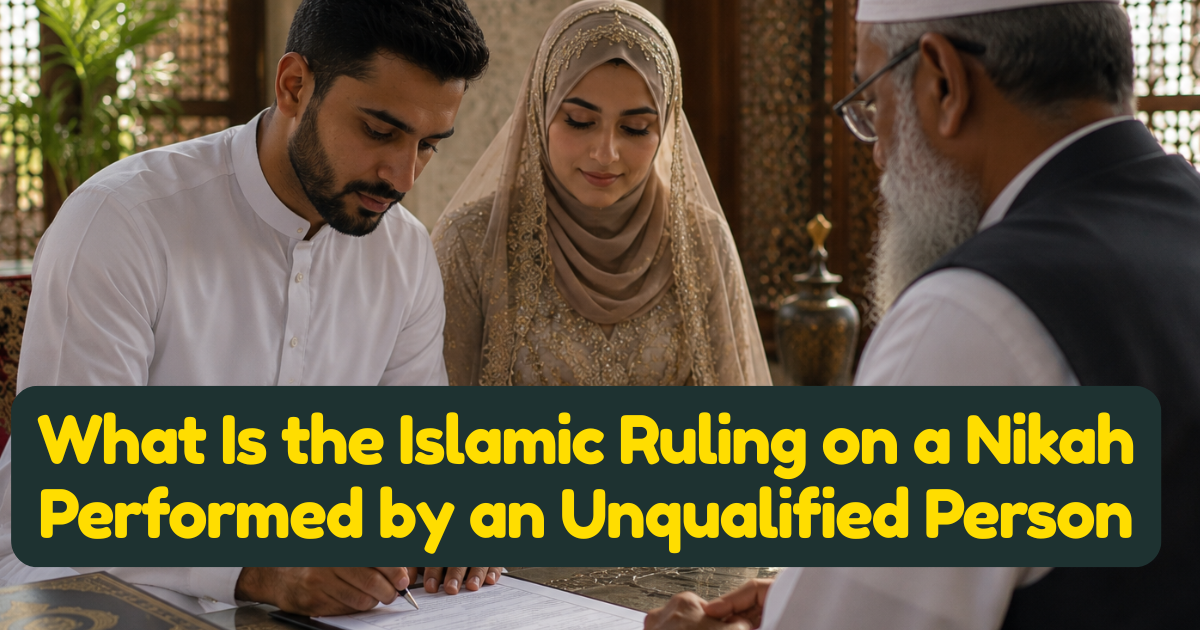
What Is the Islamic Ruling on a Nikah Performed by an Unqualified Person — Validity, Risks, and What to Do
One of the questions that arrives most quietly but carries the most weight is this: what if the person who conducted our nikah did not actually know what they were doing? Perhaps it was a family friend who offered to help because there was no imam available. Perhaps the ceremony was rushed, informal, conducted over a phone call with someone who had never done it before. Perhaps the "sheikh" who performed the ceremony has since been found to have no real Islamic education. Or perhaps a couple simply did not know enough at the time to ask the right questions about the person they entrusted with one of the most important moments of their lives.
These situations are more common than they should be — and the question of what they mean for the validity of the nikah is one the Islamic scholarly tradition can actually answer, with considerable precision.
The Starting Point: Does Islamic Law Require a Qualified Officiant?
The foundational ruling is important and often misunderstood: Islamic law does not require a qualified scholar, imam, or qadi to be present for a nikah to be valid. This is one of the most significant ways Islamic marriage law differs from some other religious traditions. There is no priesthood in Islam, no ordained clergy through whose authority a marriage must be sanctioned. The validity of the nikah derives from the conditions of the contract itself — not from the religious credentials of the person who facilitates it.
As the Halal Marriage Contract's scholarly guidance explains with precision: "The presence of an imam is not required for a Muslim marriage since it is never the imam who is marrying the spouses. Rather, spouses are married through the consent they give during the ceremony, whether directly or through a legal representative (wali). The Prophet Muhammad could marry people, but his companions got married without him being present."
The same ruling is confirmed by SeekersGuidance on the minimum steps for a valid nikah: "There is no requirement for there to be an imam figure when it comes to the marriage ceremony. The basic elements of the nikah are: the two parties (or their appointed representatives), the witnesses, and the actual offer and acceptance."
And as the Pakistani legal and nikah resource at Zahid Law's step-by-step nikah guide confirms: "Any trustworthy practicing Muslim can conduct the nikah ceremony, as Islam does not advocate priesthood."
This is the reassuring foundation. If a nikah was conducted by a non-scholar — a knowledgeable Muslim friend, a respected community elder, a family member with sufficient understanding — the absence of formal religious credentials does not by itself invalidate the ceremony.
What the Officiant's Role Actually Is
Understanding why an unqualified officiant does not automatically invalidate a nikah requires understanding what the officiant's role actually is in Islamic law — because it is frequently misunderstood.
The nikah is a contract between the parties. The officiant — whether called a qadi, imam, nikah khwan, or simply a knowledgeable Muslim elder — is a facilitator, not a contracting party. They guide the ceremony, deliver the khutbah al-nikah (the marriage sermon, which is Sunnah but not obligatory), confirm the mahr, and oversee the exchange of ijab and qabul. They witness the ceremony in their capacity as a responsible person. But they do not make the marriage happen. The marriage is made by the ijab and qabul between the parties themselves.
As the Silsila Islamic knowledge platform at Who Qualifies to Be a Nikah Officiant explains: "In Islam, it is not an obligation to have an officiant present at the nikah. Marriages in Islam are still valid even without one. However, any knowledgeable Muslim, male or female, may officiate the Nikah."
This means the person conducting the nikah is fulfilling a role of guidance, structure, and oversight — not a role of legal authority or sacred power. The validity of the nikah is determined by whether the conditions of the contract were met, not by the credential of whoever was present to guide the ceremony.
So When Does an Unqualified Officiant Become a Problem?
If the officiant is not technically required for validity, why does it matter whether they are qualified or not? The answer is in what an unqualified officiant is likely to get wrong — and the conditions they are likely to fail to verify or ensure.
The nikah's validity depends entirely on its conditions being met. As the Halal Marriage Contract's comprehensive guide to invalid marriages in Islam establishes: "A Muslim marriage is considered absolutely invalid in certain cases. It is invalid when one of the four conditions necessary for forming a marriage contract or making it valid are incomplete or lacking." Those conditions — consent, witnesses, wali (where required), and mahr — must all be properly present and properly fulfilled.
An unqualified person conducting a nikah is significantly more likely to:
- Fail to confirm witness qualifications — not knowing to check that witnesses are adult, Muslim, sane, and able to clearly hear the ceremony
- Use incorrect or ambiguous wording for the ijab and qabul — not knowing the exact form of offer and acceptance required by the relevant madhab
- Omit or incorrectly handle the mahr — not stating it clearly before witnesses, not specifying prompt vs deferred portions, or not recording it properly
- Fail to properly confirm the wali's authority — not checking whether the person acting as guardian is authorised to do so, or whether a wakeel appointment was properly made
- Not check for legal impediments — not asking about existing marriages, iddah periods, or prohibited degrees of relation
- Conduct the ceremony in a form the parties' madhab does not accept — not knowing the differences between what Hanafi, Shafi'i, Maliki, or Hanbali fiqh require
The problem is not the person's lack of credentials — it is the practical consequence of their lack of knowledge. The nikah's validity is in the details, and the details are what knowledge protects.
The Specific Ways an Unqualified Ceremony Can Be Invalid
Based on the conditions of a valid nikah, here are the specific ways in which a poorly conducted ceremony can affect validity:
Invalid Witnesses
If the witnesses were not properly Muslim, adult, and sane — or if they could not hear and comprehend the ijab and qabul — the witnessing condition is not met and the nikah may be invalid. An unqualified officiant conducting an informal ceremony might simply invite whoever was present to serve as witnesses without checking their qualifications. As confirmed by Mufti Ebrahim Desai's institution at IslamQA — Nikah With Non-Muslim Witnesses: "In order for the nikah between a Muslim man and woman to be valid, it is a condition that it be witnessed by at least two males, or one male and two females who are sane, mature, and Muslim. Therefore, in the enquired situation, the nikah will not be valid." Non-Muslim witnesses — however well-intentioned — cannot fulfil the Islamic witnessing requirement.
Incorrect Wording of Ijab and Qabul
The offer and acceptance must be in clear, unambiguous terms that definitively convey the intention to contract a marriage. An unqualified officiant might use casual or conversational phrasing — "do you agree to marry?" and "yes" — rather than the proper forms recognised by the relevant madhab. While the Hanafi school is the most flexible on wording, the Shafi'i and Hanbali schools require specific derivatives of the nikah or zawaj roots. A ceremony conducted in incorrect form for the couple's madhab may not constitute a valid contract.
Wali Confusion or Absence
Under the Shafi'i, Maliki, and Hanbali schools, the wali is a required condition for validity. An unqualified officiant might not know to confirm who the wali is, whether they are authorised, or — in cases where the natural wali is absent — how to properly arrange a wakeel appointment. A ceremony where the wali role was filled by someone without authority, or skipped entirely in a school that requires it, may have a validity problem the officiant was entirely unaware of.
Mahr Not Properly Stated or Agreed
If the mahr was not clearly stated and agreed before witnesses — or if it was mentioned so casually that no one present could confirm what was actually agreed — the mahr condition is not properly fulfilled. Under the Maliki school, mahr is a pillar of the nikah; its absence or ambiguity creates a specific legal problem. An unqualified officiant rushing through the ceremony might treat the mahr as a formality rather than a substantive part of the contract.
The Distinction Between Validity and Good Practice
It is important to distinguish clearly between two different questions: (1) is the nikah valid? and (2) was the nikah conducted in good practice? These are not the same question, and conflating them leads to unnecessary anxiety in some cases and unwarranted confidence in others.
A nikah conducted by an unqualified person who nevertheless managed to meet all the conditions — correct ijab and qabul, qualified Muslim witnesses who heard the ceremony, the mahr stated, the wali arrangement appropriate — is a valid nikah. The absence of an imam or scholar did not make it invalid, provided the conditions were all actually met.
A nikah conducted by a highly qualified scholar but in which one condition was not properly fulfilled — for example, witnesses who could not hear the ijab and qabul because the room was too noisy — may have a validity problem despite the scholar's presence. The scholar's presence does not substitute for the conditions being met.
The reason an unqualified officiant creates risk rather than certain invalidity is that their lack of knowledge makes it substantially more likely that conditions were not properly checked or met. The Silsila guidance captures this balance precisely: "It's highly recommended to find someone knowledgeable about the fiqh rules of nikah." Recommended — not obligatory — but the recommendation carries real weight because of what is at stake.
What to Do If Your Nikah Was Conducted This Way
For couples who have discovered that their nikah was conducted informally, by someone without proper knowledge, or in circumstances that raise questions about whether the conditions were met, the following guidance applies:
1. Reconstruct What Actually Happened
Think carefully and honestly about what occurred during the ceremony. Were the witnesses Muslim, adult, and sane? Did they hear the ceremony clearly? Was an ijab and qabul clearly stated? Was a mahr agreed? Was the wali or his representative present? This reconstruction, as honest and specific as possible, is the starting point for any scholarly assessment of validity.
2. Seek Scholarly Assessment
A qualified Islamic scholar who knows the details of what occurred can assess whether the conditions were actually met. This is not a casual inquiry — it requires honest disclosure of all the circumstances. The scholar may conclude that the nikah was valid (because the conditions were met despite the informal setting), or may advise that certain conditions were not properly fulfilled and need to be addressed.
3. If There Is Genuine Doubt, Renew the Nikah
If there is genuine, unresolved doubt about whether any of the conditions were properly met, the practical and scholarly advice is consistent: renew the nikah. A fresh nikah properly conducted — with qualified witnesses, clear ijab and qabul, stated mahr, and appropriate wali arrangements — removes all uncertainty. This is not an admission of failure or wrongdoing. It is an exercise of Islamic legal prudence, and the scholars have always recognised that renewing a nikah under these circumstances is a responsible act of care for the marriage.
The earlier article on this topic at Is Nikah Valid Without a Qazi addresses the core validity question in detail. For the specific question of what must actually happen during a ceremony, the step-by-step guide at How Long Is a Nikah Ceremony and What Must Happen During It provides the complete picture.
Common Scenarios and Their Likely Assessment
To help couples assess their situation practically, here are common informal ceremony scenarios and their likely scholarly assessment:
Scenario: A knowledgeable family elder conducted the ceremony with two Muslim male witnesses who heard clearly, mahr was stated, and the wali was present
Likely valid. The absence of a formal imam title is irrelevant. The conditions appear to have been met. No action is required unless a specific condition is now uncertain.
Scenario: The ceremony was conducted over a phone call with a person who "offered to help," witnesses were present in the room but in a noisy environment and could not clearly hear
Potential validity concern. If the witnesses could not hear the ijab and qabul clearly, the witnessing condition may not have been met. Scholarly assessment is strongly advisable, and renewing the nikah under proper conditions would resolve the uncertainty.
Scenario: A nikah was conducted online by someone who described themselves as a "sheikh" but had no formal Islamic education, and later turned out to have fabricated their credentials
Depends on the conditions, not the person. The deception about credentials is deeply concerning and morally serious — but it does not by itself determine validity. If the conditions of the nikah were genuinely met during the ceremony (qualified witnesses, proper ijab and qabul, stated mahr, appropriate wali), the nikah may still be valid despite the officiant's dishonesty. If conditions were missing, they were missing regardless of the officiant's title. Seeking scholarly review of the specific ceremony is essential in this case.
Scenario: Friends informally performed the nikah among themselves, with no real structure, and are now uncertain what was actually said or agreed
Significant concern, likely renewal advisable. When the parties themselves are not certain whether a definitive ijab and qabul took place, there may not have been a valid nikah. As covered in the article on witnesses who did not understand the ceremony, a nikah where all participants are uncertain whether the contract was definitely formed is a nikah whose validity is in genuine doubt. Renewal is the scholarly and practical recommendation.
How InstantNikah.com Protects Against These Risks
Every ceremony conducted through InstantNikah.com is performed by a qualified Islamic scholar with formal religious education and specific experience in Islamic marriage law. The scholar's knowledge serves one purpose above all others: ensuring that every condition of the nikah is actively verified and properly fulfilled — not just hoped for.
This means witnesses are confirmed and briefed before the ceremony. The wali arrangement is verified in advance. The mahr is stated explicitly on record. The ijab and qabul are conducted in the correct form for the couple's madhab. The ceremony is documented in a nikah certificate that records all conditions and parties. And the couple receives that documentation — a clear, verifiable record that the conditions were met — rather than a fading memory of an informal gathering.
For couples who are questioning the validity of a previous ceremony or who want to ensure their upcoming nikah is properly conducted, the team at InstantNikah.com can assist. The contact page is the starting point for any questions. To review and book a ceremony, visit the process page and choose from Instant Nikah, Same Day Nikah, Express Nikah, or Essential Nikah. Verified experiences from couples who used the service can be found at the reviews page.
Admin User
Author