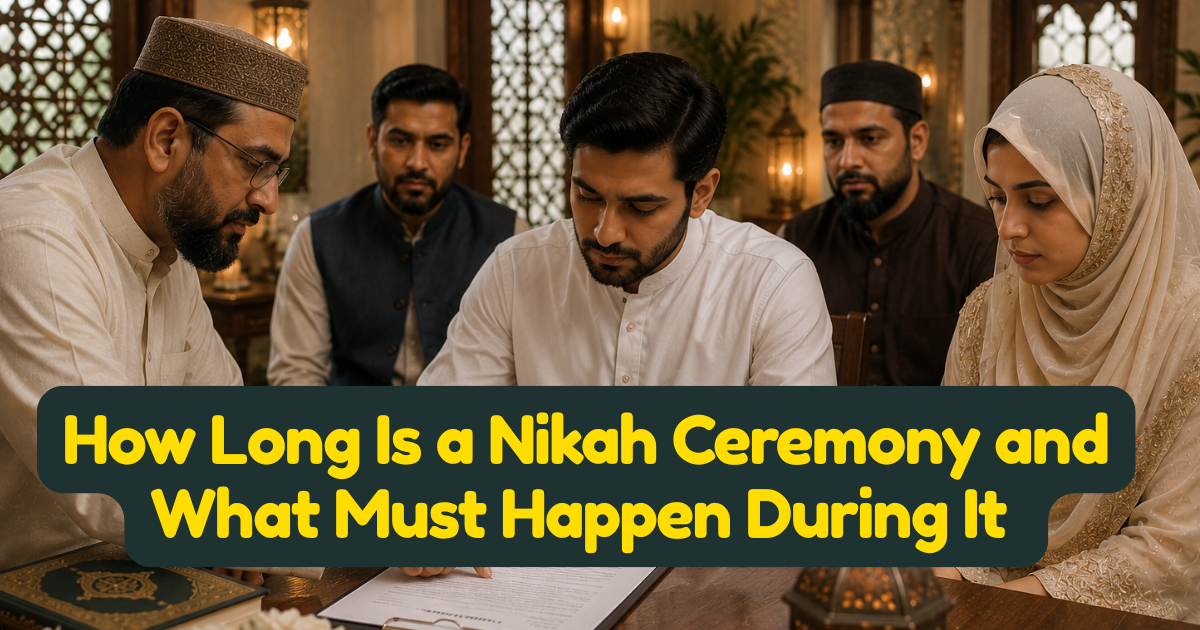
How Long Is a Nikah Ceremony and What Must Happen During It — Step-by-Step Islamic Guide
One of the most common things couples discover in the weeks before their nikah is that nobody has ever explained to them — clearly, practically, step by step — what will actually happen during the ceremony itself. They know there will be witnesses. They know mahr is involved. They have heard the word ijab and qabul. But the actual sequence, the timing, what the qadi says and does, which parts are required by Islamic law and which are cultural tradition — these things rarely get explained in a way that helps couples feel truly prepared.
This guide fills that gap. It covers every stage of a nikah ceremony in sequence, distinguishes between what is obligatory and what is Sunnah, explains what a qadi or officiant actually does during each step, and addresses how the ceremony functions in both physical and online settings. By the end, you should know exactly what a nikah looks like — and be able to walk into yours with complete confidence.
First: How Long Does a Nikah Actually Take
The nikah itself — the actual Islamic marriage contract — is a short ceremony. In its pure form, without extended cultural additions, a nikah can be completed in fifteen to thirty minutes. This surprises many people, particularly those from South Asian or Middle Eastern backgrounds where the broader wedding celebration spans many hours or even days.
The reason for this brevity is theologically intentional. The Prophet Muhammad (peace be upon him) encouraged ease in marriage, and Islamic law did not design the nikah as an elaborate ritual. It is a contract — solemn, deeply meaningful, spiritually significant — but structurally simple. The ceremony involves a sermon, a statement of mahr, an exchange of offer and acceptance, and a closing supplication. That is, at its core, the complete sequence.
What extends the duration of most traditional ceremonies is the cultural layering: the speeches, the photography, the signing of multiple documents, the extended family involvement, the reception. None of these are requirements of the nikah itself. A nikah performed by a qualified qadi for a couple with two witnesses, a confirmed mahr, and a wali (where required) is entirely valid whether it takes twenty minutes or two hours — the length does not affect the Islamic validity in any direction.
For online nikah ceremonies conducted through a service like InstantNikah.com, the ceremony typically runs between fifteen and forty-five minutes, depending on the couple's preferences and how much time they wish to spend on the opening sermon and closing duas. The Islamic requirements are the same — the format simply makes them more focused.
The Two Categories: What Is Fard (Obligatory) and What Is Sunnah
Before walking through the ceremony sequence, it is important to establish this foundational distinction — because understanding it prevents confusion about what can be adapted and what cannot.
The obligatory elements (those whose absence affects the validity of the nikah) are:
- Ijab and Qabul — the verbal offer and acceptance of the marriage contract, expressed in clear and unambiguous terms
- Two qualifying witnesses — adult, sane, Muslim witnesses who hear and comprehend both the offer and acceptance
- Mahr — a marriage gift from the groom to the bride, which must be agreed upon as part of the contract
- Wali — the bride's guardian, whose role varies between madhabs (obligatory in Shafi'i and Hanbali, strongly recommended in Hanafi, not required in some Maliki applications)
- Absence of legal impediments — neither party being in an incompatible existing marriage, prohibited degree of relation, or iddah period
As confirmed by SeekersGuidance in its answer on the minimum requirements for a valid nikah: "The basic elements of the nikah are: the two parties (or their appointed representatives), the witnesses, and the actual offer and acceptance." Everything else — the sermon, the prayers, the Quran recitation, the reception — is either Sunnah (recommended practice following the Prophet's tradition) or cultural custom.
The Sunnah elements (those the Prophet practiced and encouraged, and which are part of a complete, blessed ceremony, but whose absence does not invalidate the nikah) include:
- The Khutbah al-Nikah (the marriage sermon)
- Recitation of Quranic verses
- The closing dua (supplication for the couple)
- The Walima (the post-marriage feast, to be held after consummation)
- Public announcement of the marriage
Before the Ceremony: What Must Be Confirmed in Advance
A well-prepared nikah begins well before the ceremony itself. The following must be confirmed and arranged prior to the ceremony beginning. Attempting to resolve these at the last minute is a common source of stress and, in some cases, validity concerns.
Confirm Both Parties Are Eligible to Marry
Both parties must be free from any existing marriage, not in a prohibited degree of relation, not in a state of iddah (waiting period after divorce or widowhood), and — under most madhab positions — not currently in ihram during Hajj or Umrah. The qadi should confirm these eligibility conditions before proceeding. A responsible officiant will ask directly.
Agree on the Mahr in Advance
The mahr must be confirmed before the ceremony. It does not need to be paid at the ceremony (it can be deferred in whole or in part), but the amount and terms must be clearly agreed. As documented at Halal Marriage Contract's Muslim Wedding Ceremony Guide, the mahr is the bride's exclusive right — it cannot be revised downward after the ceremony without her consent. Confirming it precisely in advance prevents ambiguity during the ceremony itself.
Confirm the Witnesses and the Wali
The witnesses must be identified and informed of their role before the ceremony. They must understand they are serving as legal witnesses to a marriage contract — not merely attending. The wali (where applicable) must be present or, if absent, a duly appointed wakeel must be confirmed in advance. As the resource at Ashton Central Mosque's Islamic Marriage guide explains, these are structural requirements whose absence after the ceremony begins is not easily remedied.
Obtain the Bride's Explicit Consent
Consent is not merely assumed. A responsible officiant will confirm the bride's consent independently — not simply ask the wali to confirm it. The bride must, at some point in the process, clearly express her agreement to this specific marriage with this specific groom. In Hanafi fiqh, the bride's own verbal or written consent is her legal act; the wali represents her formally but does not replace her will.
Step One: The Opening and the Khutbah al-Nikah
The ceremony begins with the Khutbah al-Nikah — the marriage sermon. This is the established Sunnah of the Prophet Muhammad (peace be upon him), who taught a specific khutbah for nikah ceremonies narrated by Ibn Masood and reported in Tirmidhi.
The sermon opens with praise of Allah (hamd), seeks His help and forgiveness, and declares the Shahadah. The officiant then recites three specific Quranic verses which the Prophet consistently used in marriage khutbahs. As documented across multiple Islamic sources including SoundVision's resource on the Prophetic marriage sermon, these three verses are:
- Surah An-Nisa 4:1 — "O people, fear your Lord Who created you from a single soul, and from it created its match, and spread many men and women from the two…"
- Surah Ali Imran 3:102 — "O you who believe, fear Allah as He should be feared, and let not yourself die save as Muslims."
- Surah Al-Ahzab 33:70-71 — "O you who believe, fear Allah, and speak in straightforward words. He will correct your deeds for your benefit, and forgive your sins for you…"
These verses are not mere recitation. Each addresses a dimension of married life: the first speaks to the origin and sanctity of the marital bond; the second calls both spouses to maintain their faith and die as believers; the third calls for truthfulness and righteousness in speech — the foundation of a functional marriage. The Prophet's choice of these three verses for every marriage ceremony was not incidental.
The khutbah may be brief — some officiants deliver it in under five minutes — or more extended. It is Sunnah, not obligatory. A nikah without a khutbah is still valid. But a ceremony that includes it is richer and more aligned with the Prophetic tradition.
Step Two: Stating and Confirming the Mahr
Before the ijab and qabul are performed, the qadi confirms the mahr publicly and clearly. This is not a formality — it is a substantive legal step. The mahr must be stated in the ceremony so that the witnesses hear and can later confirm what was agreed.
The qadi will typically ask: what is the agreed mahr, how much is to be paid promptly (muajjal), and how much is deferred (muakhkhar)? The groom confirms the terms. If the bride or her representative wishes to add any conditions regarding the mahr to the contract, this is the moment to do so.
The amount of mahr has no legally specified minimum or maximum in Islamic law. As noted in the Islamic marriage resource at Qiran.com: moderation according to existing social norms is recommended. The deferred portion of the mahr — if any — becomes an immediate debt upon divorce or the death of the husband. This should be clearly understood by both parties before signing anything.
Step Three: The Ijab — The Offer
The ijab is the formal offer of the marriage contract. Classically, this comes from the wali (the bride's guardian) or his wakeel, offering the bride in marriage to the groom. The typical Arabic form is a variation of: "I give [bride's name] in marriage to you, with a mahr of [agreed amount]."
This offer must be made in clear, unambiguous terms. It must be made in the same session as the acceptance. And it must be heard by the witnesses. The language does not need to be Arabic — it can be in any language the participants understand, according to the majority scholarly position — but the words used must clearly convey the intent to establish a marriage contract.
In the Hanafi school, the bride herself may also make the ijab without going through a wali, as Hanafi fiqh does not require a wali for the validity of the contract (though her guardian's involvement is strongly recommended). In the Shafi'i school, the wali or his authorised wakeel must make the offer — the bride does not make the ijab directly.
Step Four: The Qabul — The Acceptance
The qabul is the groom's acceptance of the offer. It must follow the ijab in the same session without interruption or contradiction. The typical form is: "I accept this marriage" or "Qabiltu" — I have accepted.
It is a common Sunnah practice for the qabul to be stated three times, as described in the Wikipedia entry on Islamic marriage contracts: "The verbal aspect involves both the bride and groom responding 'Qubool' (meaning 'I accept') three times." This repetition is not legally required — the contract is formed on the first clear, unambiguous acceptance — but it is widely practiced as it reinforces the certainty and deliberateness of the commitment.
At the moment the qabul is spoken in response to the ijab, with the witnesses present and the mahr confirmed, the nikah is contractually formed. The couple is married in Islamic law from this point forward. Everything that follows is either documentation, Sunnah practice, or cultural celebration.
Step Five: Witness Confirmation
Immediately after the ijab and qabul, a responsible officiant confirms that the witnesses heard and understood the exchange. This step is often skipped in informal ceremonies but is essential procedural practice. The witnesses should verbally confirm their comprehension — that they heard both the offer and the acceptance, that they understood a marriage was being contracted, and that they witnessed it in their capacity as Muslim adults.
As established in the fiqh scholarship covered in our previous article on witness understanding, this confirmation transforms the witnessing from passive attendance into active legal function. It is the difference between witnesses who happen to be in the room and witnesses who have genuinely fulfilled the role Islamic law assigned them.
Step Six: Signing the Nikah Contract (Aqd-Nikah)
The written marriage contract — known as the Aqd-Nikah or Nikah Nama — is signed by the bride, the groom, the wali, the witnesses, and the officiant. This document is not technically required for the Islamic validity of the nikah (the verbal ijab and qabul form the contract), but it is a strongly recommended practice that provides a permanent record of all the terms.
The nikah contract should record: the names of both parties, the name of the wali (and wakeel if applicable), the names of the witnesses, the agreed mahr (prompt and deferred portions), the date and location of the ceremony, and any additional conditions the parties wished to include. Conditions in a nikah contract are permitted under Islamic law, and including them protects both parties' rights in clear terms.
For couples using InstantNikah.com's online nikah certificate service, the nikah certificate records all these elements in a professionally prepared document issued after the ceremony. For information on what makes a nikah certificate valid under Islamic and civil law, see the dedicated guide at What Makes a Nikah Certificate Islamically and Legally Valid.
Step Seven: The Closing Dua
The ceremony closes with a dua — a supplication asking Allah to bless the marriage, grant the couple love and mercy, and protect their union. This is Sunnah and is deeply valued in the Islamic tradition of marriage. The three Quranic verses recited at the opening of the ceremony are thematically reflected in the dua: the couple is asked to fear Allah, to speak truthfully with each other, and to build their home on a foundation of piety.
The closing dua is also the moment when those present — family, witnesses, and friends — are encouraged to offer their own supplications for the couple. The Prophet Muhammad (peace be upon him) taught specific duas for newlyweds, including: "Baarakallahu laka wa baaraka alayka wa jama'a baynakuma fi khayr" — "May Allah bless you, and shower His blessings upon you, and join you together in goodness."
Step Eight: The Walima — After the Ceremony
The Walima is a post-marriage feast — a celebration of the marriage hosted by the groom for family, friends, and community. It is an established Sunnah of the Prophet Muhammad (peace be upon him), who held a walima after each of his marriages. As documented in the Halal Marriage Contract's comprehensive ceremony guide, citing Bukhari Hadith 6386: the walima is Sunnah rather than obligatory, and should be conducted according to the family's means — simple or elaborate, the Sunnah is fulfilled.
The walima typically takes place within three days of the marriage being consummated. Its purpose is the public announcement and celebration of the marriage — which aligns with the Islamic principle of ishhar, making the marriage known to the community. As the Prophet said: "Publicize this marriage" (Al-Tirmidhi). A marriage that is widely known is one that is protected — no one can later falsely deny it, and the couple's status as husband and wife is established in their community's awareness.
The Complete Ceremony at a Glance
For couples who want a clear, practical overview, here is the complete nikah sequence with approximate timing for a focused ceremony:
- Pre-ceremony confirmation (5–10 minutes before): eligibility confirmed, mahr agreed, witnesses oriented, wali confirmed
- Opening and Khutbah al-Nikah (5–10 minutes): praise of Allah, Shahadah, three Quranic verses, brief sermon on the meaning of marriage
- Mahr statement (2–3 minutes): the qadi confirms the mahr amount and terms clearly before witnesses
- Ijab (1–2 minutes): the wali or his wakeel makes the formal offer of the marriage
- Qabul (1–2 minutes): the groom accepts — typically three times — in clear and deliberate terms
- Witness confirmation (1–2 minutes): the qadi confirms both witnesses heard and understood the exchange
- Contract signing (3–5 minutes): bride, groom, wali, witnesses, and officiant sign the Nikah Nama
- Closing dua (3–5 minutes): supplication for the couple's happiness, mercy, and piety
Total for the Islamic ceremony itself: approximately 20–35 minutes. Everything else — speeches, photography, family gatherings — is additional and does not affect the validity of the nikah one way or the other.
How Online Nikah Ceremonies Follow the Same Sequence
A common misunderstanding about online nikah is that it must involve different procedures or shortcuts. It does not. The sequence described above applies in exactly the same way whether the ceremony is conducted in a mosque, a private home, or over a video call.
What changes is logistics, not structure. The qadi confirms eligibility through documentation rather than in-person conversation. The witnesses are physically present with one or more of the parties rather than all being in one room. The wali or his wakeel is confirmed in advance rather than spontaneously present. But the khutbah still happens, the mahr is still stated, the ijab and qabul are still spoken clearly, the witnesses still confirm their comprehension, and the dua is still offered.
The legal and Sunnah structure of the nikah is entirely preserved. The medium of communication — video call rather than physical co-location — changes the mechanism of delivery, not the content of what is delivered. This is why scholars across multiple madhabs who have examined online nikah carefully have concluded that it can be valid when properly structured. For a deeper exploration of how this is established in Islamic jurisprudence, see the article on Is Online Nikah Valid in Islam.
What to Ask Your Qadi Before the Ceremony
Whether your nikah is in person or online, the following questions are worth confirming with your officiant before the ceremony begins:
- Which madhab will the ceremony follow, and how does that affect the wali requirement?
- How will the mahr be recorded and confirmed during the ceremony?
- Will the witnesses be briefed and their comprehension confirmed?
- What documentation will be issued after the ceremony, and what will it record?
- Will the Khutbah al-Nikah be included, and in which language?
- If any party is joining remotely, how is the witness and presence arrangement structured?
A qualified, experienced qadi will answer all of these questions clearly and without hesitation. An officiant who cannot answer them should raise concern about whether the ceremony will be properly structured.
Book Your Nikah with InstantNikah.com
InstantNikah.com provides a premium Shariah-compliant online nikah service, conducted by qualified Islamic scholars who follow the complete ceremony sequence described in this article — every step, every condition, every required element, with proper documentation issued afterwards. The service is available globally, supporting couples across the UK, USA, Canada, Europe, Australia, and beyond.
To see the service's process in detail, visit the process page. To view real ceremonies and read verified reviews from couples, visit the gallery and reviews pages. Booking options include the Instant Nikah for urgent ceremonies, Same Day Nikah, Express Nikah, and the fully supported Essential Nikah. For questions specific to your situation, the team is reachable through the contact page.
Admin User
Author