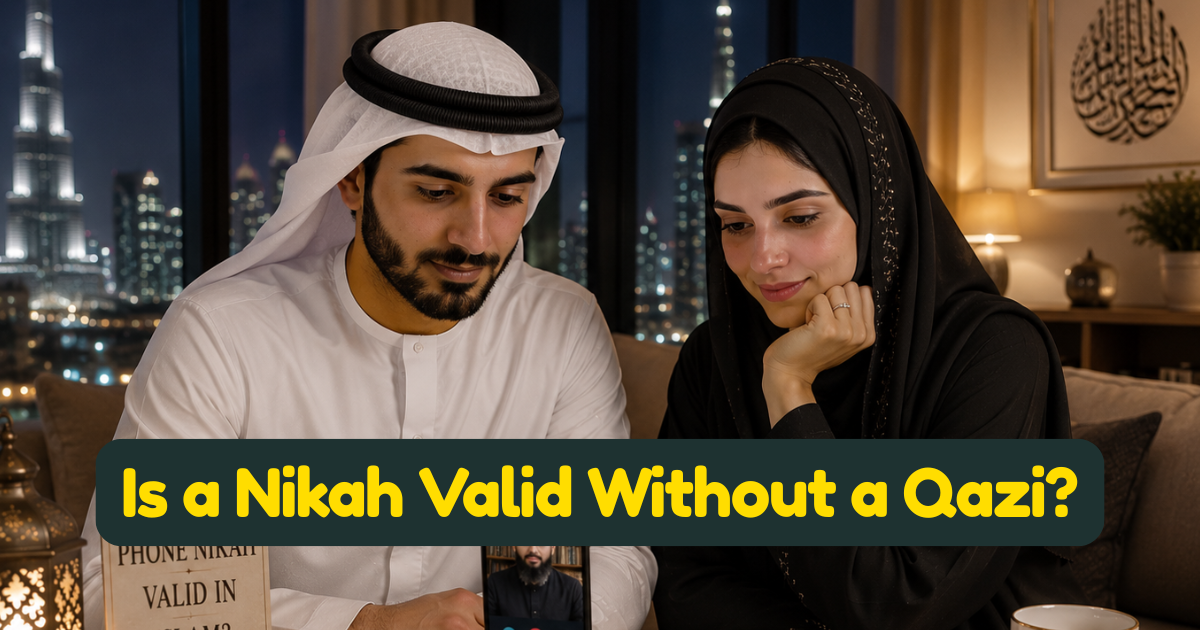
Is a Nikah Valid Without a Qazi? Who Has the Authority to Conduct an Islamic Marriage Ceremony
It is one of the most common assumptions in Muslim communities across the world — that a nikah is only valid if a qazi conducts it. Families insist on it. Wedding planners book around it. Couples delay their marriage waiting for one to be available. But is it actually true? Does Islamic law require a qazi to officiate a nikah, or is this a cultural assumption that has been mistaken for a religious requirement?
The answer matters enormously — not just academically, but practically. For Muslims living in the United Kingdom, the United States, Germany, Canada, Australia, and across Europe, finding a qualified Islamic official is not always simple. For those marrying urgently, marrying across borders, or marrying without large family gatherings, the question of who can legitimately conduct their nikah is one of the most important questions they will ask.
This article examines what Islamic law actually says, what the four major madhabs require, and who genuinely holds the authority to make a nikah valid — whether that person is called a qazi, an imam, a scholar, a wali, or something else entirely.
What the Word "Qazi" Actually Means
The word qazi (also written as qadi) comes from the Arabic root meaning to judge or decide. Historically, a qazi was an Islamic judge — a scholar appointed by a Muslim state or authority to adjudicate legal matters, including the formalisation of marriage contracts. In classical Islamic governance, the qazi held an official state role. He was not simply a religious figure. He was a legal officer of the Islamic state.
This distinction is critical to understanding the modern question. The classical qazi system was a product of a particular historical and political context — one where Muslim-majority states administered Islamic law formally through appointed officers. That system still exists in some countries. In Pakistan, Bangladesh, and parts of the Arab world, a nikah registrar or qazi operates within a state-sanctioned framework. But for the approximately fifty million Muslims living across Western Europe, North America, and Australasia, no such state apparatus exists.
When a Muslim in Manchester or Minneapolis asks whether they need a qazi, they are really asking: who has the Islamic authority to conduct and validate my marriage contract? And that is a very different question from whether they need a state-appointed officer.
What Islamic Law Actually Requires — And Does Not Require
Here is the clarification that many Muslims are never given clearly: Islamic law does not require a qazi, imam, or any religious official to be present for a nikah to be valid.
This is not a liberal or modernist interpretation. It is the classical position across all four major schools of Islamic jurisprudence. The Hanafi school — followed by the majority of Muslims in South Asia, Turkey, and Central Asia — does not list the presence of a religious officiant among the conditions of a valid nikah. Neither does the Maliki school, predominant across North and West Africa. The Shafi'i school, followed widely in Southeast Asia and East Africa, and the Hanbali school, prevalent in the Gulf region, share the same foundational position.
What Islamic law does require — rigorously and without exception across all four madhabs — are the following conditions:
- Ijab and Qabool — a clear, unambiguous offer and acceptance exchanged in a single uninterrupted sitting
- Two Muslim witnesses who are present, sane, adult, and able to hear both the offer and the acceptance clearly
- The wali — the bride's guardian, whose involvement is required by the Shafi'i, Maliki, and Hanbali schools, and strongly recommended though not strictly required by the majority Hanafi position in certain scenarios
- Mahr — a defined gift from the groom to the bride, agreed upon as part of the contract
- The absence of legal impediments — no unexpired iddah, no impermissible blood relation, no existing binding marriage that prohibits remarriage
A qazi, imam, or scholar is not listed among these conditions. The nikah is a contract between two parties, solemnised by the wali's involvement and witnessed by two Muslims. If those conditions are met, the marriage is valid in Islamic law — regardless of whether a religious official presided.
So Why Is a Qazi or Imam Usually Present?
If a qazi or imam is not strictly required, why has their presence become so standard — and why do scholars and institutions still recommend it strongly?
The reason is practical wisdom, not legal necessity. A qualified scholar or imam who presides over a nikah serves several vital protective functions that go beyond the bare minimum of Islamic validity:
Ensuring Conditions Are Correctly Met
The conditions of a nikah — clear ijab and qabool, proper witnessing, mahr agreement, wali involvement — must not only exist in theory but be correctly executed in practice. A qualified scholar knows what correct execution looks like. He can identify if the ijab and qabool are ambiguously worded, if the witnesses are not actually qualified, if the mahr has not been properly agreed, or if the wali's role has not been correctly fulfilled. Without someone with this knowledge present, couples may believe their nikah is valid when it legally is not.
Providing Documentation
A qazi or registered Islamic official typically issues a nikah certificate — a formal document recording the marriage, its witnesses, the mahr, and the date. This documentation serves both religious and practical purposes. It provides evidence of the marriage if it is ever questioned. In some jurisdictions it is the basis for civil registration. Without it, a couple may find themselves unable to prove their marriage in situations where proof is needed — visa applications, inheritance matters, custody proceedings.
Providing Religious Legitimacy and Community Recognition
Islam places enormous value on the public and recognised nature of marriage. The Prophet Muhammad, peace be upon him, is reported to have said: "Announce the nikah." A scholar or imam's presence contributes to the public and recognised character of the marriage. It signals to the community that this is a legitimate, properly conducted union — not a secret arrangement.
Protecting Against Exploitation
When couples conduct nikah privately, without any qualified oversight, the conditions most vulnerable to being skipped or mishandled are those that protect the bride — the wali's involvement, the mahr, and the proper witnessing. A scholar's presence creates accountability. It ensures the bride's rights are formally acknowledged and recorded.
Who Can Conduct a Nikah in the Absence of a State-Appointed Qazi?
For Muslims living in non-Muslim-majority countries — across Europe, North America, and beyond — the question of who can conduct a nikah deserves a clear answer.
In Islamic law, any Muslim who possesses the knowledge necessary to correctly fulfil the conditions of the nikah contract can facilitate the ceremony. This does not require a state appointment, an official title, or a religious certificate from a government body. What it requires is:
- Knowledge of the conditions of a valid nikah under the relevant madhab
- The ability to conduct the ceremony correctly — asking the right questions, confirming the ijab and qabool clearly, confirming the mahr, and ensuring the witnesses are qualified
- The trust and recognition of the parties — particularly the bride's family
In practice, this means any of the following individuals can legitimately facilitate a nikah, provided the conditions above are met:
- A local imam from a mosque or Islamic centre
- A qualified Islamic scholar, even one without an official title
- The bride's wali himself, in cases where he has the relevant knowledge
- A qualified online qazi operating through a verified Islamic service
- A Muslim scholar from a recognised institution, even if he holds no state appointment
The title matters far less than the knowledge, the conditions, and the documentation that follows.
What Global Scholarly Bodies Say About This Question
Authoritative Islamic institutions across the world have addressed the question of nikah authority in modern contexts, particularly for Muslim minorities in Western countries.
Dar al-Ifta al-Misriyyah — Egypt's official fatwa authority and one of the world's most respected Islamic legal bodies — has confirmed in multiple rulings that the presence of a state-appointed qazi is not a Shariah condition for nikah validity. The conditions of the contract itself are what determine validity. However, Dar al-Ifta strongly advises that a knowledgeable Muslim who can correctly oversee the conditions be present to protect all parties.
Al-Azhar University — the world's oldest and most globally recognised centre of Sunni Islamic scholarship — has consistently held that the essential conditions of the nikah contract are what the Shariah mandates. A religious official's presence is a protective measure, not a doctrinal requirement. Al-Azhar scholars have further noted that for Muslim communities in non-Muslim countries, flexibility in who facilitates the ceremony is recognised — provided the conditions are properly met.
In the United Kingdom, the Muslim Council of Britain (MCB) has published guidance specifically addressing nikah ceremonies for British Muslims. The MCB has repeatedly noted that many British Muslims conduct religiously valid nikah ceremonies through qualified imams and scholars without any state-appointed officer being involved. Their guidance focuses on the importance of ensuring the conditions are correctly met and that proper documentation is obtained — not on the title of whoever facilitates the ceremony.
In North America, the Islamic Society of North America (ISNA) has published marriage guidance that clarifies this point explicitly for American and Canadian Muslims. ISNA's resources confirm that any knowledgeable Muslim — including an imam, scholar, or qualified community leader — can facilitate a valid Islamic marriage, provided the Shariah conditions are properly fulfilled. ISNA's marriage officiant training programmes exist precisely because no state system appoints Islamic marriage officials in the United States.
The Islamic Fiqh Academy of the Organisation of Islamic Cooperation, representing fifty-seven Muslim-majority nations, has addressed the adaptation of Islamic marriage practices for Muslim minorities living under non-Islamic civil legal systems. Their resolutions acknowledge that the classical qazi role as a state-appointed officer does not translate directly into non-Muslim legal contexts — and that Muslim communities in those contexts must rely on qualified scholars and imams to fulfil equivalent protective functions.
In Europe, the European Forum of Muslim Women (EFOMW) — an NGO recognised at the Council of Europe level — has highlighted the importance of ensuring Muslim women's rights in nikah ceremonies are properly protected, particularly when no state-appointed official is present. Their advocacy has focused on documentation, mahr rights, and the protective role that qualified officiants play in ensuring women's interests are upheld within the marriage contract.
The Civil Law Dimension: A Separate but Important Consideration
It is important to distinguish between Islamic validity and civil legal recognition. A nikah can be fully valid in Islamic law while having no automatic legal recognition in UK, US, German, French, or Australian civil law — unless additional steps are taken.
In England and Wales, for example, the UK Government's official guidance on marriages makes clear that a religious ceremony alone — including an Islamic nikah — does not automatically constitute a legally registered marriage under civil law. Couples who wish their marriage to have civil legal status must register it separately through the appropriate civil channels.
This dual-layer reality — Islamic validity on one hand, civil registration on the other — affects millions of Muslim couples across Europe and North America. A nikah conducted by a qualified imam or online qazi may be fully valid Islamically while remaining unregistered civilly. Whether civil registration is necessary depends on the couple's specific needs, jurisdiction, and circumstances.
The key point is that the question of who conducts the nikah Islamically and the question of civil registration are entirely separate matters requiring separate steps.
The Rise of the Online Qazi: A Legitimate Modern Solution
For Muslims who cannot easily access a local imam or scholar — whether due to geography, urgency, family circumstances, or cross-border marriage situations — the qualified online qazi has emerged as a practically and Islamically sound alternative.
An online qazi operating through a structured, verified service fulfils exactly the same protective functions as an in-person religious official: confirming the conditions are met, facilitating the ijab and qabool correctly, confirming the mahr, ensuring qualified witnesses are present and visible, and issuing proper documentation. The ceremony is conducted via verified video call, allowing all parties to be seen and heard simultaneously.
Given that Islamic law has never required a specific title or state appointment — only knowledge, competence, and the correct fulfilment of conditions — a qualified online qazi conducting a properly structured video ceremony satisfies the Islamic requirement fully, provided every condition of the nikah is correctly met.
How InstantNikah.com Provides Qualified Islamic Oversight
At InstantNikah.com, every ceremony is led by a qualified online qazi — a scholar with the knowledge and experience to correctly fulfil all conditions of a valid Islamic nikah. The ceremony is conducted via verified video call, ensuring witnesses can see and hear all parties simultaneously. The mahr is formally agreed. The ijab and qabool are conducted correctly. A formal nikah certificate is issued following the ceremony.
For couples who are geographically separated, living abroad, facing urgent circumstances, or simply seeking a properly conducted nikah without the logistical complexity of large in-person arrangements, InstantNikah provides the Islamic oversight and documentation that makes the difference between a ceremony that may be valid and one that demonstrably is.
Explore the full process here, read verified reviews from couples across the world, or book your online nikah today.
Admin User
Author