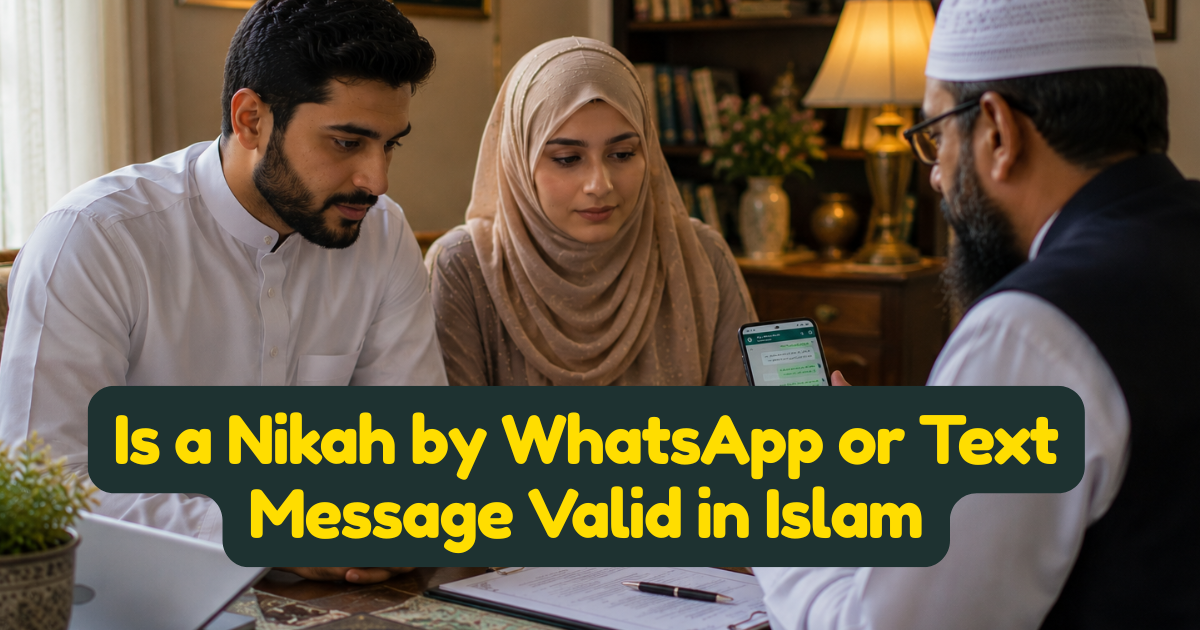
Is a Nikah by WhatsApp or Text Message Valid in Islam — The Complete Scholarly Ruling
Every year, thousands of Muslims type some version of this question into a search engine or send it to an imam in a WhatsApp message: "We did our nikah over text — is it valid?" The circumstances vary. Sometimes it was done casually between two people in a relationship who wanted to make things halal. Sometimes it was done "as a joke" that one or both parties later began to worry about. Sometimes a proposal was sent by message and an acceptance received in return, with witnesses looking on somewhere — but not in a clearly defined way. And sometimes someone has been told by a friend or a YouTube comment that this kind of nikah is perfectly fine.
The Islamic scholarly answer to this question is precise, well-reasoned, and more nuanced than a simple yes or no. Understanding it properly requires separating several things that are often confused: the role of written communication in classical Islamic marriage law, the distinction between asynchronous text and live audio, the witness requirement and what it actually demands, and what "WhatsApp nikah" usually means in practice versus what the scholarship actually permits.
The Foundation: What Makes Any Nikah Valid
Before addressing text messages specifically, the baseline conditions of a valid nikah must be clearly in view. As established by the comprehensive scholarly consensus documented at IslamQA on online nikah validity: a valid nikah requires an offer (ijab), an acceptance (qabul), two Muslim witnesses who hear and comprehend both the offer and acceptance, and — under most madhabs — the wali (guardian). These conditions are not suggestions. They are the structural requirements without which no marriage contract exists.
The most critical element for the WhatsApp/text message question is the simultaneity requirement — what classical scholars called ittihad al-majlis, the unity of the contract session. The offer and acceptance must be part of a single, unbroken session in which all parties are simultaneously engaged. As the Cardiff University peer-reviewed research on the legal status of online nikah in Hanafi fiqh (Journal of Hanafi Studies, 2024) explains: "What is meant by the majlis is that nothing is found within that session which is indicative of displeasure" — and critically, that the offer and acceptance are connected in one unified contractual session.
The question of whether a text message or WhatsApp exchange can constitute such a session is precisely where the scholarly analysis becomes specific and important.
The Classical Precedent: Written Letters in Islamic Marriage Law
Islamic jurisprudence did not encounter the question of text messages for the first time in the smartphone era. The classical scholars addressed written communication in marriage contracts centuries ago — in the form of letters sent between parties who were geographically separated. Their analysis of this scenario provides the foundational framework for understanding modern text-based nikah.
As the SeekersGuidance ruling on whether marriage can occur through text message, checked and approved by Shaykh Abdul-Rahim Reasat, explains — citing the classical Arabic text directly: the scenario in which someone writes a letter proposing marriage is addressed in classical Hanafi fiqh. The ruling is that when the letter arrives, the recipient gathers witnesses, reads the letter aloud to them, and says: "So-and-so wrote to me proposing marriage; bear witness that I have accepted his marriage proposal." This constitutes a valid ijab and qabul.
Notice what this classical ruling requires: the letter is read audibly before witnesses who are physically present. The witnesses hear the proposal — even though it came in writing — because it is read aloud. And the acceptance is spoken audibly in their presence. The text itself is not the contract; the audible reading and spoken acceptance before witnesses is what creates the contract.
This classical framework is the foundation for the modern ruling on text messages. The Askimam ruling at IslamQA — Askimam on nikah through text message, issued by Mufti Ebrahim Desai's institution, applies this classical precedent directly: "Nikah by text message is valid if the man or woman sends a proposal (for example, 'I marry you') and the other reads the message audibly and accepts it (audibly) in the presence of at least two male witnesses or one male witness and two female witnesses. If the message is not read audibly, or the acceptance is not audible, the nikah will not be valid."
The Critical Distinction: What "WhatsApp Nikah" Usually Means in Practice
Here is where the gap between what the ruling permits and what couples actually do becomes critically important. The classical ruling permits a text-based proposal as the starting point for a nikah — but only when the receiving party reads that text aloud before physically present witnesses and then gives a spoken acceptance. What couples who describe a "WhatsApp nikah" almost always mean is something very different:
- Both parties typed messages to each other privately, in a chat
- No witnesses were physically present to hear anything read aloud
- No one read the proposal message out loud
- The acceptance was typed, not spoken
- No mahr was stated
- No wali was present or involved
Under every madhab, this scenario does not constitute a valid nikah. The exchange of typed messages between two private individuals in a chat window — no matter what words were typed — does not fulfil the witnessing condition, the majlis condition, the audibility requirement, or the wali requirement. The Hanafi scholar ruling at Askimam on nikah over text without witnesses is unambiguous: "The ruling issued by the Darul Ifta was that the nikah was not valid."
This is important reassurance for the many Muslims who worry that a casual exchange of messages in a chat may have constituted an accidental marriage. It did not — because the conditions were not met.
The Asynchronous Problem: Why WhatsApp Messages Fail the Majlis Requirement
Beyond the witness and audibility issues, WhatsApp text messages face a specific structural problem that even live communication does not: they are asynchronous. When someone sends a WhatsApp message, the other person may read it minutes, hours, or days later. The session of sending the message and the session of reading and responding to it are separated in time.
The ittihad al-majlis requirement — the unity of the contract session — demands that the offer and acceptance occur in a single, continuous, shared moment of engagement. A text message that is sent at 3pm and read at 7pm does not constitute a single session. Even if the reply comes immediately, the asynchronous nature of text communication means that each message exists independently in time, rather than as part of a simultaneous shared exchange.
As the SeekersGuidance analysis citing Shaykh Faraz Rabbani and Shaykh Hassan confirms at Is a Nikah by Text Message Valid Without Witnesses, citing Ibn Abidin's Radd al-Muhtar and Imam Marghinani's al-Hidaya: "Direct telecommunication nikahs generally fail the legal criteria for a valid contract due to strict requirements for a unified physical assembly, unless a valid physical proxy is explicitly designated."
This asynchronous problem does not apply to live audio or video calls, where all parties are simultaneously engaged in a real-time shared session. This is precisely why live video call nikah is treated very differently by scholars than text message nikah — the majlis issue is resolved by live simultaneous engagement, while typed messages are inherently non-simultaneous.
What About WhatsApp Voice Notes?
Voice notes — pre-recorded audio messages sent through WhatsApp or similar platforms — face the same asynchronous problem as text messages, and then some. A voice note is recorded at one point in time and listened to at another. The proposal is delivered as a recording, not as live speech. The acceptance may likewise be sent as a recording in return.
The scholarly ruling on this is consistent with the text message analysis. As confirmed in the AboutIslam guidance at Is a Marriage Contract via WhatsApp Valid, citing Sheikh Ahmad Kutty of the Islamic Institute of Toronto: "I do not advise anyone to follow dubious and doubtful methods to solemnize marriage contracts." Sheikh Kutty's guidance emphasises that the proper procedures of Islamic marriage must be followed — and that a voice note exchange, however informal, does not constitute those procedures.
A voice note nikah also faces the specific problem described in the ruling on the scenario where a bride sends a voice note of approval and witnesses are with the sheikh but not with the bride. This arrangement fails the witnessing requirement — the witnesses cannot verify the identity of the person sending the voice note, and they are not present to witness her spoken acceptance in real time.
What About WhatsApp Live Audio or Video Calls?
Here the analysis changes — because live calls resolve the asynchronous problem. When both parties are simultaneously engaged on a live WhatsApp audio or video call, the exchange is in real time. Both parties hear each other speaking. If witnesses are physically present with one of the parties and can clearly hear the other party's voice through the speaker, the basic requirements of a live ceremony are potentially in place.
This is why the scholarly debate around "WhatsApp nikah" is actually a debate about live calls rather than typed messages or voice notes. As the IslamQA ruling at IslamQA on nikah witnessed via WhatsApp audio group call addresses: a live audio group call on WhatsApp, with witnesses present and hearing the exchange, enters the category of telephone and audio-call nikah — which some scholars permit and others do not. The debate is about witnessing and identity verification, not about the asynchronous nature of the communication, because a live call is by definition synchronous.
The majority of scholars — including the Islamic Fiqh Council — held that even live telephone and internet nikah faces challenges around the witnessing and majlis conditions. Others, including Sheikh Ibn Baz, permitted it when no risk of tampering or impersonation exists. The scholarly divergence on this specific point is covered in detail in the existing article at Is Phone Nikah Valid in Islam.
The Madhab-by-Madhab Picture on Text-Based Communication
For completeness, here is how the four major madhabs approach the written/text-based marriage question:
Hanafi
The Hanafi school has the most developed position on written communication in nikah, rooted in classical rulings on letters. A written proposal that is read aloud before physically present witnesses, with a spoken acceptance in those witnesses' presence, is valid. A privately exchanged text that neither party reads aloud and no witnesses hear is not valid. The audibility and physical witness presence are the non-negotiable elements.
Shafi'i
The Shafi'i school is stricter on the presence requirement for nikah. As confirmed in the SeekersGuidance Shafi'i ruling at Is a Nikah via Video Call or Telecommunications Valid: "A nikah conducted via telecommunications, like video calls, is invalid because they do not adequately fulfill the integrals of nikah." For the Shafi'i school, text-based nikah without physical presence of all parties faces even greater challenges than for the Hanafi school.
Maliki
The Maliki school's flexibility on witnesses — treating witnessing as recommended rather than obligatory for the contract itself, with the condition of announcement before consummation — means that a written proposal followed by a publicly announced marriage may be valid under some Maliki interpretations. However, even within the Maliki school, scholars would not endorse a private text exchange without announcement as a valid marriage.
Hanbali
The Hanbali school's requirement for witnesses and public announcement aligns with the majority position. A private text exchange without witnesses does not meet Hanbali conditions. The Hanbali provision for public announcement as a basis for validity provides some flexibility — but only if the marriage is actually made publicly known, not if it remains a secret chat exchange.
The Scenario Most People Are Actually Worried About
The most common real-world scenario that brings this question to search engines is not a couple who carefully planned a text-based nikah with scholars involved — it is two people who, in the context of a conversation (sometimes playful, sometimes serious, sometimes both), exchanged words that sounded like a proposal and acceptance. They now worry: did we accidentally get married?
The scholarly answer — across all madhabs — is reassuring for most such cases. As the Fatwaa.com guidance on nikah through text message confirms: without witnesses present and hearing the exchange, no nikah occurred. As the Darul Uloom ruling cited in the Askimam response to a concerned Muslim confirmed: "The ruling issued by the Darul Ifta was that the nikah was not valid."
The requirement for witnesses is not a technicality that can be supplied after the fact. Informing a friend later about the exchange — by text or in person — does not make that friend a witness. As the Askimam ruling makes clear: telling someone afterwards about a nikah that happened does not constitute witnessing the nikah. The witnesses must be present at the time of the exchange, hearing both the offer and the acceptance.
What This Means Practically: Do Not Treat Text as a Ceremony
The most important practical takeaway from all of the above is this: a WhatsApp or text message exchange is not and cannot be a nikah ceremony. No matter what words are typed, no matter how sincerely they are meant, the structural requirements of a valid nikah — live, audible, witnessed, in a unified session — are not met by text-based asynchronous communication.
A text message can be a step toward a nikah. A proposal can be made in writing. Agreement can be reached by message. But the nikah itself — the actual ceremony that creates the marriage contract — must be conducted with the conditions properly in place: qualified witnesses physically present to hear the exchange, a live spoken ijab and qabul, mahr stated and agreed, and the wali arrangement properly made.
For couples who have been in a relationship and want to make it halal quickly and properly — without a large ceremony, without family complexity, and without the barriers of geographic distance — an online nikah conducted by a qualified scholar via live video call provides exactly what a text exchange cannot: a real ceremony, with real conditions met, producing a real and valid Islamic marriage.
How InstantNikah.com Provides What Text Messages Cannot
InstantNikah.com is a premium Shariah-compliant online nikah service conducted via live video by qualified Islamic scholars. Every ceremony includes a live, simultaneous session with both parties present, witnesses physically co-located with one of the parties, the mahr stated and confirmed on record, the wali or wakeel arrangement properly managed, and the ijab and qabul conducted in the correct form for the couple's madhab. The result is a properly documented, valid Islamic marriage — not a text exchange that may or may not have created a contract.
For couples who need their nikah arranged quickly — including those who want to formalise a relationship they have been conducting informally — the Instant Nikah and Same Day Nikah services are available at short notice. For planned ceremonies, Express Nikah and Essential Nikah provide comprehensive support. For questions about your specific situation, the team is reachable through the contact page.
For related guidance, the articles at Is Phone Nikah Valid in Islam, Can a Nikah Be Done Over Zoom, and Is Online Nikah Valid in Islam cover the spectrum of remote ceremony questions in full scholarly depth.
Admin User
Author