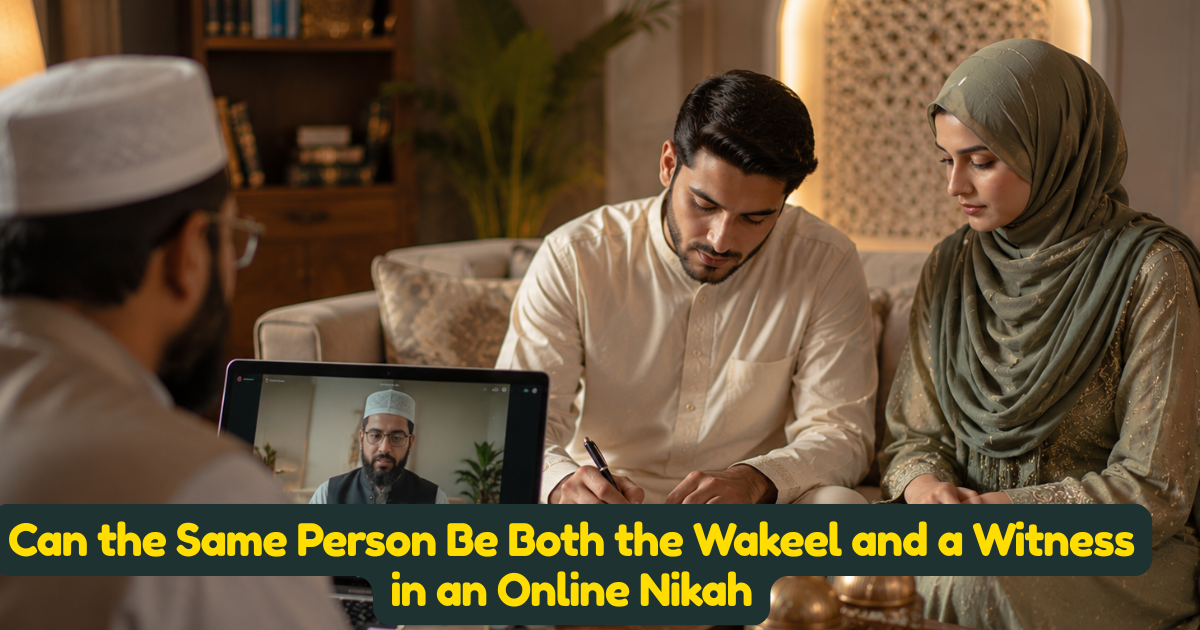
Can the Same Person Be Both the Wakeel and a Witness in an Online Nikah?
The Convenient Shortcut That Isn't
It comes up constantly when families are coordinating an online nikah across time zones, especially when the bride can't be physically present with her side of the family: someone suggests that the trusted uncle already stepping in as wakeel — the appointed representative conducting the offer on the bride's behalf — could simply also count as one of the two required witnesses. One less person to coordinate, one less schedule to align. It sounds efficient. It's also, according to the dominant position across Islamic legal scholarship, not permitted.
Why the Two Roles Can't Overlap
A wakeel and a witness perform fundamentally different functions in a nikah, and the difference matters legally, not just administratively. The wakeel is a party to the contract — they are, for the purposes of the ceremony, standing in the shoes of the person who appointed them, making the offer or acceptance on that person's behalf. A witness, by contrast, exists specifically to be an independent third party confirming that the offer and acceptance took place between two parties. Those two functions are structurally incompatible: a person cannot simultaneously be one of the two parties transacting and an independent observer confirming that the transaction happened, any more than a signatory to a contract can also serve as the notary certifying their own signature.
A direct ruling on this exact question puts it plainly: a person cannot be both a wakeel and a witness on the same occasion. This position, drawn from established Hanafi scholarship, treats the presence of two independent witnesses as a non-negotiable condition for validity — and a wakeel, having already stepped into the role of a contracting party, cannot also occupy the separate, independent role the witnessing requirement was designed to fill.
This isn't a Hanafi-specific concern, either. Maliki jurists express the same underlying logic even more broadly, extending it to the guardian (wali) role as well: a guardian or his proxy conducting the marriage contract cannot simultaneously serve as one of its witnesses, because the entire point of witnessing is to have someone outside the transacting parties confirm what took place. Classical Maliki commentary on this point is explicit that the witnesses must be people other than whoever is executing the contract on the bride's behalf.
The Narrow Hanafi Exception — and Why It's Easy to Misapply
There is one specific, narrow scenario where some Hanafi scholars allow a version of this overlap: when the person the wakeel represents is themselves present in the same session as the contract is conducted. In that specific case, because the represented party is physically present and directly hears the exchange, the contracting party is treated as executing the contract personally — with the wakeel's role effectively folding into that of a witness rather than remaining a separate, exclusive agency role. This is a meaningfully different situation from the everyday case that actually comes up in online nikah planning, where the bride or groom is not physically present with their wakeel — which is usually the entire reason a wakeel was appointed in the first place. In the far more common scenario — a wakeel representing someone who isn't in the room or on the call at that exact moment — this exception simply doesn't apply, and the dual role reverts to being invalid.
Why This Logic Extends Beyond Marriage Contracts
This isn't an isolated rule invented specifically for nikah. It reflects a broader principle running through Islamic contract law generally: an agent (wakeel) is bound by fiduciary obligations to the person they represent, and is expected to avoid situations that blur the line between representing someone's interests and independently verifying a transaction on their behalf. Academic analysis of wakalah (agency) in Islamic commercial law makes this same self-dealing concern explicit — research published through Malaysia's INCEIF University discusses at length how an agent occupying two conflicting roles in the same transaction undermines the very check that role was meant to provide, whether in a commercial contract or, by direct extension, in a marriage contract.
What This Means for Planning an Online Nikah
The practical takeaway is straightforward: when appointing a wakeel for a bride or groom who won't be present at the exact moment of the ceremony, plan for at least two witnesses who are entirely separate from that wakeel. This is especially worth flagging for online nikah ceremonies, where the pool of people on the call is sometimes smaller than an in-person gathering would naturally provide, and it can be tempting to double up roles simply because fewer people are logged in. A properly structured online nikah service should flag this combination automatically during pre-ceremony planning, rather than leaving a family to discover the problem only when a certificate or sharia council review is later contested.
A Quick Reference
- Wakeel representing someone not present at the ceremony: cannot also serve as a witness — appoint two separate, independent witnesses.
- Wakeel representing someone who is present and directly hears the exchange: some Hanafi scholars permit the wakeel to also function as a witness, since the represented party's presence changes the nature of the transaction.
- Wali (guardian) acting on the bride's behalf: the same restriction applies under Maliki reasoning — the guardian conducting the contract cannot double as one of its witnesses.
Frequently Asked Questions
What happens if a nikah was already conducted with the wakeel also serving as a witness?
Given the difference of opinion and the seriousness of the issue, it's worth consulting a knowledgeable scholar or sharia council about the specific circumstances — many recommend renewing the contract with properly separated roles as a precaution.
Can a witness later become someone's wakeel in an unrelated matter?
Yes — the restriction is specific to holding both roles in the same nikah contract, not a general lifetime restriction on the individual.
Does this rule apply the same way to the groom's side as the bride's?
Yes — the underlying principle, that a contracting party's representative can't double as an independent witness to their own transaction, applies symmetrically to whichever side appoints a wakeel.
Authority References Used (Live & Clickable)
- Darul Ifta Birmingham (via islamqa.org) — UK-based Hanafi fatwa authority, direct ruling on the wakeel-witness dual role
- Islam Question & Answer (islamqa.info) — Maliki jurisprudence on guardian/proxy witness exclusion
- International Journal of Islamic Finance, INCEIF University, Malaysia — academic research on agency (wakalah) conflict-of-interest principles
Suggested Internal Links
- What Is a Wakeel in Nikah, and How Do You Appoint One?
- Online Nikah vs. Nikah by Proxy: What's the Difference?
- How to Choose the Right Witnesses for Online Nikah
- What Happens If a Wali Refuses Nikah?
- Book Your Online Nikah
Why This Article Is Different
Existing wakeel content on the site explains what a wakeel is and how to appoint one, but nothing addresses this specific, easy-to-fall-into planning mistake. Pulling in the conflict-of-interest logic from Islamic agency (wakalah) law more broadly — rather than treating the marriage-specific ruling as an isolated rule — gives this piece a level of legal grounding and cross-topical authority that a narrower, marriage-only treatment wouldn't have, while the "quick reference" section gives it strong featured-snippet and AI-extraction potential.
Zainab Butt
Author