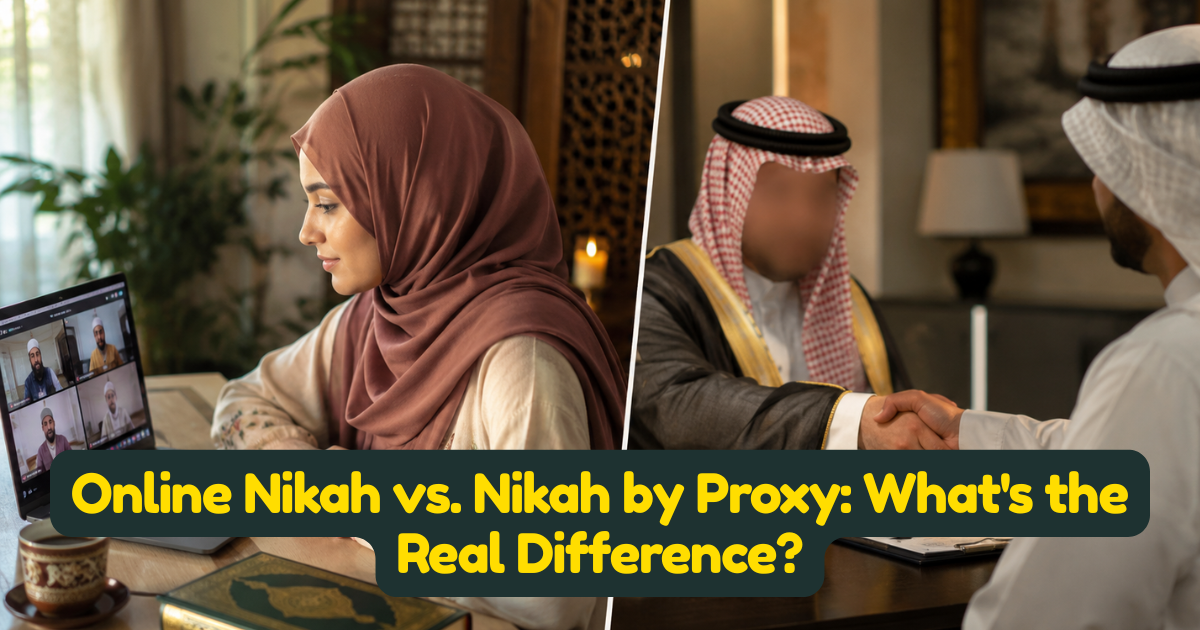
"Online nikah" and "nikah by proxy" often get used as if they're the same thing — both are ways of marrying when a couple can't be physically together. They aren't the same mechanism, though, and the difference between them is exactly where genuine scholarly disagreement about distance marriages actually concentrates.
Nikah by Proxy: One Location, One Representative
A detailed explanation of marrying by proxy lays out the mechanism precisely: a representative (wakeel) is physically present in the same geographical location as the other party and the witnesses, and all the actual proceedings of the nikah — the offer and acceptance — take place there, in person, even though the person being represented is somewhere else entirely. The absent party's role is fulfilled entirely through their representative; they don't need to be on a call or watching at all for the proxy version to work.
Online (Direct Video) Nikah: Everyone Connects, But From Different Places
A direct online nikah works completely differently: there's no proxy standing in anyone's place. Instead, everyone — bride, groom, wali, witnesses — connects via the same live video call from their own separate locations, and the actual offer and acceptance happen in real time, witnessed by everyone simultaneously through that connection. No one is physically substituting for anyone else; everyone is genuinely present for themselves, just not in one shared room.
Why This Distinction Is the Actual Source of Disagreement
A detailed fatwa on solemnising marriage over the phone draws the line precisely, and explains why it matters: in a proper proxy arrangement, the offer and acceptance take place in one identical geographical location, with witnesses physically present there to observe both parts together — which is why it's considered valid. A direct call or video nikah, by contrast, involves the offer and acceptance happening in two different geographical locations at once, witnessed separately in each location rather than together in one place — and this is precisely the structural difference some scholars hold makes direct video nikah invalid, even though the same parties, words, and witnesses are all genuinely involved.
The More Permissive View, and Why It Exists
Not all scholars take the stricter position. Other detailed rulings on this exact question hold that the marriage contract is valid over the phone or internet specifically when there's no danger of tampering, the identities of the husband and wali are clearly established, and the two witnesses can genuinely hear the proposal and acceptance — treating the witnesses hearing the exchange clearly, regardless of physical location, as the operative requirement rather than everyone sharing one room. This is the reasoning underlying most contemporary online nikah services: a properly verified, clearly conducted video ceremony satisfies the underlying purpose of witnessing, even without shared physical geography.
Which One Applies to You?
- If your officiant or chosen scholar follows the stricter geographical-unity position, a proper proxy arrangement — your representative physically present with the other party and witnesses — is the safer route.
- If you're working with a service or scholar who follows the more permissive contemporary view, a direct video nikah with strong identity verification and clear audio/video for all witnesses is considered valid.
- Either way, ask your officiant directly which position they're applying before the ceremony, rather than assuming — this is exactly the kind of question a knowledgeable officiant should be able to answer clearly.
- Don't assume the two terms are interchangeable when researching your options — "online nikah" services and "proxy nikah" services may be offering genuinely different mechanisms, even if both are marketed as solutions for distance.
Key Takeaway
Nikah by proxy and a direct online video nikah solve the same practical problem — distance — through genuinely different mechanisms: one puts a representative physically in the room with witnesses, the other connects everyone live from separate locations. The real scholarly disagreement about distance marriages lives specifically in whether that second structure satisfies the witnessing requirement, which is exactly why it's worth knowing which mechanism your own ceremony is actually using, and which position your officiant is applying, before the day itself.
```Admin User
Author