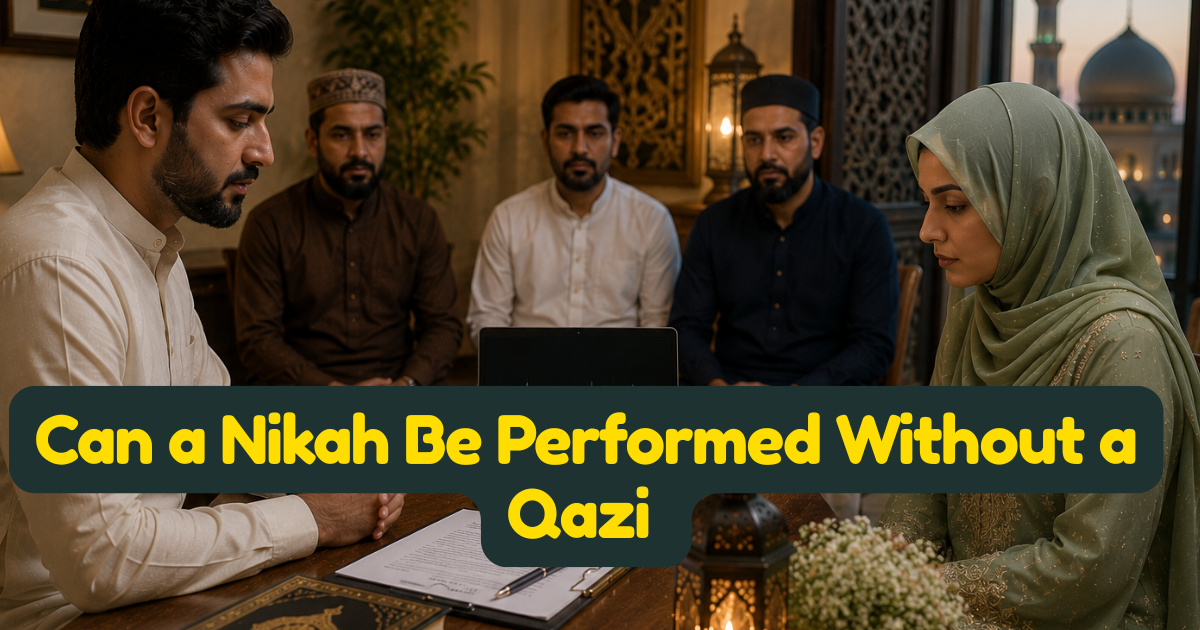
Can a Nikah Be Performed Without a Qazi — and Why the Answer Is More Nuanced Than You Think
It is one of those questions that arrives with an almost rebellious energy. Can we do our nikah without a qazi? Without an imam? Without a formal religious authority? The Islamic legal answer — and this is genuine — is that a qazi is not one of the obligatory pillars of a valid nikah. The scholars are clear on this. But the honest follow-up to that answer, the part that rarely gets said in the same breath, is what makes this question genuinely worth exploring.
Because while it is technically true that a nikah can be valid without a qazi, the reasons why scholars almost universally recommend involving one anyway are not ceremonial preferences or clerical self-interest. They are rooted in a sober understanding of how many ways an unguided nikah can go wrong — and what the consequences of those errors actually are for the couple who went ahead without proper oversight.
What the Scholars Actually Say: No Qazi Required
The foundational scholarly ruling on this is unambiguous and widely agreed upon. As confirmed in a direct fatwa response at IslamQA: "A marriage contract is valid in Islam if the following conditions are met, even if the marriage does not take place in a court, or in the presence of a Judge or the Imam of the masjid."
This position is echoed by SeekersGuidance in its guidance on minimum nikah requirements: "There is no requirement for there to be an imam figure when it comes to the marriage ceremony. The basic elements of the nikah are: (a) the two parties or their appointed representatives, (b) the witnesses, and (c) the actual offer and acceptance."
The Darul Uloom Deoband — one of the most influential Hanafi seminaries in the world — has issued the same ruling on multiple occasions. As stated in their recorded fatwa response: "If the boy and girl themselves or their wakil do ijab-o-qabul in the presence of two Muslim witnesses then nikah shall be valid. The boy or his wakil may also read the khutbah and perform nikah even without a qazi or molvi." (Darul Uloom Deoband fatwa on nikah without qazi)
And as the Halal Marriage Contract scholarly guide explains with precision: "The presence of an imam is not required for a Muslim marriage since it is never the imam who is marrying the spouses. Rather, spouses are married through the consent they give during the ceremony, whether directly or through a legal representative." It cites the Prophetic precedent that his Companions got married without him being present (Sunan Abi Dawud, Hadith 2109).
The theological reasoning behind this ruling reflects something important about the nature of nikah itself. Unlike a sacrament in some other religious traditions, the nikah does not require a priest, cleric, or religious intermediary to make it spiritually valid. The marriage is contracted by the parties themselves — or their duly authorised representatives — and its validity derives from their consent and the proper fulfilment of conditions, not from the authority of whoever is present to guide the ceremony.
What a Qazi Actually Does in a Nikah — and Why It Matters
To understand why the scholars still strongly recommend a qualified officiant despite not requiring one, it helps to understand precisely what role a qazi or Islamic marriage scholar plays. This is not primarily a ceremonial role. It is a legal verification and quality-assurance function.
A qualified qazi conducting a nikah:
- Verifies the eligibility of both parties — confirms they are not already married to others, not in iddah, not within prohibited degrees of relation, not in ihram, and otherwise free of any Islamic legal impediment to this specific marriage
- Confirms the bride's consent independently — asks the bride directly, in a manner that makes clear her answer is genuinely her own and not the result of pressure from others present
- Establishes and records the mahr — confirms the amount agreed, the proportion payable immediately, the proportion deferred, and records this in the nikah documentation
- Confirms the wali's authority — verifies that the person acting as guardian is qualified to do so, or that a properly authorised wakeel has been legitimately appointed
- Orients and confirms the witnesses — ensures they know their role, confirms their qualifications, and verifies they can hear the ceremony clearly
- Delivers the ijab and qabul in the correct form — uses unambiguous language that clearly constitutes a marriage offer and acceptance, avoiding common errors in phrasing
- Issues documentation — prepares and certifies the nikah certificate recording all conditions and parties
None of these individual actions are, strictly speaking, impossible without a qualified scholar present. A knowledgeable layman can theoretically check eligibility, confirm consent, establish a mahr, orient witnesses, and say the right words. The question is: how reliably can they do all of this, in the right sequence, without missing anything, under the emotional pressure of a marriage ceremony?
As the Islamic Association of Raleigh notes in its guidance on what makes a marriage contract valid: each of the pillars of the nikah has conditions that must be met to validate the pillar. The pillars are only sound when their conditions are properly fulfilled. A qualified scholar understands those conditions in depth — including their madhab-specific variations, their edge cases, and the procedural steps that protect against inadvertent error.
The Errors That Actually Happen in Unguided Nikah Ceremonies
This is where the theoretical discussion meets practical reality. The errors that occur in unqualified nikah ceremonies are not hypothetical edge cases. They are recurring patterns that scholars and sharia councils encounter regularly when couples approach them after the fact with questions about whether their nikah was actually valid.
Mahr Not Properly Stated or Agreed
The mahr must be agreed upon and stated as part of the marriage contract. In informal ceremonies, this is often glossed over — parties assume it was understood, or a figure is mentioned casually without being formally incorporated into the contract. Under the Maliki school, mahr is actually a pillar of the nikah itself; under other schools it is a required condition. Either way, its absence or ambiguity creates a real legal weakness that can cause disputes later. A qualified qazi confirms the mahr explicitly, on the record, before witnesses.
Wali Not Properly Confirmed or Authorised
In ceremonies conducted without a scholar, the question of who is acting as wali — and whether they have the authority to do so — is frequently not verified. A brother assuming the role, a father acting when a closer male relative exists, or a friend acting without a formal wakeel appointment from the actual wali can all create questions about whether the guardianship pillar was properly fulfilled. Under the Shafi'i, Maliki, and Hanbali madhabs, this matters significantly for validity.
Ambiguous or Incorrectly Phrased Ijab and Qabul
The offer and acceptance must be in clear, unambiguous terms that definitively express the intention to marry. Informal phrasings — questions and answers that sound like consent but are not technically the correct form of ijab and qabul — can create valid doubt about whether a marriage contract was actually concluded. As the Halal Marriage Contract guide on invalid marriages notes: when one of the four conditions is incomplete or lacking, a marriage is absolutely invalid — and this includes situations where the contract was not expressed in clear and unequivocal terms.
Witnesses Not Properly Briefed, Positioned, or Confirmed
As covered in detail in the previous article in this series, witnesses must meet specific Islamic conditions and must be oriented to their role before the ceremony. Without a qualified officiant managing this, witnesses are often simply family members who happened to be present — with no formal confirmation of their comprehension, qualifications, or understanding of what they were witnessing.
No Documentation or Incomplete Documentation
An informally conducted nikah frequently produces no reliable written record. No nikah certificate, no record of the mahr agreed, no record of the witnesses who were present. Years later — in the event of dispute, divorce, visa application, inheritance claim, or a spouse's death — the couple or their heirs may find themselves unable to prove that the marriage took place at all or that its terms were what both parties remembered them to be.
Legal Impediments Not Checked
A qualified qazi will ask, as a matter of routine, whether either party has been previously married, whether a divorce was properly concluded, whether the woman has completed any applicable iddah period. These are not embarrassing questions — they are necessary verification steps that protect both parties. In unguided ceremonies, they are regularly omitted, sometimes with serious consequences.
What Qualifications Should a Nikah Officiant Actually Have?
Since the scholars confirm that any knowledgeable, trustworthy Muslim can technically officiate a nikah, the practical question becomes: what does "knowledgeable" actually mean in this context, and how do couples identify someone who genuinely meets this standard rather than someone who simply offers to help?
The traditional training path for a qazi or Islamic marriage scholar involves deep study across several disciplines. As explained in the guidance from Mufti Ebrahim Desai's Askimam platform on what constitutes a qualified Islamic scholar, traditional Islamic academic training covers: Arabic language and classical texts, Quran and Tafsir, Hadith and its sciences, and Fiqh (Islamic jurisprudence) including its legal methodology (Usul al-Fiqh) — typically over a period of at least eight years in traditional institutions. A qazi specifically must have deep familiarity with the marriage contract in the context of their madhab, including its conditions, its pillars, its common errors, and the consequences of deficiency in each.
For practical purposes, when couples are evaluating whether an individual is qualified to officiate their nikah, the following indicators are meaningful:
- Formal Islamic education — completion of an alim or equivalent course at a recognised Islamic institution
- Experience specifically with nikah ceremonies — having officiated multiple ceremonies with knowledge of the common questions and complications that arise
- Knowledge of the couple's madhab — the conditions for a valid nikah vary between Hanafi, Shafi'i, Maliki, and Hanbali, and an officiant should know how to apply the relevant school's conditions
- Ability to issue proper documentation — a qualified nikah official can prepare and certify a nikah certificate that records all conditions and is recognised by Islamic institutions
- Willingness to ask the right questions — a knowledgeable officiant will not hesitate to ask about previous marriages, eligibility, consent, and witness qualifications before proceeding
The Position of Established Islamic Institutions on This Question
While the theoretical ruling permits nikah without a qazi, every major Islamic institution that offers guidance to Muslim families in practice recommends — strongly — involving a qualified scholar. This convergence across institutions is itself significant.
The Islamic Sharia Council UK, which provides nikah services and also handles Islamic divorce proceedings, specifically requires that nikah ceremonies conducted under its oversight be performed by qualified scholars who verify all conditions. Its experience handling contested marriages and divorce cases gives it an acute practical understanding of what goes wrong when nikah ceremonies are conducted without proper oversight.
Similarly, the Islamic Association of Raleigh's fiqh guidance — a US-based institution providing Islamic legal guidance to American Muslims — emphasises that while the pillars define validity, each pillar has conditions, and those conditions require knowledge to apply correctly. The recommendation to involve a qualified person is not about making the ceremony more elaborate. It is about reducing the risk of error in something that cannot easily be undone.
Even in countries where state-appointed qazis are not legally required, the scholarly advice is consistent. The Darul Uloom Deoband fatwa that confirms nikah without a qazi is valid also mentions that reciting the khutbah is Sunnah and conducting the ceremony in a mosque is recommended — making clear that while the absence of a qazi does not automatically invalidate the nikah, doing it without one should not be a casual choice.
A Specific Concern for Online Nikah: The Unverified Internet Officiant
The growth of online nikah services has brought genuine benefit to Muslims worldwide — couples in different countries, converts with no local Muslim family, diaspora Muslims navigating complex circumstances can now access properly conducted nikah ceremonies that were previously out of reach. But it has also created a space where individuals with no real qualifications advertise themselves as online qazis or nikah officiants.
The technical ability to conduct a video call and recite words that sound like a nikah ceremony does not make someone a qualified Islamic marriage official. A person who does not know the madhab conditions for witnesses, who cannot advise on mahr, who does not check for eligibility impediments, and who produces no proper documentation is not serving the couple — they are providing a service that feels like a nikah while leaving its validity open to serious question.
This is the genuinely important practical implication of the ruling that permits nikah without a qazi. That ruling was never intended to open a market for unqualified officiants. It was intended to confirm that the authority of the ceremony rests in the couple's consent and the proper conditions, not in any specific person's official title. A person with genuine knowledge and care can perform this service well. A person without genuine knowledge and care cannot perform it at all — regardless of what they call themselves.
Questions Every Couple Should Ask Before Booking an Online Nikah Officiant
Whether choosing an online nikah service or an individual to conduct an in-person ceremony, these questions help separate genuinely qualified officiants from those who cannot actually protect the validity of the marriage:
- What is your Islamic education background and where did you study? — A genuine scholar will be able to name their institution and the course they completed.
- Which madhab do you follow, and how does your approach change for couples from different madhabs? — This tests whether they understand that nikah conditions differ across schools and can apply the relevant one correctly.
- What eligibility checks do you conduct before the ceremony? — A responsible officiant will ask about previous marriages, iddah, and prohibited relationships as a matter of standard procedure.
- How do you handle the wali requirement, and what happens if the wali is overseas? — Knowledge of the wakeel system and how it operates is essential for any online nikah officiant.
- What documentation will you issue, and what will it contain? — A qualified officiant should be able to issue a nikah certificate that records all conditions and parties and is recognised by Islamic institutions.
- Can you explain the mahr options and how the deferred portion works? — Understanding mahr in detail is part of any genuine nikah scholar's knowledge base.
The Honest Summary: You Can, But You Probably Should Not
The Islamic ruling is clear: a nikah without a qazi can be valid. But the weight of scholarly wisdom, practical experience, and the track record of unguided ceremonies suggests that the better answer for almost any couple is to involve a qualified person — not because the qazi makes the nikah valid, but because a qazi who knows what they are doing makes it far less likely that you will one day discover the nikah was not as valid as you assumed.
The SeekersGuidance guidance on minimum nikah requirements makes this point gently but clearly: "It is good to have a religious figure overseeing the process to ensure everything is conducted soundly." That phrase — ensure everything is conducted soundly — is the core of it. The pillars of the nikah are not difficult to understand in outline. They are difficult to consistently apply correctly without the knowledge and experience to know where the real risks lie.
For a deeper understanding of everything that must happen in a properly conducted nikah ceremony, the step-by-step guide at How Long Is a Nikah Ceremony and What Must Happen During It covers each stage in detail. For guidance on the role of the imam or qadi specifically, see the dedicated article at The Role of the Imam in a Nikah Ceremony.
How InstantNikah.com Ensures Your Ceremony Is Conducted Soundly
Every nikah ceremony conducted through InstantNikah.com is performed by a qualified Islamic scholar with formal religious education and experience specifically in Islamic marriage law. The scholar applies the conditions relevant to the couple's madhab, verifies eligibility, confirms consent independently, establishes and records the mahr, orients and confirms witnesses, and delivers the ijab and qabul in proper Islamic form.
Every ceremony is documented with a nikah certificate that records all parties, conditions, and terms. This documentation is prepared to a standard recognised by Islamic institutions in the UK, USA, Canada, Europe, Australia, and internationally. For couples planning to use their nikah certificate for visa applications, embassy submissions, or civil registration, the certificate produced by InstantNikah.com has been accepted by embassies and Islamic councils worldwide — as evidenced in the reviews and gallery.
To begin, visit the process page for a full overview of how ceremonies are structured. Booking options include Instant Nikah for urgent same-session needs, Same Day Nikah, Express Nikah, and the comprehensive Essential Nikah. For specific questions about whether your circumstances require any special arrangements, the team is available through the contact page.
Admin User
Author