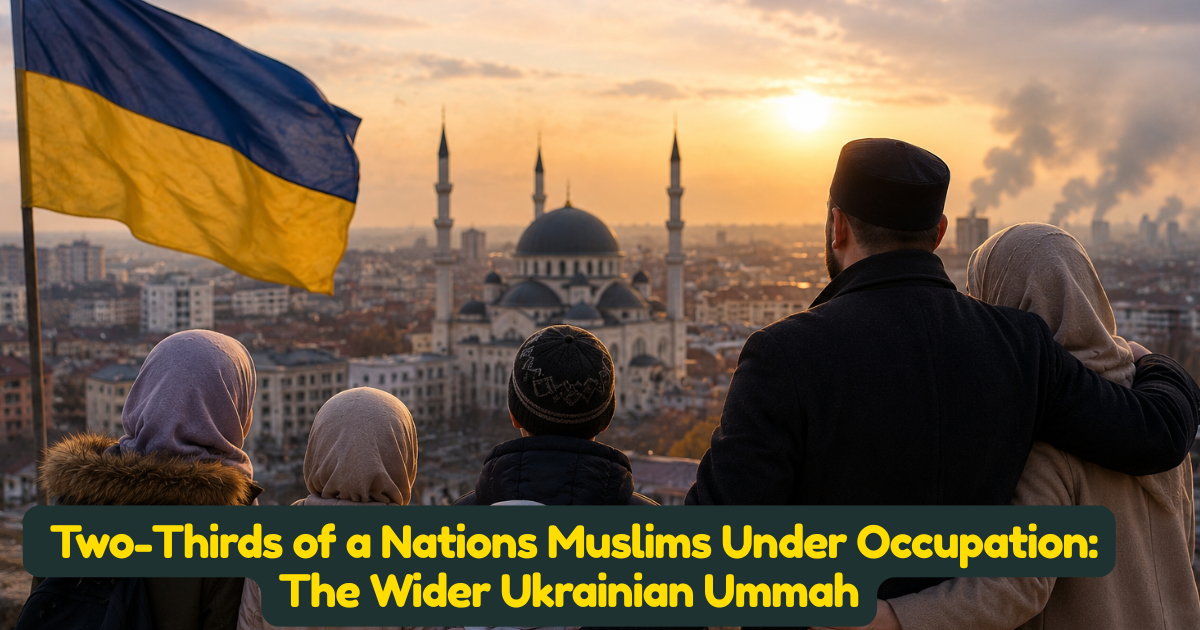
Two-Thirds of a Nation's Muslims Under Occupation: The Wider Ukrainian Ummah
This site's Crimean Tatars page covers one specific, indigenous community's history of genocide, exile, and renewed persecution. This page tells the broader story: Ukraine's Muslim population as a whole, and the staggering scale of what the current war has done to it.
A History Reaching Back to a Genuine Islamic State
Islam's roots in Ukrainian territory run deep, centered on the Crimean Khanate, an Islamic state that governed the Crimean Peninsula from the 15th to the 18th century. Its capital, Bakhchisaray, held 18 mosques and numerous religious educational institutions by the 18th century, and as late as 1917, Muslims still made up roughly a third of Crimea's total population and 11 percent of its urban residents.
A Staggering, Current Statistic
This is worth stating with the weight it deserves: according to Ukraine's own Mufti, Said Ismagilov, roughly one million Muslims live in Ukraine today — and at least 700,000 of them, two-thirds of the country's entire Muslim population, currently find themselves living under occupation in Crimea and the Donbas region, precisely because most of Ukraine's historic Muslim institutions, mosques, and educational centers were concentrated in exactly those two areas. This isn't a historical statistic; it describes the present reality for the majority of Ukrainian Muslims right now.
A Community Without a Single Hierarchy — By Design
Unlike the Catholic or Orthodox churches, Sunni Islam — historically dominant in Ukraine — has no single administrative hierarchy, which means Ukrainian Muslims organize through a range of independent communities and organizations rather than one central body. The Religious Administration of Muslims of Ukraine "Ummah" (RAMU), founded in Kyiv in 2008 by independent communities from ten regions across the country, is one of the most prominent of these. In 2016 and 2017, more than 30 Muslim organizations and communities came together to sign the Ukrainian Muslims Charter and the Ukrainian Muslims Social Conception — formal documents establishing shared principles for how Muslim organizations engage with each other and the Ukrainian state, covering everything from public health to language and education.
A Mosque Built Entirely by Its Own Community
Kyiv's Ar-Rahma Mosque, in the city's Tatarka neighborhood, has a construction story worth knowing: the first attempt to build a mosque in Kyiv actually dates back to 1897, and a modern attempt began in earnest in 1991, with land granted in 1996. Construction proceeded in stages over 15 years, funded entirely by donations from Kyiv's own Muslim community, with the mosque finally completed and opened in 2011 — now able to hold up to 3,000 worshippers. A second major center, the Kyiv Islamic Cultural Centre, broke ground in 2001 and was completed in 2015.
Marriage Law in Ukraine
As with most of the countries covered on this site, only civil marriage carries legal recognition in mainland, government-controlled Ukraine, with a nikah held as a separate, independently meaningful religious ceremony.
Where an Online Nikah Fits
Given the scale of displacement Ukraine's Muslim population has experienced — family split between occupied Crimea, occupied Donbas, government-controlled Ukraine, and a global diaspora shaped directly by the ongoing war — an online nikah offers something genuinely meaningful rather than merely convenient, echoed directly by this site's Crimean Tatars page: a way for family scattered by occupation and displacement to be present for a properly documented, recorded religious ceremony. The underlying requirements remain the same as anywhere else: a clear offer and acceptance, the wali's role, two qualifying witnesses, and an agreed, documented mahr.
Who This Tends to Fit
- Ukrainian Muslim families separated by occupation in Crimea or the Donbas.
- Families connected to Kyiv, Kharkiv, Zaporizhzhia, Dnipro, and other government-controlled centers.
- Ukraine's wider Muslim diaspora, displaced by the ongoing conflict.
- Couples who want a documented, recorded ceremony honoring a community history reaching back centuries.
Frequently Asked Questions
How many Muslims live in Ukraine, and how many are currently under occupation?
Ukraine's own Mufti estimates roughly one million Muslims in the country, with at least 700,000 — two-thirds — currently living under occupation in Crimea and the Donbas.
Does a nikah carry legal effect in mainland Ukraine?
No — only civil marriage is legally recognized; the religious ceremony is held separately.
Can family separated by occupation or displacement join the same online nikah?
Yes — this is one of the most genuinely meaningful applications of the online format found anywhere in this series.
Authority References Used (Live & Clickable)
- Religious Administration of Muslims of Ukraine "Ummah" — official statistics on Ukraine's Muslim population and the impact of occupation, per Mufti Said Ismagilov
Suggested Internal Links
- Preserving Nikah Tradition Through Genocide and Exile: The Crimean Tatars
- Documents Needed Before Booking an Online Nikah
- Online Nikah for Couples Facing Immigration Delays
- Can Online Nikah Be Performed Across Different Time Zones?
- Book Your Online Nikah
Why This Article Is Different
This page carries forward the gravity of the Crimean Tatars piece into the wider Ukrainian Muslim population as a whole, anchored in a specific, sobering statistic from the country's own Mufti — treating an ongoing humanitarian reality with the seriousness it deserves rather than reducing it to a demographic footnote.
Zainab Butt
Author